There is something exciting about taking a house or property back to a blank canvas. Maybe an aging garage is making way for a backyard studio. Perhaps you bought a fixer-upper with an addition that simply cannot be saved. Or you might be clearing an entire home so you can finally build something that works better for your family.
But demolition is one home project where enthusiasm needs to come with a solid plan.
Unlike removing cabinets or pulling up old flooring, structural demolition can involve permits, hazardous materials, disconnected utilities, heavy equipment, waste disposal, neighboring properties, and environmental rules. In Wisconsin, there are also state requirements that homeowners need to understand before work begins.
The good news? A little preparation can prevent a lot of expensive surprises.
If demolition is part of your next renovation, here is what to know about regulations, site clearing, hiring professionals, salvaging materials, and getting the property truly ready for whatever you plan to build next.
Start With the End Goal, Not the Excavator
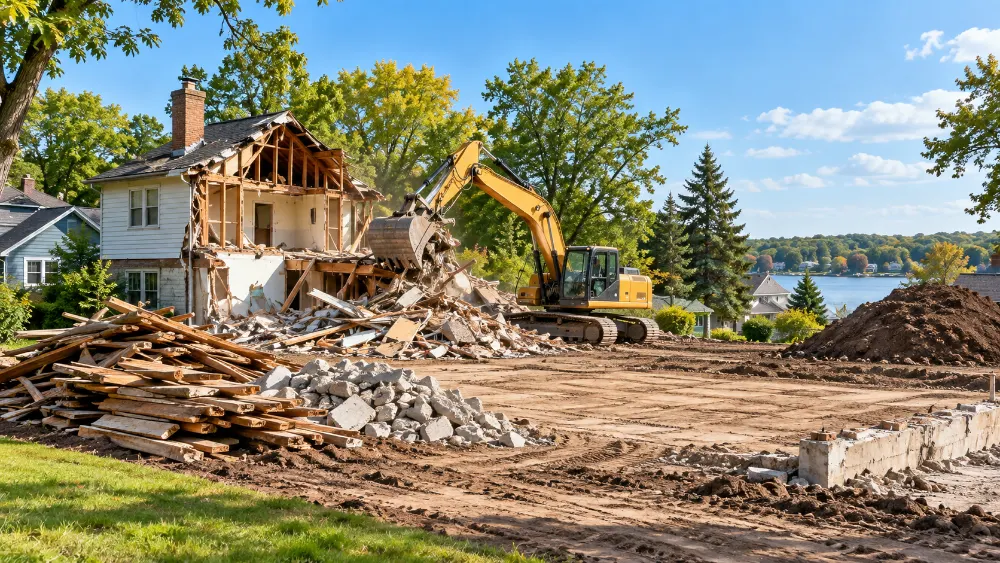
When homeowners picture demolition, the first image that comes to mind is often an excavator knocking down walls.
That is actually one of the later steps.
Before anything comes down, decide what the site needs to look like when the project is finished. Are you removing only a detached garage? Taking down an entire house? Keeping the foundation? Reusing part of the structure? Planning to build immediately afterward?
Those decisions affect nearly everything that follows.
Before requesting estimates, make a basic project list that identifies:
- What structures are being removed
- What portions, if any, will remain
- Whether the foundation needs to come out
- Whether trees, sheds, fences, patios, or driveways are also being removed
- What utilities serve the structure
- Whether reusable materials should be salvaged
- How the property will be graded afterward
- Whether new construction will begin immediately
A contractor quoting a simple structure removal may give you a very different price than one quoting demolition, foundation removal, debris hauling, grading, and construction-ready site preparation.
Get specific early.
Understanding Wisconsin Demolition Requirements
Demolition rules can vary according to the type of building, the scope of the project, and where the property is located.
The Wisconsin Department of Natural Resources regulates several environmental aspects of demolition, including asbestos requirements and the handling of demolition debris.
One of the most important steps is determining whether asbestos-containing materials may be present.
Wisconsin DNR guidance requires regulated facilities to be thoroughly inspected for asbestos before demolition or renovation activities covered by the rules. Depending on the material discovered and the demolition method, asbestos may need to be removed by properly qualified workers before demolition proceeds.
This is particularly important with older homes and buildings.
Potential asbestos-containing materials can be hidden in places homeowners might never suspect, including certain types of insulation, flooring, adhesives, siding, roofing products, pipe insulation, textured surfaces, and other older building materials.
You cannot reliably identify asbestos simply by looking at a material.
Testing and professional inspection matter.
What About Wisconsin’s 10-Working-Day Notification Rule?
This is an area where homeowners should avoid making assumptions.
Wisconsin DNR requires notification for demolition of facilities covered by its regulations, and normal regulated demolition projects generally require a notification at least 10 working days before demolition begins. The DNR notes that notification may be required even when no asbestos is found.
However, there is an important residential exception.
According to current DNR guidance, a single, isolated residential structure containing four or fewer dwelling units is generally exempt from the demolition notification requirement. Different rules can apply when residential structures are part of a larger commercial or development project.
That distinction matters.
A homeowner tearing down one detached house may face different state notification requirements than a developer clearing several homes for a new project.
Because property circumstances vary, verify the requirements for your specific structure before scheduling equipment or signing a demolition date into a construction contract.
Don’t Forget About Local Demolition Permits
State environmental rules are only one part of the process.
Your city, village, town, or county may have its own demolition permit requirements.
Depending on the municipality, you may be asked to provide information such as:
- Property ownership documentation
- Contractor information
- Proof of insurance
- Asbestos documentation
- Utility disconnection confirmations
- Site or plot plans
- Erosion-control plans
- Waste disposal information
- Demolition timelines
- Plans for foundation removal
- Proposed final grading
Requirements can differ significantly from one municipality to another.
That means advice from a friend who demolished a garage two counties away may not apply to your project.
Contact the local building or zoning department early, preferably before scheduling demolition or committing to a construction start date.
Utility Disconnection Is More Important Than It Sounds
A building should never simply be knocked down while active utilities remain connected.
Before structural demolition begins, determine what services enter the property and how each one needs to be handled.
Common utilities include:
| Utility | What May Be Required |
|---|---|
| Electricity | Service disconnected or safely removed |
| Natural gas | Line shut off and properly capped |
| Water | Service shut off or disconnected |
| Sewer | Lateral capped or protected |
| Septic | Tank and system evaluated according to local requirements |
| Telecommunications | Cable, phone, or fiber lines removed or protected |
| Propane | Tank disconnected and relocated or removed |
Do not assume shutting off a breaker or closing a household valve is enough.
Permanent service lines may need to be disconnected by the utility company or another qualified professional.
This is also something to address early. Utility companies may have scheduling requirements that affect your demolition date.
Older Homes May Have More Than Asbestos to Consider
Asbestos receives a lot of attention during demolition, but it is not the only material worth thinking about.
Older structures can contain products or devices involving:
- Lead-based paint
- Mercury switches or thermostats
- Fluorescent lighting components
- Refrigerants from older cooling equipment
- Chemicals stored in garages or basements
- Old fuel or heating-oil tanks
- Treated or painted lumber
Wisconsin DNR specifically advises property owners to identify hazardous materials before demolition and properly remove materials that require special handling.
This is one reason a pre-demolition walk-through can be so valuable.
Go through the structure room by room before the crew arrives. Remove household chemicals, batteries, old electronics, propane cylinders, paint containers, appliances, and anything else that should not simply disappear into mixed demolition debris.
Demolition Does Not Mean Everything Has to Become Trash
One of my favorite approaches to a major renovation is figuring out what can be saved before deciding what gets destroyed.
Think of it as reverse remodeling.
Instead of installing the pretty pieces, you carefully remove them first.
Depending on the condition of the house, you may be able to salvage:
- Solid wood doors
- Cabinetry
- Hardwood flooring
- Vintage hardware
- Lighting fixtures
- Plumbing fixtures
- Fireplace mantels
- Decorative trim
- Brick
- Stone
- Lumber
- Windows in good condition
- Architectural details
Some materials can be reused in the future house. Others may be donated, sold, or repurposed into smaller DIY projects.
A beautiful old door, for example, might become a pantry door, headboard, desk, or garden feature instead of ending up in a landfill.
Wisconsin DNR encourages salvaging and recycling demolition materials where practical and identifies numerous construction materials that can be reused or recycled.
Deconstruction vs. Demolition
If a structure contains materials worth saving, ask whether partial deconstruction makes sense before mechanical demolition begins.
These two approaches are different.
Traditional demolition prioritizes taking the building down efficiently.
Deconstruction involves carefully dismantling portions of the building so materials can remain usable.
You do not necessarily have to choose one or the other.
A project might involve several days of removing cabinets, fixtures, hardwood, doors, and architectural details before an excavator handles the remaining structure.
That hybrid approach often gives homeowners the best balance between efficiency and material recovery.
Sort Materials Whenever Possible
Mixed demolition debris can quickly turn into an enormous pile.
Separating materials before or during demolition can create more opportunities for recycling and reuse.
Wisconsin DNR lists a wide range of construction and demolition materials that may have recycling or reuse options, including concrete, brick, asphalt, metal, untreated wood, drywall, siding, plumbing fixtures, and other materials.
A basic sorting strategy might look like this:
| Material | Possible Destination |
|---|---|
| Metal | Scrap recycling |
| Concrete | Crushing/recycling or qualifying reuse |
| Brick | Reuse or recycling |
| Clean dimensional lumber | Salvage or reuse |
| Cabinets and doors | Donation, resale, or reuse |
| Asphalt shingles | Specialized recycling where available |
| Mixed unusable debris | Approved landfill or disposal facility |
| Hazardous materials | Appropriate approved handling facility |
Not every material will have a convenient recycling option near your property, so ask the demolition contractor how debris will actually be handled.
Burning Demolition Debris Is Not a Disposal Plan
A large pile of old lumber might look like easy bonfire material.
Don’t assume it can be burned.
Wisconsin DNR states that burning construction and demolition materials is generally illegal, with limited exceptions. Demolition waste also cannot simply be buried on the property because it came from a building you own.
Painted wood, treated materials, plastics, roofing products, insulation, and other building components can release harmful contaminants when burned.
Proper hauling and disposal should therefore be included in the demolition plan from the beginning.
What Homeowners Can DIY—and Where to Draw the Line
If you love DIY projects, demolition can be dangerously tempting.
There is something deeply satisfying about swinging a hammer at a wall.
For small interior renovation projects, homeowners may be able to handle certain types of nonstructural demolition themselves after checking for hazards and understanding what is behind the surfaces.
Examples might include removing:
- Cabinets
- Trim
- Carpet
- Some flooring
- Nonstructural fixtures
- Shelving
- Easily removable finishes
Whole-building demolition is very different.
Once structural systems, underground utilities, hazardous materials, foundations, heavy machinery, neighboring properties, or substantial debris are involved, professional expertise becomes much more important.
Knowing what not to DIY can be just as valuable as knowing how to use a tool.
Choosing a Demolition Contractor
A good demolition contractor does more than arrive with an excavator.
The contractor should understand how permitting, safety, material handling, demolition sequencing, hauling, and site preparation fit together.
Before hiring anyone, ask:
- Are you properly insured for this type of work?
- Who is responsible for securing permits?
- Who coordinates utility disconnections?
- Is asbestos testing or documentation required?
- Does the quote include debris hauling?
- Are landfill or disposal fees included?
- What materials will be recycled?
- Can I salvage items before demolition?
- Is foundation removal included?
- Will the basement or foundation excavation be backfilled?
- Is final grading included?
- What happens if unexpected underground structures are discovered?
- How will neighboring properties be protected?
If you are researching demolition services in Wisconsin, compare the actual scope included in each estimate rather than looking only at the total price.
A cheaper quote can become expensive very quickly if foundation removal, hauling, permits, grading, or disposal charges appear later as extras.
Prepare the Property Before Demolition Day
Once permits and professional requirements are handled, homeowners can still do plenty of preparation.
Walk through the house one final time.
You would be surprised how often useful or sentimental items remain tucked inside closets, garages, attics, and basements.
Before the crew arrives:
- Remove all personal belongings.
- Take out appliances that are not included in the contractor’s scope.
- Salvage fixtures you want to keep.
- Photograph the house and surrounding property.
- Move vehicles, trailers, patio furniture, and portable structures.
- Identify plants or trees that must remain.
- Confirm which fences should stay.
- Discuss access for excavators and dumpsters.
- Talk with nearby neighbors about the schedule.
- Verify that required utilities have been disconnected.
Take photos of surrounding driveways, fences, trees, landscaping, and neighboring structures too.
Those photos provide a useful record of existing conditions before heavy equipment enters the site.
Think About Equipment Access
A demolition project needs room.
Large equipment may require significantly more clearance than homeowners expect, especially if an excavator, roll-off dumpster, dump truck, or material-processing equipment will be involved.
Look at the route from the street to the building.
Consider:
- Driveway width
- Overhead utility lines
- Tree branches
- Septic fields
- Wells
- Retaining walls
- Fences and gates
- Soft lawns
- Neighboring property lines
- Underground utilities
A narrow suburban lot presents different challenges than a rural property with acres of access.
Discuss these limitations before demolition day instead of discovering them when a truck is already sitting at the curb.
Dust and Debris Need to Be Controlled
Demolition is messy.
Even a relatively small structure can create a surprising amount of dust and loose debris.
Professional crews may use water or other dust-control methods as appropriate while controlling access to the work zone.
For homeowners living next door to the demolition area—or demolishing one structure while continuing to live in another on the property—close windows and move outdoor furniture, toys, grills, and other items away from the work zone.
You may also want to temporarily cover delicate plants or relocate container gardens.
When demolition happens close to another occupied structure, talk with the contractor about protecting windows, siding, HVAC equipment, and exterior surfaces from dust and flying debris.
Don’t Stop Planning When the Building Comes Down
Watching the final wall fall can feel like the end of the project.
Usually it is only the midpoint.
A truly cleared site may still contain:
- Concrete foundations
- Basement walls
- Footings
- Utility lines
- Old slabs
- Buried construction materials
- Tree roots
- Septic components
- Uneven excavation areas
If you’re building something new, these conditions need to be dealt with correctly.
Ask exactly what “site clearing” means in your contract.
Does it mean removing the visible building?
Or does it mean leaving you with a graded, stable property ready for the next construction phase?
Those are very different scopes of work.
Foundation Removal and Backfilling
If an old basement or foundation is being removed, the resulting excavation must be addressed properly.
The contractor may need to remove concrete, import suitable fill material, compact the area, and establish the correct final elevation.
Poorly handled backfill can settle later.
That becomes particularly important if a future driveway, patio, landscaping feature, or building will occupy the area.
If you already have architectural or site plans for the next project, share them with the demolition and excavation team.
Sometimes it makes sense to coordinate demolition and new construction rather than treating them as completely separate jobs.
Grading Sets Up Everything That Comes Next
Once the debris disappears, pay attention to the shape of the land.
Water should move away from structures instead of collecting beside foundations or in low areas of the yard.
Proper final grading can influence:
- Drainage
- Erosion
- Landscaping
- Driveway placement
- Future foundations
- Lawn installation
- Accessibility around the property
This part is not nearly as dramatic as knocking down a building.
It may be more important.
A beautifully cleared lot that collects several inches of water every time it rains is not construction-ready.
Build a Demolition Contingency Into Your Budget
Old buildings are full of surprises.
Once walls come down or foundations are exposed, contractors may discover materials or conditions that were impossible to see earlier.
Possible surprises include:
- Additional concrete
- Buried foundations
- Unknown utility lines
- Abandoned septic components
- Contaminated soil
- Unexpected hazardous materials
- Deep footings
- Underground tanks
- Extra debris beneath slabs
Instead of planning your demolition budget down to the last dollar, leave room for unexpected conditions.
Also make sure estimates clearly state whether they include:
- Permits
- Inspections
- Equipment
- Labor
- Debris containers
- Transportation
- Disposal fees
- Foundation removal
- Backfill
- Grading
The more detailed the estimate, the easier it is to compare contractors fairly.
A Simple Homeowner Demolition Checklist
Before demolition begins, run through this list:
Planning
- Define exactly what is being removed.
- Decide what materials you want to salvage.
- Determine what the finished site should look like.
Regulatory Steps
- Check Wisconsin demolition and asbestos requirements.
- Confirm whether DNR notification applies.
- Contact your local municipality about permits.
- Complete required inspections.
Utilities
- Coordinate electricity disconnection.
- Address natural gas or propane.
- Confirm water and sewer requirements.
- Locate underground utilities.
Site Preparation
- Remove belongings.
- Photograph the property.
- Protect landscaping that will remain.
- Establish equipment access.
- Confirm dumpster and truck locations.
Demolition
- Keep people and pets outside the work zone.
- Follow the contractor’s safety instructions.
- Separate salvageable or recyclable materials when practical.
After Demolition
- Remove remaining foundations as required.
- Backfill excavated areas.
- Compact soil appropriately.
- Complete final grading.
- Verify drainage before moving on to construction.
Demolition Is Really the First Step of the Remodel
Demolition tends to get treated like destruction.
For homeowners, it is more useful to think of it as preparation.
You are not simply removing an unwanted structure. You are creating the conditions for whatever comes next—a new house, an addition, a workshop, a garden, a cleaner backyard, or simply a property that finally works the way you want it to.
And just like the prettier stages of a renovation, the quality of the finished result depends heavily on what happens underneath.
Check the regulations. Plan for hazardous materials. Salvage what is worth saving. Understand where the debris is going. Clarify what your contractor’s price includes. And think about grading, drainage, and future construction before the first machine arrives.
The actual teardown may happen quickly.
Good demolition planning starts long before that—and it can make the entire project that follows much easier.