This post contains affiliate links. As an Amazon Associate, I earn from qualifying purchases, at no extra cost to you. See our disclosure policy.
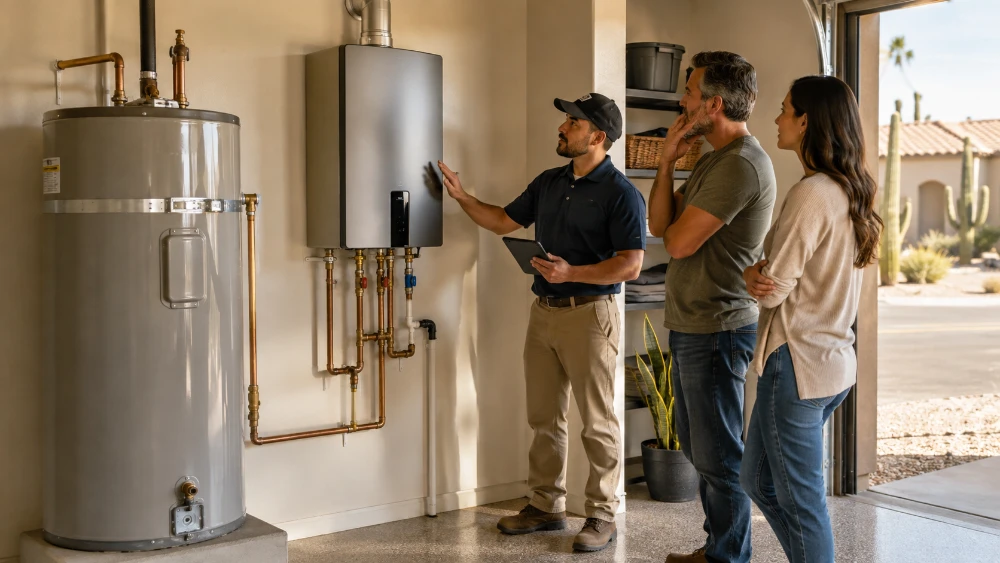
For many homeowners in Phoenix, replacing an aging water heater raises an important question: is a tankless system worth the extra investment? While tankless water heaters are known for their energy efficiency and long lifespan, they’re not the right fit for every home. Factors like household size, water usage, hard water conditions, and installation costs all play a role in determining whether the upgrade makes financial sense.
Working with an experienced home services company can help homeowners evaluate these factors and choose a system that matches their home’s needs rather than simply opting for the newest technology.
The decision should be based on more than a product advertisement or a neighbor’s experience. Two homes on the same Phoenix street may have very different hot water demands. One might have two occupants who take short showers, while another may have a large family running showers, a dishwasher, and a washing machine at the same time.
Before upgrading, homeowners should think about their current water heater’s condition, their monthly utility bills, how long they plan to remain in the home, and whether their existing gas or electrical system can support the new equipment. A tankless water heater can be a smart long-term improvement, but only when it is properly sized and installed for the property.
Understanding How Tankless Water Heaters Work
Unlike traditional storage tanks that continuously heat and store water, tankless water heaters warm water only when a hot water tap is turned on. Cold water passes through a heat exchanger, providing hot water on demand without maintaining a large reserve throughout the day.
Because there’s no stored water to keep warm, tankless systems eliminate standby heat loss. Over time, this can reduce energy consumption, especially in households with moderate to high hot water usage.
A conventional water heater usually stores between 30 and 80 gallons of heated water. Once that supply has been used, the household must wait for the tank to refill and reheat. A tankless system does not rely on a stored reserve. Instead, it continues heating water as long as the unit remains within its flow-rate capacity.
However, the phrase “endless hot water” can be misunderstood. A tankless unit can operate continuously, but it can only heat a certain number of gallons per minute. If several fixtures demand more water than the unit can handle, the water temperature may fall or the flow may become less consistent.
For example, a shower may use approximately two gallons per minute, while a dishwasher or washing machine creates additional demand. If two showers and an appliance are operating at the same time, the system must be sized to handle the combined flow.
Tankless and Traditional Water Heaters at a Glance
| Feature | Tankless Water Heater | Traditional Storage Water Heater |
|---|---|---|
| Hot water supply | Continuous when properly sized | Limited to stored tank capacity |
| Energy use | Heats water on demand | Reheats stored water throughout the day |
| Equipment size | Compact and usually wall-mounted | Requires floor space for a tank |
| Upfront cost | Generally higher | Generally lower |
| Expected lifespan | Often longer with maintenance | Usually shorter |
| Maintenance | Regular descaling may be necessary | Periodic flushing and anode inspection |
| Simultaneous use | Limited by flow rate | Limited by tank volume |
| Installation complexity | May require utility upgrades | Often simpler as a direct replacement |
This comparison does not automatically make one system better. A storage tank may remain the most practical option for a homeowner who wants the lowest upfront cost. Meanwhile, a tankless system may be more attractive to someone who values efficiency, space savings, and a longer service life.
Why Phoenix Homes Can Benefit
Phoenix has several characteristics that make tankless water heaters particularly appealing.
One advantage is the region’s relatively warm groundwater. Since incoming water starts at a higher temperature than in colder climates, the unit doesn’t need to work as hard to reach the desired output temperature. This often results in better operating efficiency and more consistent hot water delivery.
Another benefit is the long cooling season. Many households use showers, laundry, and dishwashers frequently throughout the year, making energy savings more noticeable over the life of the system.
However, every home is different, and expected savings depend on daily water consumption and the number of occupants.
Phoenix homeowners may also appreciate the compact size of tankless equipment. Because the unit is often mounted on a wall, it may free up part of a garage, utility room, or storage closet. That additional space can be valuable in homes where every square foot is already being used.
The local climate may also reduce some of the performance challenges experienced in colder regions. When groundwater is extremely cold, a tankless heater must produce a much larger temperature increase. Warmer incoming water can allow the equipment to provide a stronger flow rate while still reaching the desired temperature.
That does not mean climate alone guarantees savings. A household that uses very little hot water may not save enough each month to quickly offset the higher purchase and installation costs. Homeowners should request realistic operating estimates based on their own usage rather than relying on general efficiency claims.
Comparing the Long-Term Costs
A tankless water heater generally costs more upfront than replacing a conventional storage tank. Installation expenses may also increase if gas lines, venting, or electrical systems require modifications.
Despite the higher initial investment, many homeowners recover part of the additional cost through lower energy bills and a longer service life. A traditional storage water heater often lasts between 8 and 12 years, while a properly maintained tankless model may continue operating for nearly two decades.
Instead of focusing only on installation costs, it’s helpful to consider the total ownership cost over the system’s lifespan.
The total cost may include:
- The price of the water heater
- Installation labor
- Permit or inspection expenses
- Gas-line modifications
- Venting changes
- Electrical panel or circuit upgrades
- Water treatment equipment
- Routine maintenance
- Replacement parts
- Monthly energy consumption
- The expected number of years before replacement
A homeowner comparing estimates should ask contractors to separate equipment costs from infrastructure upgrades. This makes it easier to understand why one proposal is more expensive than another.
For instance, the unit itself may be reasonably priced, but an undersized gas line could require substantial work. A gas-powered model may also need specialized venting. An electric tankless unit could require multiple high-amperage circuits, making an electrical panel upgrade necessary.
A Simple Ownership-Cost Exercise
Homeowners can use the following questions to think beyond the initial estimate:
- How much does the tankless system cost compared with a standard replacement?
- What utility modifications are included in the quote?
- How much could the household reasonably save each year?
- How often will professional maintenance be required?
- How long does the manufacturer’s warranty last?
- How long does the homeowner expect to remain in the property?
- Could the system’s longer lifespan prevent another replacement during that time?
Suppose a tankless installation costs several thousand dollars more than a conventional replacement. The upgrade may make financial sense if the homeowner stays in the property for many years, reduces energy consumption, and avoids replacing another storage tank. The same upgrade may be less compelling for someone planning to sell the home soon.
Resale value may also be part of the decision. Some buyers view an efficient, recently installed tankless system as a useful feature. However, homeowners should not assume they will recover the full installation cost through a higher sale price.
Hard Water Requires Extra Attention
One challenge unique to Phoenix is its hard water.
The local water supply contains high levels of calcium and magnesium, which can gradually accumulate inside plumbing equipment. In tankless systems, mineral deposits may build up inside the heat exchanger, reducing efficiency if maintenance is neglected.
For this reason, many manufacturers recommend periodic descaling in areas with hard water. Some homeowners also install water treatment systems to reduce mineral buildup and extend the equipment’s lifespan.
Routine maintenance not only helps preserve efficiency but can also support warranty requirements specified by the manufacturer.
Hard-water deposits can restrict water flow and make it harder for heat to transfer efficiently. Over time, the unit may take longer to heat water, make unusual noises, display error codes, or shut down unexpectedly.
Homeowners should review the manufacturer’s maintenance schedule rather than waiting for performance problems to appear. The recommended frequency may depend on water hardness, household usage, and the system’s design.
Signs That Mineral Buildup May Be Affecting the Unit
Watch for:
- Water temperatures that fluctuate unexpectedly
- Lower hot water pressure
- Longer delays before hot water arrives
- Unusual sounds during operation
- Frequent system error messages
- Rising energy bills without a clear explanation
- Reduced performance when multiple fixtures are running
These symptoms can also have other causes, so a professional inspection may be needed before assuming mineral buildup is responsible.
Some installations include isolation valves that make flushing and descaling easier. Homeowners should ask whether these valves are included in the installation proposal. Adding them during the original installation may simplify future maintenance.
A water softener or another treatment system may reduce scale, but the right solution depends on the home’s water quality and plumbing. Water treatment equipment also has purchase, operating, and maintenance costs, which should be included in the overall budget.
Gas or Electric: Which Is Better?
Both gas and electric tankless water heaters have advantages, but the best option depends on the home’s existing infrastructure.
Gas-powered units generally provide higher flow rates, making them suitable for larger households where multiple fixtures may operate simultaneously. Homes that already have natural gas service often require fewer modifications during installation.
Electric models can work well for smaller homes or point-of-use applications. However, older properties may require electrical panel upgrades before installation, which can increase project costs.
A professional assessment can determine which option offers the best balance of performance and installation expenses.
Gas Tankless Systems
Gas units may be a strong option when:
- The home already has adequate natural gas service
- Several occupants regularly use hot water at the same time
- The household needs a higher flow rate
- Suitable venting can be installed
- The owner is comfortable with combustion-related maintenance
And gas systems usually need proper venting and combustion air. The existing gas line must also be large enough to support the unit’s demand. Simply having a gas connection does not guarantee that the current line is adequate.
Electric Tankless Systems
Electric models may be suitable when:
- The home has limited hot water demand
- The system will serve one fixture or a small area
- Gas service is unavailable
- Venting would be difficult to install
- The electrical panel has sufficient capacity
Whole-home electric units can draw a significant amount of power. Before choosing one, homeowners should confirm that the panel, wiring, breakers, and utility service can safely support it.
Whole-Home or Point-of-Use?
Not every tankless installation has to serve the entire property. A point-of-use heater can be installed near a distant bathroom, guest suite, sink, or other fixture. This approach may reduce the wait for hot water without requiring the homeowner to replace the main water heater.
A whole-home system, by contrast, must be sized for the combined demand of the household. The choice depends on whether the homeowner is solving a localized problem or replacing the central water-heating system.
Sizing Matters More Than the Brand Name
Even a high-quality tankless heater may disappoint if it is undersized. Proper sizing should consider both the required temperature rise and the maximum simultaneous flow rate.
The installer should evaluate:
- The number of residents
- The number of bathrooms
- Showerhead flow rates
- Bathtub size
- Dishwasher usage
- Washing machine usage
- Typical morning and evening routines
- Incoming water temperature
- Desired output temperature
- Whether several fixtures frequently run at once
Homeowners can make the assessment more accurate by describing their busiest hot water period. For example, a household may regularly use two showers while the dishwasher is operating. That peak demand is more important for sizing than the average amount of water used across the entire day.
A unit that is too small may struggle during simultaneous use. A dramatically oversized unit may cost more than necessary. Professional sizing helps balance comfort, performance, and cost.
What About the Wait for Hot Water?
A tankless system produces hot water on demand, but it does not necessarily deliver it to the faucet instantly. Water still has to travel through the pipes from the heater to the fixture.
A bathroom located far from the unit may continue to experience a delay. During that delay, water may be wasted while the homeowner waits for the temperature to rise.
Possible solutions include:
- Installing a hot water recirculation system
- Choosing a tankless model with recirculation capability
- Adding a point-of-use heater near a distant fixture
- Improving pipe insulation
- Locating the new unit closer to the highest-demand area
Each solution has installation and operating considerations. A recirculation system can improve convenience but may reduce some energy savings if it is allowed to operate continuously. Timers, demand controls, or smart scheduling can help limit unnecessary operation.
Is a Tankless Water Heater Right for Every Home?
Not necessarily.
A small household with relatively low hot water usage may take longer to recover the additional installation cost through energy savings. On the other hand, larger families that use hot water throughout the day often benefit more from continuous hot water availability and improved efficiency.
Homeowners should also consider available installation space, utility connections, maintenance requirements, and long-term ownership plans before making a decision.
Rather than assuming one solution fits everyone, evaluating the home’s specific needs leads to a better investment.
A Tankless Upgrade May Be Worth Considering When:
- The current water heater is near the end of its service life
- The household frequently runs out of hot water
- Several people use hot water throughout the day
- The homeowner plans to remain in the property long term
- Energy efficiency is an important priority
- Additional storage or floor space would be useful
- The home already has suitable gas or electrical infrastructure
- The owner is willing to complete regular maintenance
A Traditional Storage Tank May Still Be Practical When:
- The installation budget is limited
- Hot water demand is low
- The home will likely be sold soon
- Utility upgrades would be unusually expensive
- The household prefers a simpler direct replacement
- Maintaining and descaling a tankless system would be inconvenient
- A properly sized storage tank already meets the family’s needs
There is no reason to replace a functional storage water heater solely because tankless technology is available. The best time to compare options is often when the existing unit is aging, leaking, becoming inefficient, or requiring frequent repairs.
Questions to Ask Before Approving the Installation
A detailed consultation can help prevent unexpected expenses. Homeowners may want to ask:
- What size unit does the household need, and how was that size calculated?
- What flow rate can the system provide at the required temperature rise?
- Can it support two showers and an appliance simultaneously?
- Does the gas line need to be enlarged?
- Will new venting be required?
- Does the electrical panel need to be upgraded?
- Are permits and inspections included in the estimate?
- Are isolation valves included for future maintenance?
- How often should the unit be flushed or descaled?
- Will Phoenix’s hard water affect the warranty?
- Is a water treatment system recommended?
- How long are the equipment and labor warranties?
- Who will handle warranty service if a problem develops?
- Is recirculation available for distant fixtures?
- What is the estimated annual operating cost?
Homeowners should also request a written estimate describing the scope of work. The least expensive proposal may not include all necessary modifications, while a higher quote may include permits, venting, valves, electrical work, and disposal of the old water heater.
Making an Informed Decision
A tankless water heater can offer meaningful advantages, including improved energy efficiency, longer service life, and endless hot water when properly sized for the household. At the same time, higher installation costs and ongoing maintenance requirements should be considered before upgrading.
By understanding how local conditions such as Phoenix’s climate and hard water affect system performance, homeowners can make a more informed decision that balances upfront costs with long-term value. Consulting a qualified professional before installation helps ensure the chosen system matches both the home’s infrastructure and the family’s daily hot water needs.
The strongest decision is not automatically the newest or most expensive system. It is the system that reliably meets the household’s peak demand, fits the available infrastructure, and remains affordable to operate and maintain.
Before choosing, homeowners can perform one final review:
- Record how often the current tank runs out of hot water.
- Identify which fixtures are commonly used at the same time.
- Review several months of utility bills.
- Ask for both tankless and storage-tank estimates.
- Confirm whether utility upgrades are required.
- Calculate the approximate long-term ownership cost.
- Consider how many years the family expects to remain in the home.
- Review maintenance and warranty requirements in writing.
For some Phoenix homes, a tankless water heater can provide better comfort, efficiency, and long-term value. For others, a modern high-efficiency storage tank may deliver dependable performance at a lower initial cost. A careful comparison allows the homeowner to choose based on real household needs rather than broad marketing claims.