This post contains affiliate links. As an Amazon Associate, I earn from qualifying purchases, at no extra cost to you. See our disclosure policy.
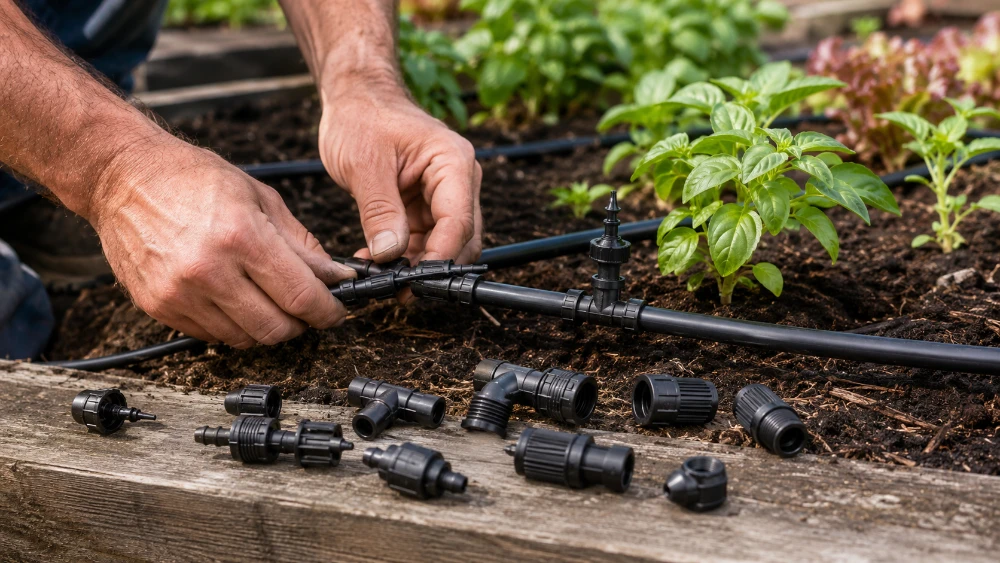
A drip system can have the right tubing, the right emitter spacing, the right controller schedule, and still disappoint because the fittings were treated like afterthoughts. I have seen that happen on gardens, commercial planting areas, nurseries, farms, and retrofit jobs. The water loss rarely starts with a dramatic pipe failure. It starts with a small weep at a tee, a kinked bend near an elbow, a stretched compression fitting, or an end cap that was never designed for repeated flushing.
Fittings are the service points, direction changes, transitions, repairs, and termination points of the system. They decide how cleanly the layout installs, how easily it can be modified, and how much time someone will spend troubleshooting later.
This guide covers the main fitting types used in drip irrigation, how to choose them, and how suppliers worth evaluating compare with each other: NDS, DIG, Rain Bird, Hunter, and Netafim.
Start With Tubing Compatibility Before You Choose the Fitting Style
Most fitting problems begin with a size assumption. Someone sees “1/2 inch tubing” and assumes every 1/2 inch fitting will work. In drip irrigation, that assumption causes leaks, split tubing, loose connections, and wasted labor.
Drip tubing is often identified by nominal size, while fittings depend on actual inside diameter, outside diameter, wall thickness, and product family. A 17 mm insert fitting may work beautifully with one dripline and poorly with another. Compression fittings may accept a range of tubing sizes, but not every compression fitting is universal.
NDS insert fittings are made for 17 mm tubing or dripline, with barbed ends that anchor into the line. The NDS insert range includes ball valves, couplings, crosses, elbows, tees, and wyes. NDS also offers compression fittings that connect tubing or dripline with a compression ring, where an internal barb compresses the inserted tube and holds it in place.
That is the first lesson: select fittings around the tubing you are actually installing, not around the name printed on the bin.
Couplings: The Repair Fitting You Will Use More Than Expected
Couplings look simple, but on real jobs they are some of the most useful fittings in the truck. They join two sections of tubing, repair cuts, extend lines, and help crews recover when a layout shifts in the field.
In new installations, couplings should be used deliberately, not as a way to patch together every leftover piece of tubing. Too many couplings create more leak points and make the system look improvised. In maintenance work, however, a good coupling is the fastest way to bring a damaged line back into service.
For 17 mm dripline, barbed couplings are common because they are compact and quick. Compression couplings are useful where the installer wants a larger gripping surface or expects to reopen the connection. Locking-style fittings can be helpful when tubing size varies slightly or when repairs need to be durable but still serviceable.
My practical rule is straightforward: use couplings freely for repairs, but use them sparingly in new layouts. A clean, planned run is easier to flush, inspect, and explain to the next person who services the system.
Tees and Crosses: Useful Branching, But Easy to Overuse
Tees are where many drip systems lose discipline. They are convenient, so installers keep adding branches until the layout becomes hard to balance and harder to service.
A tee is best used when the branch is intentional: feeding two planting rows, splitting a bed, creating a loop, or sending water around an obstruction. A cross can be useful in grid-style layouts, but it should not become a shortcut for weak zone planning.
NDS includes tees, crosses, wyes, and related fittings in its 17 mm insert fitting selection. Rain Bird’s XF Dripline Insert Fittings are also 17 mm barbed insert fittings used with Rain Bird XF Series dripline, including XFD and XFS dripline. Rain Bird says the redesigned fittings can be installed more than twice as fast as other barbed fittings.
When comparing tees between suppliers, do not only look at price. Look at how easily the fitting inserts, how securely it holds, whether it is compatible with the tubing family, and whether the shape creates strain on the line after backfilling or mulching.
Elbows: Use Them to Prevent Kinks, Not to Decorate the Layout
Elbows have one main job: they let tubing change direction without bending so tightly that flow is restricted or the tubing wall is stressed. A neat-looking bend that is kinked under mulch is worse than an exposed elbow that preserves flow.
I see elbows underused in tight corners and overused in open areas. Tubing can handle gentle curves. It should not be forced around sharp corners, valve boxes, hardscape edges, raised beds, or tree wells.
Hunter’s PLD barbed fittings include a 17 mm barb elbow, coupling, threaded adapters, end cap, manual flush valve, and other parts. Hunter notes that its PLD barbed fittings use acetal material, a dual-barb design for stronger hold, and are intended for 17 mm dripline and tubing without clamps.
That dual-barb detail is worth noting. An elbow is often placed where tubing is already under directional stress. A fitting with stronger hold can reduce pullout risk when installation conditions are less forgiving.
Adapters: The Transition Point That Deserves Extra Attention
Adapters connect unlike parts: tubing to pipe thread, dripline to PVC, a hose bib to a drip zone, drip tubing to a valve assembly, or 17 mm tubing to another supply size. Because adapters sit at transitions, they often carry more stress than ordinary inline fittings.
This is where I want installers to slow down. Thread type, sealing method, pressure rating, tubing size, and access for future service all count. A hidden adapter inside a tight valve box can create years of nuisance repairs.
NDS Smart Loc multidiameter fittings are designed to connect a range of supply tubing or dripline sizes and are available as an adapter, coupling, elbow, tee, or end cap. NDS also positions them as reusable, which is useful during repairs or layout changes.
Adapters are also where brand systems can start to diverge. Rain Bird, Hunter, Netafim, and NDS all have fitting families designed to work with their own tubing and dripline products. Mixing suppliers can work, but it should be done deliberately, not by guesswork.
End Caps and Flush Points: Do Not Treat the End of the Line as an Afterthought
The end of a dripline is not just a place to stop water. It is usually the place where you flush the line, diagnose sediment, and clear debris after repairs.
A figure-eight end closure may be inexpensive and easy to use. A threaded cap or flush valve may be better where the system needs regular maintenance. A manual flush valve is useful when the line must be opened without disassembling the tubing end every time.
Hunter’s PLD fitting model chart includes a 17 mm barb x 1/2 inch male pipe thread end cap with cap and a 17 mm barb manual flush valve. Netafim’s Techline dripline page notes that Techline products pair with matching fitting systems, including 17 mm fittings with tees, elbows, couplings, and end caps.
For professional work, I prefer an end treatment that makes flushing easy. If a system is hard to flush, it usually will not be flushed.
Supplier Comparison: NDS, DIG, Rain Bird, Hunter, and Netafim
The right fitting supplier depends on the type of job. A homeowner garden, a contractor retrofit, a commercial planting area, and a farm block do not place the same demands on fittings.
1. NDS
NDS is a practical supplier when the job needs more than one fitting type and the installer wants a coherent low-volume irrigation system. Its irrigation fitting range includes insert fittings, compression fittings, and Smart Loc multidiameter fittings. Insert fittings fit 17 mm tubing or dripline and include ball valves, couplings, crosses, elbows, tees, and wyes. Smart Loc fittings are especially useful because they connect a range of supply tubing or dripline sizes and are available as adapters, couplings, elbows, tees, and end caps.
Where NDS is strongest: residential gardens, contractor retrofits, commercial planting beds, and projects where the installer wants a single source for a broad range of irrigation tubing fittings.
Specify with care when: tubing sizes are mixed across brands. Smart Loc can help with multidiameter work, but the exact tubing and fitting combination still needs to be checked before installation.
2. DIG
DIG is useful for gardens, homeowner systems, small commercial work, and accessible repair parts. DIG’s drip irrigation tubing and fittings guidance notes that compression fittings are available in configurations including coupler, elbow, tee, end cap, hose adapter, and more. DIG products are also widely available through retail channels, including 1/4 inch barb connectors, goof plugs, barb tees, and 1/2 inch Universal Nutloc couplings.
DIG’s strength is accessibility and variety. For small systems, that is valuable. A homeowner or maintenance tech can often find the exact fitting needed without going through a specialty distributor.
Where DIG performs well: garden systems, patio irrigation, small repairs, homeowner drip layouts, and jobs where retail availability helps.
Confirm during design: whether the selected fitting is barbed, compression, or Nutloc style, and which tubing outside diameter it actually accepts. DIG has several fitting families, and they are not interchangeable.
3. Rain Bird
Rain Bird is a suitable option for professional irrigation contractors, especially when the system already uses Rain Bird XF or XFS dripline. Its XF Dripline Insert Fittings are designed for all Rain Bird XF Series Dripline, including XFD and XFS subsurface dripline. Rain Bird also highlights faster installation compared with other barbed fittings.
That installation-speed claim is relevant in commercial work. Labor cost often outweighs the fitting price difference. A fitting that inserts cleanly and reduces hand fatigue can pay for itself on larger installations.
Where Rain Bird earns consideration: contractor-installed dripline systems using Rain Bird XF products, especially where labor speed and brand consistency are priorities.
Review before purchase: compatibility if the tubing is not Rain Bird XF Series. A fitting designed around a specific dripline family should not be treated as universal.
4. Hunter
Hunter’s PLD fittings are a good match for professional dripline systems using Hunter PLD, Eco-Mat, Eco-Wrap, or compatible 17 mm tubing. Hunter offers PLD-LOC and 17 mm barb fitting options. PLD-LOC fittings use glass-filled polypropylene, push-on installation, threaded locking, multidiameter compatibility across a stated inside diameter range, and reusability. Hunter’s barbed fittings use acetal material and a dual barb for stronger hold than a single barb.
Hunter also lists a practical fitting set that includes 17 mm barb elbows, couplings, threaded adapters, tee adapters, manual flush valves, and end caps.
Where Hunter is a strong candidate: professional residential and commercial systems where reusability, secure grip, and compatibility with Hunter dripline products are useful.
Check in the field: whether the application calls for PLD-LOC or standard barb. PLD-LOC can be easier to reuse, while barbed fittings may be the lower-cost choice for straightforward permanent connections.
5. Netafim
Netafim belongs in the comparison when the project involves Techline dripline, high-value planting, subsurface drip, greenhouse work, or agricultural-grade irrigation. Netafim’s Techline dripline page explains that every Techline dripline pairs with a matching fitting system, including standard 17 mm insert fittings for Techline HCVXR, CV, DL, RW, and RWP, plus 12 mm fittings for Techline EZ and TechLock push-to-connect fittings.
Netafim also positions its connectors and accessories around durable, field-proven performance for precision irrigation systems. Its barb connector literature says the fittings are suitable for heavy wall driplines and intended to prevent leakage across surface and subsurface drip irrigation installations.
Where Netafim leads: Techline-based systems, subsurface drip, nurseries, agriculture, greenhouse work, and installations where fitting durability supports a long service life.
Evaluate alternatives when: the job is a simple garden repair and the buyer needs immediate retail availability rather than a precision-irrigation product family.
Practical Comparison Table
| Supplier | Strong application | Notable fitting strengths | Specification caution |
|---|---|---|---|
| NDS | Gardens, commercial planting beds, retrofits | Insert, compression, and Smart Loc multidiameter options | Verify tubing compatibility across mixed brands |
| Rain Bird | XF and XFS dripline systems | Fast-install 17 mm barbed fittings for XF Series dripline | Best used with Rain Bird XF products |
| DIG | Homeowner systems, small repairs, gardens | Broad retail availability, compression and barb options | Confirm exact tubing size and fitting family |
| Hunter | Professional PLD systems | PLD-LOC reusable fittings and dual-barb 17 mm fittings | Choose LOC or barb based on service expectations |
| Netafim | Techline, subsurface, nursery, agriculture | Matching fitting systems, TechLock, heavy-wall dripline connectors | May be more specialized than needed for simple repairs |
How to Choose the Right Fitting Type
A clean drip design usually uses more than one fitting style. The trick is knowing where each style belongs.
- Use barbed insert fittings when the tubing and fitting are properly matched, the installation is low-pressure, and you want a compact connection.
- Use compression fittings when you want a larger gripping surface, easier insertion for some tubing types, or a fitting family designed to accept a stated range of tubing sizes.
- Use locking fittings when serviceability, reusability, or multidiameter flexibility is valuable.
- Use threaded adapters carefully, especially at valves, risers, filters, pressure regulators, and hard-pipe transitions. Keep them accessible.
Use end caps or flush valves based on how often the system should be flushed. If the site has dirty water, frequent maintenance, or long runs, make flushing easy.
Field Advice That Prevents Leaks and Callbacks
Most fitting failures are preventable. Cut tubing square. Do not stretch tubing over a fitting that is too large. Do not leave fittings under tension. Warm stiff tubing slightly if needed before insertion. Flush lines before final closure. Keep a few spare couplings, tees, elbows, plugs, and end caps on site.
Avoid burying critical transitions without access. If a fitting connects drip tubing to PVC, a valve, a filter, or a pressure regulator, assume someone will need to inspect it later.
Also, do not mix fitting systems casually. If the design uses NDS, Rain Bird, Hunter, DIG, or Netafim tubing, check the manufacturer’s fitting guidance before substitutions. A fitting can feel tight during installation and still weep under operating pressure or after thermal expansion.
Final Recommendation
For general residential, garden, and commercial planting work, NDS is a feasible choice because it offers insert, compression, and Smart Loc multidiameter fittings in the shapes installers regularly need: couplings, tees, elbows, adapters, end caps, crosses, wyes, and valves.
Rain Bird may be a good option when the system is built around XF or XFS dripline and installation speed counts. DIG works well for gardens, small repairs, and accessible retail parts. Hunter is a practical professional option when PLD or compatible 17 mm systems are being used. Netafim is the supplier to evaluate for Techline, subsurface, nursery, greenhouse, and agricultural-grade installations.
Do not choose fittings as loose accessories. Choose them as part of the irrigation system’s hydraulic and maintenance plan. When the fittings match the tubing, the layout, and the service expectations, the whole system becomes easier to install, easier to repair, and far less likely to leak where nobody wants to dig.