This post contains affiliate links. As an Amazon Associate, I earn from qualifying purchases, at no extra cost to you. See our disclosure policy.
Quick Answer
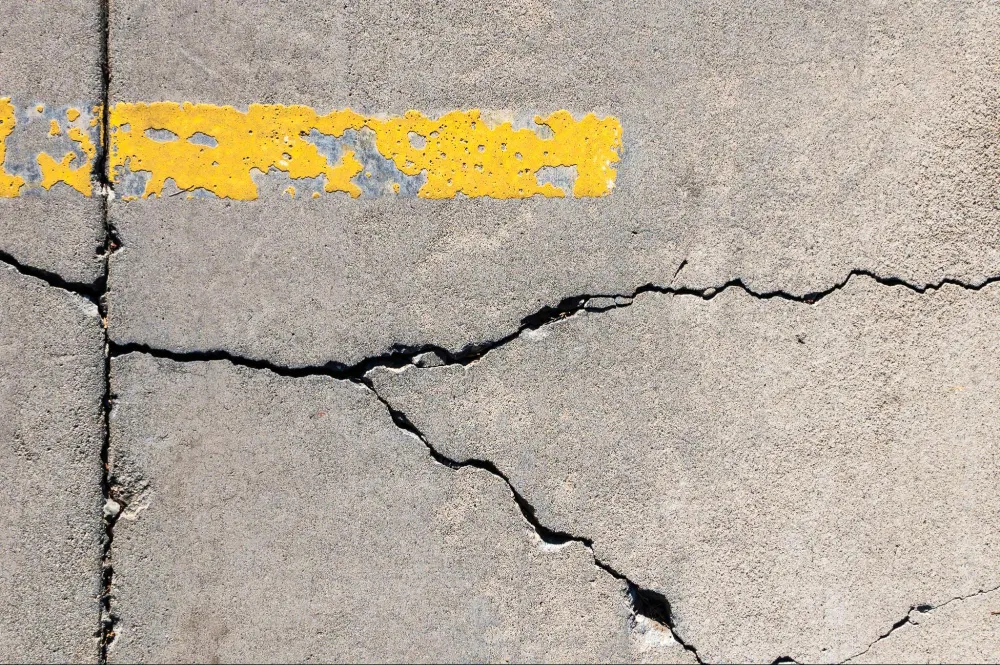
Concrete cracks because it shrinks while curing, moves with temperature, and rests on soil that shifts. Most fractures are cosmetic. Concrete services Calgary owners rely on treat width as the trigger: an opening past 3 mm, a vertical lip between sides, or steady widening each season points to movement below rather than normal curing. Depth matters too, since water reaching reinforcing steel corrodes it and accelerates damage.
Introduction
A driveway poured in June shows a hairline fracture by August, and the owner assumes the crew cut corners. That assumption is usually wrong. Concrete shrinks by roughly 0.5 mm per metre as mix water leaves the pour, so the concrete services Calgary property owners’ commission will crack regardless of who holds the trowel. What matters is where those lines land and how far they open.
Freeze-thaw cycling sharpens that question across the prairies, where a surface can pass through zero more than a hundred times in one season. Any concrete contractor in Calgary working to a 32 MPa minimum builds for that cycling rather than against fracturing itself. Reading the pattern correctly tells you whether the concrete is behaving normally or moving underneath.
Why Cracks Form in Concrete Work Calgary Homeowners Pay For
Four forces act on a pour, and each leaves its own signature on the surface. Recognising the pattern narrows the cause before any measurement begins.
Drying Shrinkage and Thermal Movement
Cement paste loses volume as mix water evaporates, pulling the pour inward from every edge. Restraint at the perimeter, around posts, or against a foundation wall stops that movement, and the concrete relieves the stress by tearing.
Thermal cycling repeats the process seasonally. A 6 m driveway panel expands and contracts by several millimetres between a July afternoon and a January night, and that travel gathers at the weakest point.
Subgrade Settlement and Frost Heave
What sits beneath the concrete matters more than most owners expect. Compacted gravel distributes load evenly; a soft pocket of backfill over a service trench does not. When one corner drops, the panel spans the void until it fractures.
Frost heave reverses the direction, lifting saturated ground and pushing sections upward through winter before dropping them in spring.
Each cause leaves a recognisable pattern:
- Random hairlines on a fresh pour, usually within 30 days, point to shrinkage or rapid surface drying
- Straight lines following a saw cut are working exactly as designed
- Diagonal splits running from a corner indicate restraint or a re-entrant angle
- Long uneven fissures with a vertical lip signal settlement below
- Map-like crazing means the finish dried faster than the body of the pour
- Flaking along an edge, with exposed aggregate, points to freeze-thaw damage or de-icing chemicals
Pattern narrows the cause, and width determines urgency.
Concrete Pouring Calgary Standards: Joint Geometry and Air Content
Two specifications decide whether a pour splits along a planned line or across the middle of a panel. Most consumer guides note that control joints exist without publishing the numbers behind them.
Cut Depth, Spacing, and the Saw Window
A control joint works only if it creates a genuine weak plane. ACI 302.1R sets the minimum cut depth at one quarter of the thickness, so a 100 mm driveway needs a 25 mm cut. Anything shallower leaves the section strong enough to tear elsewhere.
Timing carries equal weight. Miss the window, and the material relieves its own stress before the blade arrives. The governing numbers for a 100 mm residential pour:
- Cut depth: 25 mm minimum, one quarter of the thickness
- Joint spacing: 2.4 m to 3.6 m per ACI 360R-10, panels near square
- Conventional wet saw window: 4 to 12 hours after finishing
- Early entry dry-cut window: 1 to 4 hours
Air Entrainment for Freeze-Thaw Exposure
Water expands by roughly nine percent on freezing, and entrained air gives that expansion somewhere to go. CSA A23.1 classifies exterior flatwork exposed to de-icing chemicals as C-2, calling for 5 to 8 percent air depending on aggregate size.
Undermeasured air is why some driveways scale within four Calgary winters while a neighbouring pour holds. Strength class sits alongside it. A local operator specifies a 32 MPa minimum, above the 25 MPa often supplied for residential flatwork, which is the standard a concrete company Calgary owners hire should be building toward for repeated frost cycling.
Pro Tip: Ask for the delivery ticket. It records mix design, strength class, air content, and batch time, and it is the only document confirming what left the plant.
When to Monitor and When to Call a Concrete Specialist Calgary Owners Trust
Width, movement, and elevation change decide urgency. The comparison below sorts what you see against what it means.
| Observation | Likely Cause | Action |
| Under 1 mm, no lip | Drying shrinkage | Monitor annually |
| 1 to 3 mm, stable | Thermal or shrinkage | Seal against water entry |
| Over 3 mm | Settlement or overload | Assessment |
| Vertical offset over 5 mm | Subgrade failure | Assessment |
| Widening season over season | Active movement | Assessment |
| Flaking, exposed aggregate | Freeze-thaw or salt scaling | Reseal, review air content |
The table sorts symptoms, and monitoring confirms them over time.
Measuring and Tracking Movement
A single reading proves nothing. Mark both ends of a fissure with a pencil line, record the width with feeler gauges or a comparator card, and photograph it against a ruler each spring and autumn.
A separation measuring identically across four readings has finished moving. One gaining 0.5 mm a year has not. That distinction explains the toonie test some operators apply to warranty coverage, since a 28 mm coin sets an unambiguous threshold well above the hairline range.
Sealing, Drainage, and Winter Care
Maintenance addresses the mechanism rather than the mark:
- Seal openings above 1 mm with a flexible polyurethane, not a rigid filler that debonds in frost
- Reseal decorative surfaces every two to three years
- Grade soil away from edges at a minimum of 2 percent
- Clear downspout discharge at least 1.5 m from flatwork
- Skip sodium and calcium chloride on pours under one year old
- Use sand for winter traction instead
- Keep drainage paths clear before the ground freezes
Even so, maintenance cannot correct a defective subgrade. When an opening widens, offsets vertically, or lets water reach reinforcing steel, an assessment from a concrete specialist Calgary owners consult costs less than a replacement pour.
Reading Concrete Fractures Before They Become Repairs
A slab tells you what it is doing if you measure rather than guess. Pattern identifies the mechanism, width sets urgency, and a repeat reading six months later shows whether movement has stopped. Hairlines under 1 mm belong on a watch list. Openings past 3 mm, vertical offsets, and steady seasonal growth belong with an engineer. Measurement decides whether the concrete services Calgary property owners pay for solve the cause or only hide it.