Summer can be surprisingly rough on a driveway. Weeks of intense sun, parked vehicles, thunderstorms, lawn projects, kids playing outside, delivery trucks, dripping fluids, and ordinary daily traffic all leave their mark. By September, those small effects have had months to add up, making this an excellent time to inspect your driveway and see what actually changed over the summer.
You do not need to be a concrete expert to spot trouble.
In fact, many useful driveway checks come down to slowing down, looking carefully, and paying attention to changes you may have ignored during the busiest months of the year. A thin crack may have grown. A low spot may suddenly be holding water. That dark patch beneath the family car might be more than dirt.
September gives you a useful checkpoint.
The goal is not to make your driveway look brand new. It is to understand its current condition so you can clean, monitor, maintain, or repair problem areas before they become harder to manage.
Why September Is Such a Useful Time to Check Your Driveway
Think about what your driveway goes through between late spring and the end of summer.
Hot pavement expands under the sun. Cars come and go every day. Rainwater runs across the surface and collects wherever drainage is poor. Lawn equipment crosses the edges. Mulch, soil, fertilizer, grass clippings, oil, and other substances end up on the surface.
Then September arrives.
For many households, outdoor routines begin to settle down. Major summer landscaping projects may be finished, vacations are winding down, and the driveway has had several months to show where its weaker areas are.
That makes it a practical time to inspect your driveway from one end to the other.
A September inspection can help you identify:
- New cracks or cracks that have become wider
- Uneven or sunken sections
- Areas where water collects
- Crumbling edges
- Oil, rust, or other stubborn stains
- Pitting and rough surface areas
- Changes near the garage entrance
- Damage around landscaping borders
- Wear in frequently used parking areas
Some of these issues may only need monitoring. Others deserve attention sooner.
The important part is knowing which is which.
Start With the Effects of Summer Heat
Driveways spend summer sitting under direct sunlight for hours at a time.
That heat matters.
Concrete, asphalt, and other paving materials respond to temperature changes. As surfaces heat and cool repeatedly, existing weak points can become easier to see. Small cracks that were barely noticeable in spring may look longer or wider by September.
Asphalt can also become softer during periods of high heat, particularly where heavy vehicles remain parked for long periods. Concrete may show surface flaking, cracking around joints, or deterioration along unsupported edges.
You are not trying to diagnose the chemistry of the pavement.
Instead, look for change.
If you have photos from earlier in the year, compare them. A crack that looks unchanged over several seasons is different from one that has doubled in length since May.
No old photos? Start now.
Take a few clear pictures during your September inspection. Include something for scale when photographing cracks, such as a ruler or measuring tape. Those pictures can help you determine whether an area is stable or continuing to deteriorate when you inspect it again.
Inspect Cracks Instead of Simply Noticing Them
Most homeowners eventually see some kind of crack in a driveway.
The useful question is not simply, “Is there a crack?”
Look at what the crack is doing.
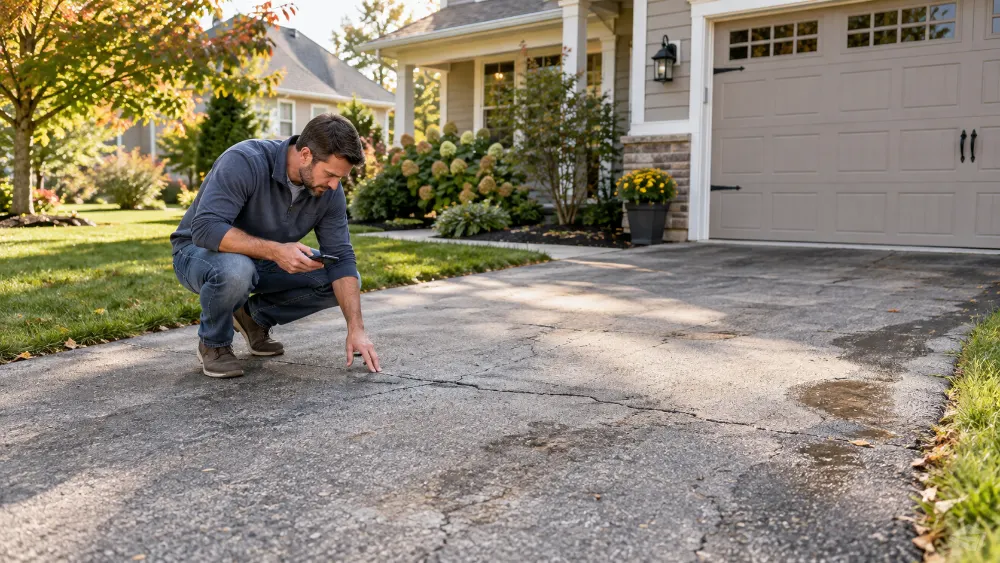
When you inspect your driveway, walk slowly enough to examine cracks from several angles. Pay particular attention to areas near joints, corners, edges, parking spots, and transitions between the driveway and other paved surfaces.
Consider these questions:
- Is the crack wider than you remember?
- Does one side sit higher than the other?
- Does the crack branch into several smaller cracks?
- Is vegetation growing through it?
- Is the material around it crumbling?
- Does water disappear into the opening?
- Are there several cracks concentrated in one small area?
A narrow surface crack and a wide opening accompanied by movement are not the same thing.
That distinction matters.
You do not necessarily need to repair every minor imperfection immediately. But cracks that are growing, separating, collecting water, or occurring alongside sinking deserve closer attention.
Take measurements. Take photos. Write the date down.
That simple habit gives you far more useful information than relying on memory.
Look for Settling and Uneven Sections
Cracks attract attention because they are easy to see.
Settling can be more subtle.
Stand near the street and look back toward the garage. Then view the driveway from the side. Changing your angle can make dips, raised sections, and uneven transitions much easier to identify.
Walk the surface too.
You may notice a slight step between two concrete slabs, a depression where a vehicle regularly parks, or a section that slopes differently from the surrounding pavement.
Possible contributors can include soil movement, erosion, tree roots, repeated heavy loads, and problems with the material beneath the driveway.
Whatever the cause, the practical concern is the change itself.
Uneven areas can affect drainage. They can become tripping points. They may also place additional stress on neighboring sections.
Mark questionable locations and monitor them.
If the movement appears substantial or seems to be progressing, professional evaluation may be more useful than repeatedly patching the visible symptoms.
Watch What Happens After Rain
A sunny afternoon is useful for inspecting cracks.
A rainy day tells you something different.
Water reveals the shape of your driveway.
After a storm, look for puddles and slow-draining areas. Pay attention to where runoff goes once it reaches the driveway.
Ideally, water should move away without repeatedly pooling against important structures or eroding the surrounding soil.
When you inspect your driveway after rainfall, check whether water is:
- Pooling in depressions
- Running toward the garage
- Collecting near the foundation
- Washing soil away along driveway edges
- Flowing through cracks
- Leaving trails of dirt or sediment behind
- Saturating landscaping beside the pavement
A puddle that disappears quickly after a major downpour may not be alarming.
A low area that holds water repeatedly deserves more attention.
Water can enter openings, carry material away, encourage vegetation growth, and make existing deterioration easier to worsen over time.
Drainage problems rarely become easier simply because they are ignored.
Check What Summer Lawn Projects Left Behind
Summer is prime time for yard work.
That can mean wheelbarrows, lawn tractors, trailers, bags of soil, piles of mulch, gardening chemicals, hoses, irrigation, tree trimming, and landscaping crews moving across the property.
Your driveway often becomes the staging area for all of it.
Take a careful look along the borders.
Soil may have eroded away from an edge. Roots may be pushing toward the pavement. Irrigation systems may repeatedly soak one section. Heavy equipment may have crossed an area that normally only handles passenger cars.
Even lawn products can leave visible marks.
Fertilizer containing certain minerals, for example, can contribute to discoloration if granules remain on a damp paved surface. Mulch, leaves, soil, and organic debris may also create dark staining over time.
Clean what you can.
Then look again.
Sometimes what appears to be damage is simply buildup. In other situations, cleaning reveals deterioration that dirt had been hiding.
Pay Extra Attention to Parking Areas
Your driveway does not wear evenly.
Some areas receive considerably more stress than others.
The tires of your primary vehicle probably follow almost the same path every day. Cars may sit in the same parking positions for hours. Family members may turn their wheels in one particular location when backing out.
Those spots deserve extra attention.
Check beneath regular parking areas for depressions, cracks, tire marks, leaking fluids, and differences in surface texture.
Also think about unusual summer activity.
Did you have a moving truck on the driveway?
A dumpster?
A boat or camper?
A contractor’s heavy vehicle?
A loaded landscaping trailer?
An occasional heavy load does not automatically mean damage occurred, but it gives you a reason to inspect that area more carefully.
Driveways tell stories through wear patterns.
You just have to look closely enough to read them.
Stains Can Tell You More Than You Think
Not every driveway problem is structural.
Some are messy.
Oil stains, rusty marks, tire residue, algae, mildew, spilled paint, lawn chemicals, and dirt can all build up over a busy summer.
Start by identifying what you are looking at rather than immediately scrubbing everything with the strongest cleaner you can find.
Common driveway discoloration includes:
| What You See | Possible Source | What to Check |
|---|---|---|
| Dark oily patch | Vehicle fluid | Check vehicles for active leaks |
| Orange or brown staining | Rust or mineral deposits | Look for metal objects or irrigation sources |
| Green or dark organic growth | Algae or mildew | Check shade and moisture conditions |
| Black tire marks | Repeated turning or parking | Inspect surrounding surface for wear |
| White deposits | Mineral residue | Look for recurring water movement |
| General darkening | Dirt and organic buildup | Clean an area and compare the surface underneath |
Stains can be cosmetic.
Still, they are worth investigating because some tell you about another problem.
A fresh oil spot might be your driveway telling you that a vehicle needs attention. Repeated mineral staining may point to sprinkler overspray. Dark organic growth can indicate a consistently damp location.
Treat the cause, not just the appearance.
A Clean Surface Can Make Damage Easier to See
Sometimes you cannot properly evaluate a driveway because you cannot properly see it.
Months of dirt, organic buildup, lawn debris, tire residue, and grime can obscure small cracks and surface imperfections.
Start simple.
Sweep thoroughly. Remove leaves from joints and edges. Pull loose weeds. Rinse away ordinary dirt where appropriate.
For heavier buildup, a more complete exterior cleaning may help reveal the actual surface condition. Homeowners researching Vero Beach pressure washing for homeowners, for example, may be looking at cleaning not simply as a cosmetic project but as one way to get a clearer view of stained, weathered, or heavily soiled pavement.
Pressure washing can make certain cracks, discoloration, pitting, and worn sections easier to evaluate once accumulated grime is removed.
But more force is not always better.
The cleaning method should suit the driveway material and its condition. Excessive pressure, poor technique, or aggressive cleaning on an already damaged surface can create additional problems.
If you clean the driveway yourself, test a small area first and avoid concentrating high pressure on weak joints, crumbling sections, or existing damaged areas.
The purpose is visibility.
Once the surface is clean, inspect your driveway again. You may notice details that were almost invisible before.
Do Not Ignore the Edges
The middle of a driveway often looks stronger because it has support on both sides.
Edges can be more vulnerable.
Walk the entire perimeter and look for crumbling material, missing chunks, exposed base material, erosion, vegetation growth, and unsupported areas.
Watch landscaping closely.
If soil has washed away beside the pavement, the edge may no longer have the same support it once had. Roots, aggressive plants, or repeated lawn-equipment traffic can also affect these areas.
Then inspect the transitions.
Pay particular attention where the driveway meets:
- The garage floor
- The public street
- A sidewalk
- A walkway
- Drainage channels
- Other paved surfaces
Changes in height can indicate movement.
Gaps can collect water and debris.
These transition points are easy to overlook, but they often experience concentrated stress as vehicles pass from one surface to another.
Use a Simple September Inspection Checklist
You do not need specialized equipment to perform a useful basic inspection.
Grab your phone, a broom, a measuring tape, and perhaps some chalk or removable markers.
Then work systematically.
| Driveway Area | What to Look For | Suggested Action |
|---|---|---|
| Main surface | Cracks, pitting, flaking | Photograph and monitor changes |
| Parking spots | Stains, depressions, cracks | Check vehicles and pavement |
| Low areas | Standing water | Observe drainage after rain |
| Driveway edges | Crumbling, erosion | Restore surrounding support if appropriate |
| Garage entrance | Gaps or uneven surfaces | Monitor movement and water flow |
| Landscaping borders | Roots, moisture, soil loss | Address vegetation or drainage issues |
| Joints | Separation, debris, weeds | Clean and check for widening |
| Entire surface | Dirt and staining | Clean carefully for better visibility |
Do not rush through it.
A useful inspection might take 15 or 20 minutes. That is still far easier than discovering a neglected issue after it has become larger.
Decide What Needs Attention and What Can Wait
Finding a problem does not mean you need to launch a major repair project this weekend.
Prioritize.
Minor cosmetic staining is different from active settling. A stable hairline crack is different from a widening crack where the two sides are no longer level.
You can divide what you find into three basic categories.
Monitor
This category may include small, stable cracks, minor discoloration, or ordinary surface wear.
Take photographs and measurements. Recheck the areas every few months.
Maintain
Cleaning, controlling weeds, redirecting sprinkler overspray, keeping drainage paths clear, and maintaining soil along driveway edges can all fall into this category.
These are simple tasks, but consistency matters.
Investigate
Rapidly growing cracks, widespread deterioration, major settling, persistent standing water, large height differences, or significant crumbling may justify a closer professional assessment.
The aim is not to assume the worst.
It is to avoid treating a meaningful problem as purely cosmetic.
Make Driveway Inspection Part of Fall Home Maintenance
Home maintenance becomes easier when it follows a rhythm.
September already serves as a natural transition point in many households, so it makes sense to inspect your driveway while handling other exterior tasks.
Create a simple routine:
- Sweep and remove accumulated debris.
- Walk the surface slowly in daylight.
- Photograph cracks and questionable areas.
- Measure noticeable openings.
- Check driveway edges and joints.
- Inspect the garage and street transitions.
- Observe drainage during the next rain.
- Clean heavily soiled areas appropriately.
- Reinspect the surface after cleaning.
- Make a short list of maintenance or repair priorities.
Save the photos.
That last step is easy to underestimate.
Next September, you will have a reference point. Instead of wondering whether a crack has always looked that way, you can compare it directly with an image from a year earlier.
That is useful information.
What I Would Look at First
If I were checking a driveway after a long summer and only had a few minutes, I would focus on three things first: movement, water, and change.
Movement includes sinking, lifting, widening gaps, and uneven slabs.
Water includes puddles, erosion, runoff toward structures, and persistently damp areas.
Change means anything clearly different from earlier in the year.
These signs generally tell you more than ordinary fading or a few tire marks.
I would also resist the temptation to judge everything from the garage door. Walk the driveway. Look back toward the house. Crouch down and view questionable areas from the side.
Perspective helps.
Sunlight hitting the surface at a lower angle can reveal dips and texture changes that disappear when viewed from directly above.
September Gives You a Useful Snapshot
A driveway works quietly in the background of daily life.
Cars cross it. Kids play on it. Packages are delivered over it. Rain runs across it. Landscaping projects surround it.
Most days, nobody gives it much thought.
That is exactly why a seasonal inspection makes sense.
September gives you an opportunity to see what summer left behind before another season adds its own wear. When you inspect your driveway, you are not searching for reasons to spend money. You are collecting information.
Look for cracks.
Notice where water goes.
Check the edges.
Pay attention to settling, staining, surface deterioration, and the areas carrying the most traffic.
Clean enough of the surface to see what is really there.
Then decide what deserves maintenance, what simply needs monitoring, and what may require a closer look.
A driveway does not need to be flawless to be functional. But small changes are much easier to understand when you catch them early.
So before September disappears into the rest of fall, walk outside and inspect your driveway from the garage to the street.
You may find nothing serious.
And that is useful information too.