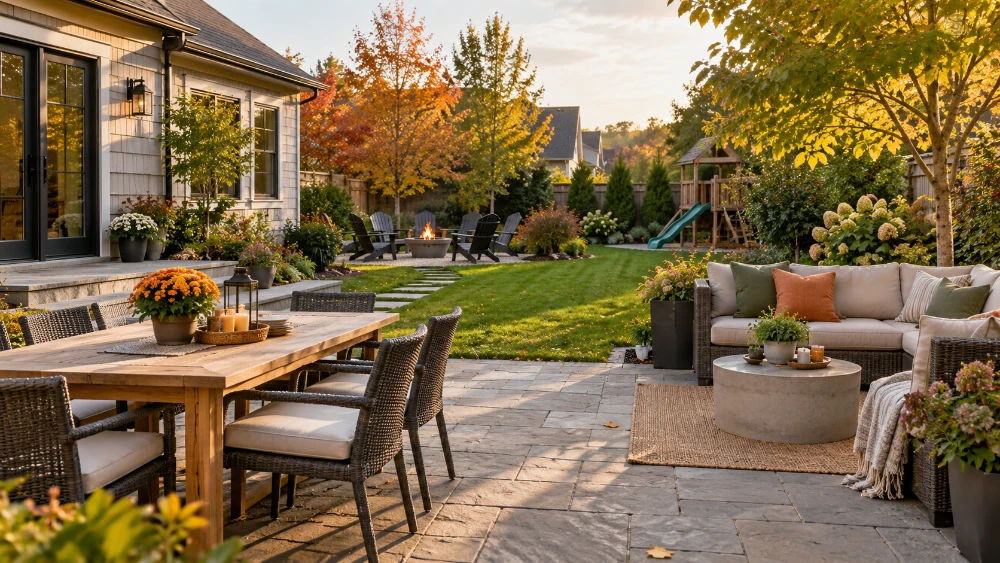
By September, your backyard has already been through the busiest part of its year. There have been sunny afternoons, hot weekends, dinners outside, kids running through the grass, gardening projects, quiet mornings, and probably a few gatherings where everyone somehow ended up standing in the same small corner of the patio.
That makes early fall an surprisingly useful time to look at your outdoor space with fresh eyes.
Instead of immediately packing away the cushions and forgetting about the yard until spring, spend a little time noticing what actually worked over the summer. Which areas did you use constantly? Which looked pretty but rarely attracted anyone? Where did you wish you had more shade, seating, lighting, or room?
A September backyard audit can reveal much more than a sketch made in the middle of winter. You have several months of real-life experience to work from, which makes it easier to plan improvements that match the way you actually live.
Why September Is Such a Useful Time to Evaluate Your Backyard
Spring tends to inspire plans.
September gives you evidence.
At the beginning of outdoor season, it is easy to imagine yourself having dinner outside every night, maintaining elaborate flower beds, lounging beside a fire pit, or entertaining a dozen friends on the patio. Once summer is over, you can compare those expectations with what really happened.
Maybe the dining table barely got used because it was too far from the kitchen. Perhaps everyone preferred sitting under the large shade tree instead of on the sunny patio. You may have discovered that your beautiful lawn becomes muddy after heavy rain or that one corner of the yard is especially pleasant during the evening.
These small observations provide clues about how your backyard could function better.
September also introduces slightly different conditions. The sun sits lower in the sky, evenings may become cooler, and shadows begin changing. Watching these transitions helps you understand whether your outdoor setup works beyond peak summer.
Start With the Places You Naturally Used Most
Walk outside and think about where you spent your time over the last few months.
Do not focus on where you intended people to gather. Look at where they actually gathered.
Sometimes those are completely different places.
Perhaps guests repeatedly pulled chairs away from the patio and moved them beneath a tree. Maybe everyone gathered near the back door because that was the easiest place to carry food and drinks. Your kids might have ignored a carefully planned play area and spent most of their time in an open patch of lawn instead.
High-use areas tell you something important: these spaces are already working.
Rather than redesigning your whole backyard, it may make more sense to improve the places you naturally enjoy.
A frequently used corner could benefit from better seating. A favorite shady spot might only need a level surface and small table. An outdoor dining area that gets plenty of use could become even more comfortable with additional lighting.
Sometimes improving what already works produces a better result than creating something entirely new.
Pay Attention to the Areas Nobody Used
Unused space deserves just as much attention.
Most yards have at least one awkward section that rarely serves a purpose. It might be a narrow side yard, an empty corner beside the fence, a patch of grass behind the garage, or a sunny section that becomes uncomfortable during the middle of the day.
Before deciding what to put there, figure out why the space is being ignored.
Common reasons include:
- Too much direct sun or too little shade
- Uneven or muddy ground
- Poor access from the house or patio
- Lack of comfortable seating
- Too little privacy
- No lighting after sunset
- Mosquitoes or other pests
- Furniture that does not suit the space
- No clear reason to spend time there
The solution does not necessarily need to involve a major renovation.
For example, an empty corner might become useful with two outdoor chairs, a small table, several planters, and solar lighting. A narrow side yard could become a garden path instead of wasted lawn. An uncomfortable sunny area might need nothing more complicated than an umbrella or shade sail.
Think in terms of function before decoration.
Once you know what you want to do in a space, choosing furniture, plants, lighting, and accessories becomes much easier.
Watch How People Move Through the Yard
Backyard design is not only about where people sit. Movement matters too.
Think about what happens when someone walks out the back door.
Can they reach the patio without stepping through grass? Is there a clear route from the kitchen to the grill? Do guests have to squeeze around furniture to reach another part of the yard?
Good outdoor spaces usually have obvious pathways.
You do not necessarily need formal stone walkways everywhere. Simple stepping stones, gravel, mulch, pavers, or changes in landscaping can visually direct movement.
If people constantly cut across the same part of the lawn, consider that useful information rather than bad behavior. They may simply be showing you where a pathway naturally belongs.
Evaluate Your Outdoor Furniture Honestly
Outdoor furniture can look wonderful when staged, yet still be uncomfortable enough that nobody wants to use it.
September is a good time to ask yourself which pieces earned their place.
Did people choose your lounge chairs voluntarily? Was the outdoor dining table large enough? Were cushions comfortable after sitting for an hour? Did lightweight chairs constantly get moved around by wind?
Also consider whether your furniture matches how you actually entertain.
A large dining table makes sense if you regularly host meals outside. If most gatherings involve casual drinks and conversation, however, comfortable lounge seating and several small side tables may work better.
You may not need new furniture at all. Rearranging what you already own could dramatically improve the layout.
Try moving pieces around before buying anything. Sometimes shifting a table several feet closer to the house or turning chairs toward the garden creates a completely different experience.
Follow the Sun and Shade
One of the easiest things to overlook when planning a backyard is how dramatically sunlight changes throughout the day.
A beautiful patio can become practically unusable at 2 p.m. if it receives intense afternoon sun.
Spend several days observing your yard at different times. Notice which areas receive morning light, where afternoon heat builds up, and which spaces remain shaded.
Then compare those observations with how you want to use each area.
Morning sun can be wonderful for a breakfast table. Afternoon shade may be more important around a seating area. Vegetable gardens often benefit from substantial sunlight, while certain ornamental plants perform better with some protection.
Permanent shade structures are one possibility, but they are not your only option. Depending on your budget and yard, umbrellas, retractable awnings, shade sails, trees, tall shrubs, pergolas, or even strategically placed curtains can make outdoor areas more comfortable.
Look at Your Backyard After Dark
Homeowners often plan outdoor spaces almost entirely during daylight.
But summer evenings may be when the backyard gets used most.
Walk outside after sunset and look around.
Can you clearly see steps? Are pathways easy to follow? Does your seating area disappear into darkness? Is the patio illuminated so brightly that it feels more like a parking lot than a relaxing outdoor room?
Layered lighting usually works better than relying on one powerful fixture.
Path lights can improve visibility. String lights create soft ambient light. Small lamps or lanterns make seating areas feel more intimate, while lighting around steps and elevation changes can help people move around safely.
Even a modest lighting update can completely change how useful your yard feels after sunset.
Think About What Summer Weather Revealed
Several months of warm weather can expose weaknesses that are difficult to notice during the planning stage.
Heavy rain may reveal areas with poor drainage. Hot weather shows where shade is missing. Wind can demonstrate whether umbrellas and lightweight furniture are positioned properly.
Look for practical clues such as standing water, bare patches of grass, washed-out mulch, damaged furniture, fading fabrics, slippery steps, or areas where water collects beside the house.
Addressing those issues can make a bigger difference than purely decorative upgrades.
A backyard becomes enjoyable when it is easy to use. Fixing drainage, improving pathways, providing shade, and choosing durable materials may not sound as exciting as buying new furniture, but those improvements often determine whether the space gets used regularly.
Match the Problem to the Right Improvement
Once you know what worked and what did not, turn your observations into specific ideas.
| What You Noticed This Summer | Possible Reason | Improvement to Consider |
|---|---|---|
| Everyone crowded onto one small patio | Main gathering area is too small | Rearrange furniture, extend the seating area, or add another surface |
| Lawn became muddy after rain | Drainage or heavy foot traffic | Improve drainage, add stepping stones, gravel, or a defined path |
| Patio was too hot during the afternoon | Insufficient shade | Umbrella, shade sail, pergola, tree, or covered area |
| Backyard stopped being used after sunset | Poor lighting | Add path, stair, task, and ambient lighting |
| One corner was always empty | No clear function | Create a reading nook, garden area, fire-pit zone, or small seating area |
| Dining area felt inconvenient | Too far from indoor kitchen | Relocate dining furniture or improve the path between spaces |
| Furniture constantly needed maintenance | Materials unsuitable for your climate | Choose lower-maintenance outdoor finishes and fabrics |
| Outdoor area felt disconnected from the house | Weak indoor-outdoor transition | Repeat colors, materials, plants, or furniture styles used indoors |
You do not need to tackle everything at once.
In fact, an outdoor space often turns out better when improvements happen gradually. Living with each change gives you another opportunity to see how it affects the way you use the yard.
Separate Easy Weekend Projects From Bigger Improvements
Your September audit might produce a long wish list, but not every issue requires the same amount of work.
Some changes can be completed during a weekend. Rearranging furniture, adding planters, installing solar lights, cleaning up garden edges, creating a gravel path, or repainting an outdoor table can make the backyard feel noticeably different without a major investment.
Other problems may point toward larger projects.
If your family consistently runs out of seating space, for example, you might eventually consider expanding the patio or adding a deck. Persistent drainage problems may require grading work. A backyard with no protection from intense sun could benefit from a permanent covered area.
The important thing is to let actual use guide those decisions.
A major project should solve a problem you have experienced rather than add a feature simply because it looks attractive online.
Think in Outdoor “Rooms”
One simple way to make a backyard more functional is to think about it as several small rooms rather than one large open space.
Inside your home, each room has a purpose. The same principle can work outdoors.
You could have a dining zone near the kitchen, a lounging area farther into the yard, a gardening section along a sunny fence, and an open area where children or pets can play.
These zones do not need walls.
Outdoor rugs, planters, pathways, changes in ground material, furniture placement, lighting, or landscaping can create subtle boundaries.
Defined areas can make even a modest backyard feel more purposeful without making it feel crowded.
Consider Maintenance Before Adding More
September is also a useful time to evaluate how much work your yard required.
Did you spend more time maintaining it than enjoying it?
If watering, mowing, pruning, cleaning furniture, replacing mulch, and dealing with weeds consumed your weekends, simplify before adding anything else.
Low-maintenance landscaping does not have to mean a plain backyard.
You can reduce upkeep by choosing perennial plants suited to your climate, grouping plants with similar watering needs, expanding mulched beds, replacing difficult patches of grass, installing more durable outdoor furniture, or using hardscaping where lawn repeatedly struggles.
Every new feature creates some level of maintenance. Asking how much work it will require before installing it can prevent frustration later.
Use Fall to Experiment With Small Changes
One advantage of reviewing your backyard in September is that you do not have to immediately commit to permanent changes.
Experiment first.
Move your dining table to another part of the patio and use it there for a few weeks. Put temporary chairs in an unused corner. Place inexpensive solar lights along the route where people naturally walk.
You can even use garden hoses, stakes, chalk, or outdoor rugs to visualize the footprint of a future patio, deck, garden bed, or seating area.
Living with a temporary arrangement often reveals problems that are difficult to see on paper.
If the experiment works, you have much more confidence when making the improvement permanent.
Plan Larger Projects Before Spring Arrives
If your backyard audit reveals that a bigger improvement really would make the space more useful, fall can be a convenient time to start planning.
Waiting until the first beautiful weekend of spring to think about a major outdoor project can leave you making rushed decisions just when you want to start enjoying the yard again.
Instead, use the cooler months to collect ideas, compare materials, measure the space, develop a realistic budget, and determine whether permits or professional help might be necessary.
For example, homeowners considering a significant deck project can consult Pasadena deck builders for custom outdoor spaces to better understand layout options, material considerations, site conditions, and other practical details before committing to construction.
Starting the research early also gives you more time to decide whether a major project is truly worthwhile or whether a smaller DIY improvement could solve the same problem.
Don’t Forget How the Backyard Looks From Inside
Your backyard is part of your home’s view even when you are not outside.
Stand at your kitchen sink, dining table, living-room window, or back door and look outside.
What catches your attention?
Sometimes a small improvement in the right location has a surprisingly large impact. A beautiful planter, flowering shrub, small tree, attractive seating area, or tidy garden bed positioned within a major sightline can make the entire outdoor space feel more intentional.
This is especially useful during colder months when you may spend more time enjoying the yard from indoors.
Designing for both perspectives helps your exterior feel like a genuine extension of your home.
Take Photos Before You Pack Everything Away
Before outdoor furniture disappears into storage, take plenty of pictures.
Photograph the yard from several angles and at different times of day.
Pictures are surprisingly useful during winter planning because they capture details you may otherwise forget—furniture placement, crowded areas, empty corners, sun exposure, plant sizes, and how different parts of the yard relate to one another.
You can even create a small folder on your phone specifically for backyard ideas. Add photos throughout the year whenever you notice something that works particularly well or needs attention.
By spring, you will have a record based on months of real observations instead of relying on memory.
Create a Backyard That Fits Your Real Life
The most successful backyard is not necessarily the one with the biggest deck, most elaborate landscaping, or trendiest outdoor furniture.
It is the one you actually want to use.
September gives you a rare opportunity to evaluate your yard immediately after months of real activity. The details are still fresh. You know where people gathered, what became inconvenient, which areas stayed empty, and what you wished you had every time you stepped outside.
Use those observations as your design guide.
Maybe the answer is a major outdoor renovation. Maybe it is a better path, another shade umbrella, softer lighting, a few comfortable chairs, or simply moving your furniture around.
Either way, start with how you already live.
When your backyard is designed around your actual habits instead of an idealized version of outdoor living, it becomes easier to maintain, more comfortable to use, and much more likely to feel like a natural extension of your home.