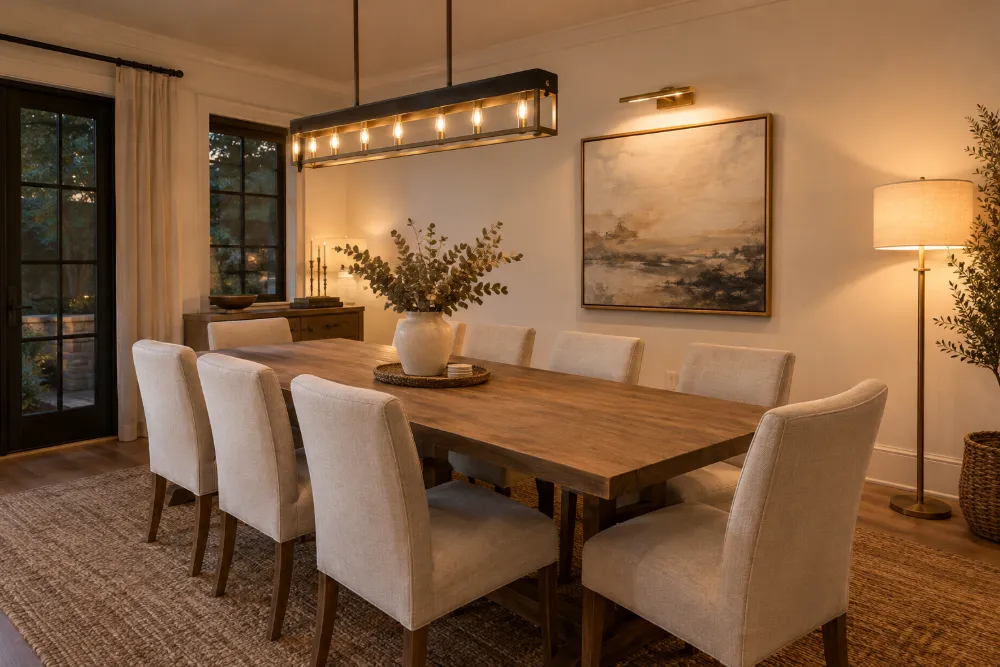
You can paint the walls, rearrange the furniture, and swap out every throw pillow, but if the lighting is wrong, the room still won’t feel finished. Lighting is one of the most underrated tools in home design. A well-chosen fixture can make a small room feel open, a plain wall look textured, and an ordinary weeknight dinner feel special.
It also matters more than most of us realize. The average person spends roughly 90 percent of their time indoors, according to the U.S. Environmental Protection Agency, so the light in your home shapes how you work, relax, and sleep. The good news for DIYers, renters, and budget decorators is that lighting is one of the easiest and most affordable things to change. Many of the best upgrades take an afternoon, a screwdriver, and a little planning.
Here are the lighting trends shaping homes right now, plus practical ways to bring each one into your own space without a full renovation.
Statement Fixtures Are Back
For years, the goal of home lighting was to disappear into the ceiling. Recessed cans did the job, but they rarely added personality. Today, homeowners are treating light fixtures as sculptural pieces that anchor a room, the same way a great rug, a vintage dresser, or a gallery wall does.
This is especially visible in dining rooms and kitchens with long islands. A traditional round chandelier can look out of proportion over a rectangular table, which is why many designers now suggest you consider a linear chandelier for these spaces. Its elongated shape follows the lines of the table or island, spreads light more evenly across the surface, and creates a clean, modern focal point. These fixtures come in finishes from matte black and brushed brass to natural wood and glass, so it’s easy to match one to your cabinet hardware, faucet, or dining chairs.
Sizing and Hanging Your Fixture Correctly
Getting the scale right is what separates a fixture that looks designer-chosen from one that looks like an afterthought. Use these rules of thumb as a starting point:
| Where It’s Going | Size Guideline | Hanging Height |
|---|---|---|
| Over a dining table | About two-thirds the length of the table | 30 to 36 inches above the tabletop |
| Over a kitchen island | Two-thirds of the island length, or two to three pendants spaced evenly | 30 to 36 inches above the countertop |
| Center of a room (no table) | Add the room’s length and width in feet; use that number in inches as the diameter | At least 7 feet from the floor |
| Entryway or foyer | Same formula as above; go slightly larger in two-story spaces | At least 7 feet from the floor, higher in tall foyers |
If you’re in a rental or don’t want to hire an electrician, a plug-in pendant with a swag hook lets you get the statement look with no hardwiring at all.
Other Statement Styles to Try
Oversized pendants, sculptural sconces, and fixtures made from natural materials like rattan, ceramic, and blown glass are also popular. The common thread is that the fixture is visible, intentional, and part of the room’s character. A few easy ways to join the trend:
- Swap a builder-grade “boob light” in a hallway or bedroom for a semi-flush fixture with a little personality.
- Add a pair of plug-in sconces on either side of a bed in place of bulky nightstand lamps.
- Update an old fixture you already own with a coat of spray paint in matte black, brass, or a bold color.
- Shop secondhand. Thrift stores and online marketplaces are full of solid metal and glass fixtures that only need new wiring or a good cleaning.
Warm Light Is Replacing Cold White
Light quality matters as much as the fixture itself. Light color is measured in Kelvins (K), and for years many LED bulbs were sold at 4000K or higher. That produces a crisp, bluish glow that can make a living room feel more like an office or a waiting room. Designers have moved toward warmer bulbs in the 2700K to 3000K range, which resemble the soft glow of traditional incandescent bulbs.
Warm lighting makes skin tones look more natural, makes wood and fabric look richer, and creates a calmer atmosphere in the evening. Many homeowners now use different color temperatures in different rooms depending on what happens there.
| Color Temperature | How It Looks | Best Rooms |
|---|---|---|
| 2200K to 2700K | Very warm, candle-like amber | Bedrooms, living rooms, dining areas at night |
| 2700K to 3000K | Warm and cozy, like classic incandescent | Living rooms, bedrooms, entryways |
| 3000K to 3500K | Soft white, warm but clear | Kitchens, bathrooms, home offices |
| 4000K and up | Cool, bright, bluish | Garages, workshops, laundry and utility spaces |
Choosing a bulb’s color temperature deliberately is one of the cheapest upgrades available. Check the “Lighting Facts” label on the bulb box, which lists the Kelvin rating, and try to keep the same temperature within a single room so your lamps and ceiling fixtures don’t clash.
Quick tip: While you’re reading the label, look at the CRI (Color Rendering Index) too. A CRI of 90 or higher means colors, from your paint swatches to your dinner, will look true to life instead of washed out.
Layered Lighting Creates Depth
Another major trend is the move away from a single overhead source. Professionals describe good lighting in three layers, and rooms that use all three simply feel more finished.
- Ambient light provides general illumination, usually from ceiling fixtures, chandeliers, or recessed lights.
- Task light focuses on activities like cooking, reading, applying makeup, or working at a desk.
- Accent light highlights art, architecture, bookshelves, plants, or interesting textures.
Homes that rely only on one ceiling fixture tend to feel flat, with harsh shadows and dull corners. Adding even one more layer can make a room look larger and more inviting.
What Layering Looks Like Room by Room
| Room | Ambient | Task | Accent |
|---|---|---|---|
| Living room | Ceiling fixture on a dimmer | Floor lamp beside the reading chair | Picture light over artwork or LED strip on a bookshelf |
| Kitchen | Flush mount or recessed lights | Pendants over the island and under-cabinet strips | Toe-kick or inside-cabinet lighting for glass doors |
| Bedroom | Semi-flush fixture or fan light | Wall sconces or bedside lamps | Small lamp on a dresser or a headboard backlight |
| Bathroom | Overhead fixture | Vanity lights at face height on both sides of the mirror | Waterproof LED strip under a floating vanity |
| Home office | Ceiling light | Adjustable desk lamp | Backlight behind a monitor or shelf lighting |
The result is a space that can shift from bright and functional to soft and inviting at the flip of a switch. Dimmers are a key part of this approach. They are inexpensive, simple to install for a confident DIYer, and let one fixture serve several moods. Just make sure your bulbs are labeled “dimmable” and the dimmer is rated for LEDs, or you may notice flickering or buzzing.
Easy DIY Layering Projects
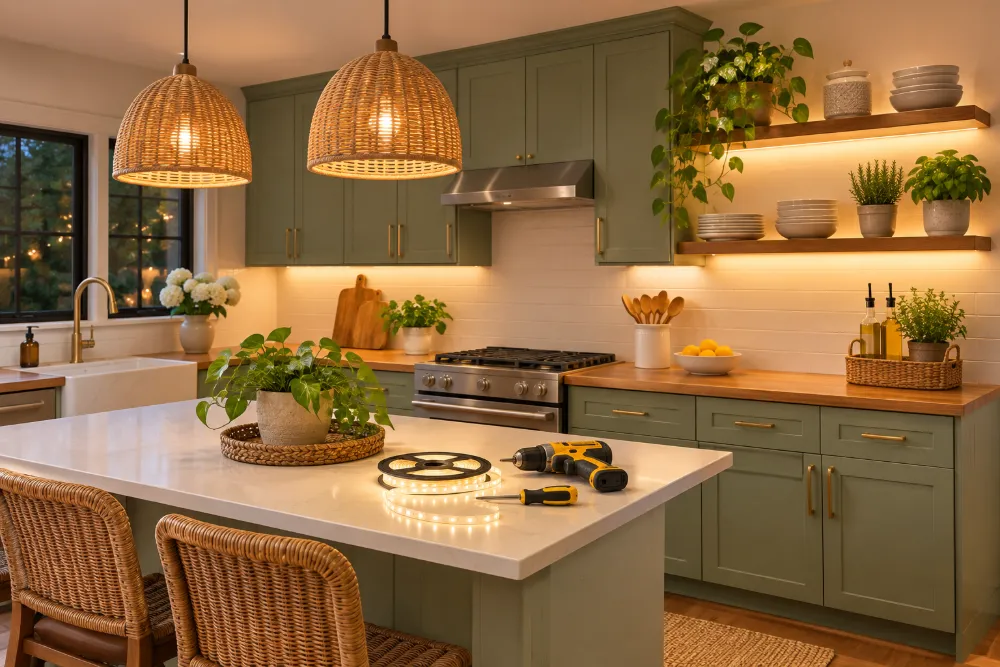
- Stick-on under-cabinet lights. Battery-powered or plug-in LED bars attach with adhesive and instantly brighten countertops.
- Bookshelf glow. Run an adhesive LED strip along the underside of each shelf for a built-in look.
- Art spotlights. A small battery-powered picture light turns a thrifted painting into a focal point.
Smart Lighting Gets Practical
Smart lighting has matured from a novelty into a practical upgrade. Connected bulbs and switches let you schedule lights, adjust brightness from your phone, and change color temperature throughout the day. Many systems can mimic natural daylight, with cooler, brighter light in the morning and warmer, dimmer light at night. That matches the way light influences the body’s internal clock, and researchers have linked evening exposure to bright, blue-rich light with trouble falling asleep.
Smart controls also help with security and convenience. Lights that turn on as you arrive home, or that simulate occupancy while you travel, add a layer of protection without any extra effort. As more manufacturers adopt shared standards for compatibility, setting up a connected home has become much less frustrating than it was a few years ago.
Smart Bulbs vs. Smart Switches
| Option | Best For | Pros | Watch Out For |
|---|---|---|---|
| Smart bulbs | Renters, lamps, trying smart lighting for the first time | No wiring; many offer color and tunable white | The wall switch must stay on for them to work |
| Smart switches and dimmers | Homeowners, rooms with several fixtures | Control every bulb on the circuit; works with regular LED bulbs | Requires basic wiring; some need a neutral wire |
| Smart plugs | Floor and table lamps | Cheapest entry point; plug and play | Only on/off control unless paired with a smart bulb |
Start with one room: put the living room lamps on a sunset schedule and expand from there.
Efficiency Is Now the Default
Energy efficiency is no longer a trade-off with style. According to the U.S. Department of Energy, LED bulbs use at least 75 percent less energy than traditional incandescent bulbs and can last up to 25 times longer. Lighting accounts for roughly 10 percent of a typical household’s electricity use, so switching to LEDs can lead to noticeable savings on utility bills over time.
Modern LEDs also come in far more shapes and finishes than early models did. Filament-style bulbs that mimic vintage designs now offer the same warm look with a fraction of the energy use, which makes them perfect for exposed-bulb fixtures and farmhouse-style pendants. Integrated LED fixtures, including slim linear designs and flat panels, allow designers to create clean profiles that were not possible with conventional bulbs. Efficiency now supports the design rather than limiting it.
Reading the Box: Lumens, Not Watts
When you shop for LEDs, brightness is measured in lumens instead of watts. Here’s a quick conversion guide:
| Old Incandescent | LED Equivalent (Approx.) | Lumens |
|---|---|---|
| 40W | 4 to 6W | About 450 |
| 60W | 8 to 10W | About 800 |
| 75W | 11 to 13W | About 1,100 |
| 100W | 14 to 17W | About 1,600 |
Replace bulbs in your most-used fixtures first, since that’s where you’ll see the biggest savings.
Natural Materials and Handcrafted Details
As homes lean toward warmer, more organic interiors, lighting is following suit. Fixtures with linen shades, hand-thrown ceramic bases, woven cane, and unlacquered brass that ages over time are growing in popularity. These materials soften a room and add texture, which balances the sleek lines of modern architecture and the hard surfaces in kitchens and bathrooms.
This trend is especially friendly to crafters and DIYers, because it’s easy to recreate with a few supplies:
- Rattan or wicker basket pendant. Flip a woven basket upside down, cut a small hole in the base, and thread through a plug-in pendant cord kit.
- Fabric lampshade refresh. Wrap an old shade in linen, burlap, or a pretty remnant fabric using spray adhesive and a hot glue gun.
- Thrifted ceramic lamp makeover. Paint a dated base with chalk paint or a textured stone-effect spray for a handmade look.
- Wood bead accents. String natural wood beads around a plain pendant for a coastal or boho feel.
- Let brass age. If you find a vintage brass lamp, skip the polish and let the warm patina show.
Putting It All Together
Transforming a home with lighting does not require a full renovation. Start with the room you use most and ask what is missing.
- If the space feels flat, add a second or third layer of light, like a floor lamp or LED shelf strip.
- If it feels harsh, swap in warmer bulbs and install a dimmer.
- If it lacks a focal point, choose a statement fixture sized to the room.
- If your bills feel high, replace the bulbs you use most with efficient LEDs.
- If you want convenience, start small with a smart plug or two.
Small, deliberate changes add up quickly, and because lighting is easy to update, it is a low-risk way to experiment with style. So grab your screwdriver, pick a room, and let your home’s personality shine.