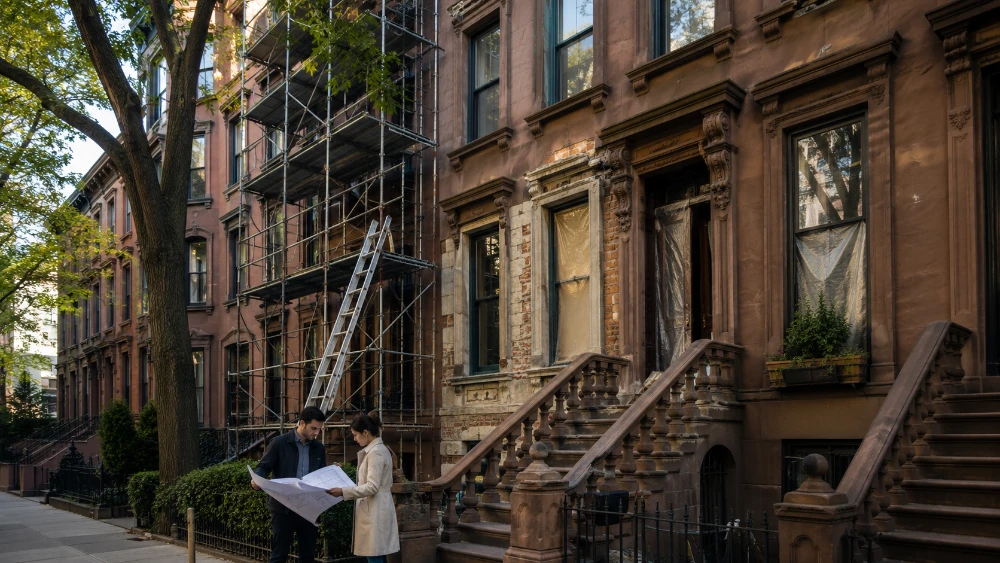
Brooklyn’s brownstones are 110 to 160 years old, and most of them sit inside a designated historic district. That single fact — more than square footage or finish level — is what separates a brownstone renovation from every other residential project in New York City. Before touching a wall, roof, or window, an owner needs to understand two systems working at once: the Department of Buildings (DOB), and, for landmarked properties, the Landmarks Preservation Commission (LPC).
Is Your Brownstone Landmarked?
Most of brownstone Brooklyn — including large sections of Park Slope, Brooklyn Heights, Fort Greene, Boerum Hill, Cobble Hill, and Crown Heights North — sits inside an LPC historic district. Landmark status doesn’t block renovation, but it does mean any visible exterior change requires Commission review before a DOB permit can move forward.
| Type of exterior work | LPC approval needed | Typical review path |
|---|---|---|
| In-kind repair (same material, same profile, same color) | Yes | Certificate of No Effect — staff-level, often same-day |
| New windows, cornice changes, facade color/material change | Yes | Certificate of Appropriateness — full hearing, 3–6 months |
| Interior-only renovation, no visible exterior change | No LPC review | Standard DOB filing only |
A homeowner planning a brownstone renovation should pull the building’s landmark designation report before finalizing any exterior design, since a change that looks minor on paper — a new front door color, a different window profile — can trigger the longer Certificate of Appropriateness path if it’s visible from the street.
What a Brownstone Renovation Actually Costs in 2026
Because owners are responsible for the entire building envelope — facade, roof, stoop, and structure — brownstone renovations run well above standard apartment pricing.
| Scope | Cost per sq ft |
|---|---|
| Light/cosmetic (refinishing, paint, basic kitchen or bath refresh) | $250–$350 |
| Mid-range (new kitchen, reworked baths, partial rewire, plumbing upgrades) | $400–$550 |
| Full gut renovation (structural, all-new MEP, DOB permitting) | $700–$1,000+ |
| Full gut renovation, landmark district | Add 15–25% for historically accurate materials |
Facade restoration alone — repointing, patching, or full masonry replacement — typically runs $30,000 to $80,000 depending on condition, with straightforward repointing priced around $10–$25 per square foot and full facade repointing often landing between $8,000 and $25,000.
The Hidden Line Item: Landmarks Filing Time
LPC filing preparation itself typically adds $2,000–$8,000 in fees and 4 to 12 weeks to the schedule before exterior work can even begin — separate from the construction time itself. For a Certificate of Appropriateness (visible facade change), add a full Landmarks hearing cycle of 3 to 6 months on top of that. Owners who skip this step in early planning are frequently the ones who end up with a sidewalk shed sitting idle for months.
Aging Systems: The Cost Nobody Budgets For Upfront
Most Brooklyn brownstones still carry some combination of knob-and-tube wiring, cast-iron drain lines, and steam boilers from their original construction. Upgrading these systems isn’t optional — it’s a code and safety requirement — and a full MEP overhaul commonly accounts for 25–35% of the total renovation budget. This is the single biggest reason brownstone renovation quotes shift once demolition opens the walls.
A Realistic Brownstone Renovation Timeline
| Phase | Duration |
|---|---|
| Pre-purchase structural assessment | 1–2 weeks |
| Design + DOB filing | 1–2 months |
| LPC Certificate of No Effect (in-kind repair) | Same day to a few weeks |
| LPC Certificate of Appropriateness (visible change) | 3–6 months |
| Full gut construction | 6–12+ months |
| Facade restoration only | 3–6 weeks (plus LPC lead time above) |
Before You Buy or Renovate: A Short Checklist
- Confirm historic district status and pull the building’s landmark designation report before finalizing design.
- Get a structural/architectural assessment before closing — a $1.5M renovation budget can become $2.5M once a party wall or foundation issue surfaces.
- Photograph the existing facade in detail; LPC review moves faster when you can prove “we’re restoring exactly what was there.”
- Budget MEP replacement at 25–35% of total cost, not as an optional add-on.
- Work with a contractor who has filed with LPC before — a team unfamiliar with Certificate of Appropriateness packages will burn months relearning the process on your project.
Frequently Asked Questions
No. LPC only reviews changes visible from the street — facade, windows, roofline, stoop. Interior gut renovations with no exterior change only need standard DOB permits.
Expect a 15–25% premium over a non-landmarked renovation, driven by required historically accurate materials like custom wood windows and matched masonry.
Construction itself typically runs 3–6 weeks. If the building requires LPC approval, add 4 weeks to 6 months depending on whether the work qualifies for a Certificate of No Effect or a full Certificate of Appropriateness hearing.
Some historic preservation tax credit programs and HPD financing options exist for qualifying properties; a financial advisor or the LPC’s own office can confirm eligibility for a specific building.
Getting It Right the First Time
A brownstone renovation is one of the few NYC projects where the paperwork can cost as much time as the construction. Owners in Park Slope, Carroll Gardens, Fort Greene, and Brooklyn Heights get the best outcomes by pairing an LPC-experienced design team with a contractor who already understands facade approval, structural joist work, and permit coordination. WhiteStar General Contractors has carried brownstone projects through that exact process across Brooklyn’s historic districts for over a decade.