This post contains affiliate links. As an Amazon Associate, I earn from qualifying purchases, at no extra cost to you. See our disclosure policy.
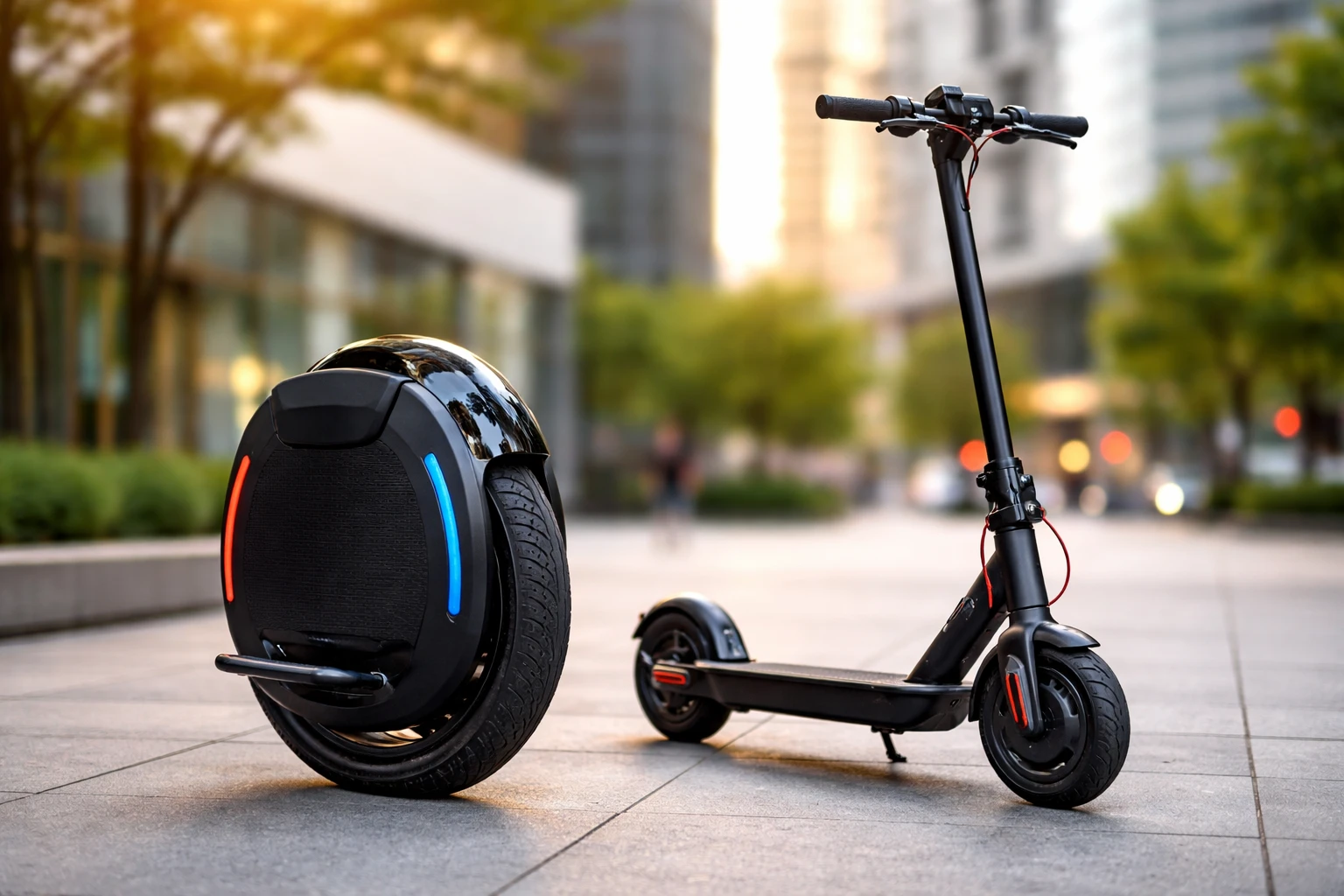
Personal electric vehicles have expanded well beyond the point where a single category dominates. Riders now have genuinely distinct options, each with different riding dynamics, learning curves, and practical trade-offs. Two categories that regularly get compared are electric scooters and electric unicycles, and the conversation is more interesting than a simple spec sheet comparison suggests.
Both attract riders who want something more engaging than a standard commute, something compact enough to carry indoors, and something that removes the frustration of parking entirely. But the experience of riding each is fundamentally different, and getting that match wrong is one of the more common mistakes first-time buyers make in the personal electric vehicle space.
The broader electric vehicle ecosystem has expanded to accommodate different rider types. Riders curious about self-balancing vehicles and what is available beyond scooters might find it worth exploring before settling. Taking the time to shop electric unicycles online alongside scooter options gives a clearer picture of just how differently these two categories approach personal electric mobility, even when they serve the same underlying commuting need.
The Learning Curve Is Real and It Matters
The single biggest differentiator between scooters and electric unicycles is how long it takes to ride them confidently. A quality electric scooter can be mastered by most adults within a few minutes. The handlebar provides stability, the deck is wide, and the steering is intuitive. Most people ride well enough within half an hour to use it practically.
An electric unicycle is a completely different proposition. Learning to balance on a single self-balancing wheel requires dedicated practice, typically measured in hours to days rather than minutes. Your first session will likely involve holding onto a wall, wobbling significantly, and probably falling more than once. This is not a criticism of the technology; it is simply the honest reality of a vehicle that asks you to develop a new physical skill set.
What Mastery of an EUC Actually Unlocks
Once a rider has put in the hours to genuinely master an electric unicycle, the experience is widely described as one of the most fluid and intuitive forms of personal transportation available. The vehicle responds to subtle shifts in body weight, accelerates and decelerates through lean rather than mechanical input, and provides a riding sensation that long-term users compare to skiing or surfing on flat ground.
High-end EUCs from brands like InMotion and King Song offer impressive top speeds and substantial range, with some flagship models capable of delivering range that rivals quality electric scooters. For experienced riders, the EUC becomes a highly capable urban and even off-road vehicle that rewards the investment in learning time significantly.
Scooters and the Everyday Practicality Advantage
Where electric scooters maintain a consistent advantage is in everyday practicality for riders who value reliability over novelty. You can hand a scooter to a friend or family member who has never ridden one and have them moving safely within minutes. You cannot do that with an EUC. That accessibility matters for shared use, for riders who are not committed to an extended learning process, and for anyone who occasionally needs someone else to move their vehicle.
Scooters also offer a more stable platform for carrying light cargo, attaching bags, or riding in conditions that require quick reaction times and emergency stops. The handlebars give you a fixed point of stability that an EUC simply does not provide, and for many riders that reliability is not something they are willing to trade.
Portability and the Commute Connection
Both categories are more portable than an e-bike, but they achieve this differently. A folding electric scooter collapses into a shape that can be carried in one hand and rolled like luggage. An electric unicycle, particularly a premium model, is a single rounded unit with a carrying handle, typically lighter than a folding scooter of equivalent performance but less intuitive to carry because of its shape.
For public transit integration, the EUC has a slight edge in terms of how it fits through narrow turnstiles and into crowded train cars. Scooters, even folded, tend to be longer and require more floor space. If your commute involves a crowded subway during peak hours, that practical dimension is worth considering seriously.
Safety Profiles and Protective Gear
Both vehicles carry risk, but the risk profiles differ. Scooter falls tend to happen at lower speeds and often involve front-wheel catching on an obstacle or losing traction on a slippery surface. EUC falls tend to involve the wheel cutting out at its operational limit, or a loss of balance during sudden direction changes at speed.
EUC riders in experienced communities consistently report wearing more protective gear than scooter riders, including wrist guards, knee pads, elbow pads, and often a full-face helmet at higher speeds. The nature of EUC falls, which often involve the rider going forward at speed, makes that investment in protective equipment genuinely important rather than optional.
Cost Comparison at Equivalent Performance Levels
Entry-level electric scooters start at a price point accessible to most riders, with capable commuter models in the mid-range. Electric unicycles tend to have a higher entry price for equivalent quality, and the premium models that experienced riders gravitate toward represent a significant investment. The cost of gear for an EUC rider also adds to the total.
When comparing total cost of ownership at equivalent performance levels, the gap is smaller than sticker prices suggest. Both categories require periodic tire replacement, battery maintenance, and occasional component service. Scooters with pneumatic tires require more frequent tire attention than solid-tire models but offer better performance in return.
Making the Choice That Fits Your Riding Identity
The honest version of this comparison is that scooters and EUCs serve different rider types. If you want something you can ride well immediately, share with others, and use purely as a transportation tool, the scooter is the more sensible choice. If you are drawn to mastering a new physical skill and want a vehicle that rewards experience with a genuinely unique riding sensation, the EUC is worth the investment in learning time.
Many riders in the personal electric vehicle community eventually own both, using a scooter for daily practicality and an EUC for the kind of riding they do for pure enjoyment. That is probably the most honest endorsement either category can receive.
FAQs
Electric scooters use handlebars and are easy to ride, while electric unicycles require balance and body control.
Electric scooters are much easier and can be learned in minutes, while EUCs may take hours or days to master.
They can be, but beginners should expect a steep learning curve and some initial falls.
Electric scooters are generally better for daily commuting due to their ease of use and stability.
High-end EUCs can match or exceed scooters in speed and range, especially for experienced riders.
EUCs are typically more compact, but scooters can be easier to carry due to their folding design.
It can be riskier, especially at higher speeds, which is why protective gear is strongly recommended.
Yes, scooters are better suited for carrying bags or light cargo due to their stable platform.
Generally, yes—especially for high-performance models, and additional gear costs should be considered.
Riders who enjoy learning new skills and want a unique riding experience may prefer an EUC.