If you’ve ever refreshed a living room, bedroom, or entryway with a new area rug, you probably know how much difference one simple piece can make. The right rug adds warmth, color, texture, and definition almost instantly. It can pull furniture together, soften an open space, and make a room feel finished without the expense or mess of a major renovation.
Then real life happens.
A few days later, the rug has shifted several inches away from the sofa. One corner keeps curling. The runner in the hallway moves every time someone walks across it. You straighten everything, only to do the exact same thing again tomorrow.
There’s another concern that’s much less obvious. Months or years later, you may lift the rug and discover an outline on your hardwood flooring from uneven sunlight exposure—or, when the wrong backing material has been used, discoloration or residue on the finish.
Both problems often come down to one overlooked detail: the rug pad underneath.
It isn’t the glamorous part of decorating. Nobody walks into your living room and compliments the rug pad.
But when you’ve invested in hardwood floors and finally found a rug that works beautifully with your space, that hidden layer can make the entire setup function better while helping protect both purchases.
Why a Rug Needs a Pad in the First Place
It’s easy to think of a rug pad as an optional accessory. In many rooms, though, it quietly solves several problems at once.
A good rug pad can help with:
- Keeping the rug from sliding. Smooth hardwood, laminate, and tile provide very little resistance for an unsecured rug.
- Protecting the floor finish. Certain solid, plasticized, adhesive, or incompatible backing materials may interact poorly with some floor finishes, while dense materials can also affect airflow beneath the rug.
- Adding comfort. A little extra cushioning can make even a relatively thin area rug feel more substantial underfoot.
- Helping the rug lie flatter. A properly sized pad can reduce shifting, bunching, and movement around the edges.
- Reducing everyday wear. The pad creates a layer between the rug and hard flooring, reducing some of the friction created by normal foot traffic.
- Making the room feel more finished. A rug that remains centered under the furniture simply looks better than one that slowly migrates across the floor.
That last point matters more than it sounds.
Area rugs often act as visual anchors. In a living room, the rug helps connect the sofa, coffee table, chairs, and other furniture into one cohesive conversation area. In a bedroom, it can soften the transition between the bed and hardwood flooring. In an entry or hallway, a runner can bring color and character into what would otherwise be a fairly utilitarian space.
When the rug constantly shifts out of place, the whole room can start to look slightly off.
The Rug Pad Is Part of the Design—even If You Never See It
When decorating, we naturally focus on everything visible.
We compare rug colors. We debate patterns. We measure furniture. We move a coffee table three inches to the left, decide we hate it, and move it back again.
The pad rarely gets the same attention.
But the pad affects how the rug actually behaves in the room.
Think of it a little like hanging curtains. Beautiful fabric matters, but so does the hardware holding everything up. A poorly installed curtain rod can make expensive drapes look awkward. In the same way, even a beautiful rug can become frustrating if it slides, wrinkles, or feels flimsy because there isn’t an appropriate layer beneath it.
For a home that needs to look good and work for everyday life, both layers matter.
Not All Rug Pads Are Created Equal
This is where things become a little more nuanced than simply buying the first pad you see in the rug aisle.
The best option depends on several factors:
| Consideration | What to Think About |
|---|---|
| Floor material | Hardwood, tile, laminate, vinyl, and carpet can have different requirements |
| Floor finish | Some flooring manufacturers restrict which backing materials can be used |
| Rug backing | A smooth flatweave behaves differently from a rug with its own gripping backing |
| Room traffic | Hallways and family rooms generally need more grip than low-traffic spaces |
| Furniture placement | A rug anchored beneath heavy furniture may require less grip |
| Desired comfort | Thicker felt adds more cushion, while thinner pads maintain a lower profile |
| Rug size and shape | Standard rectangles are easy; runners, round rugs, and vintage pieces may require custom sizing |
If You Have Hardwood Floors
Start with the care instructions or warranty information provided by your flooring manufacturer.
Hardwood finishes vary, which means a pad that works perfectly well on one floor may not necessarily be approved for another. If you know the manufacturer or installer, check their recommendations before putting any material directly against the finish.
As a general rule, be cautious with adhesive-backed products and inexpensive PVC, vinyl, foam, or rubber compounds unless they are specifically labeled as non-staining and compatible with your flooring.
Felt and natural rubber are two common materials used for a non-slip rug pad for hardwood floors. Felt provides cushioning, while natural rubber provides grip. Combination pads attempt to provide both benefits.
Compatibility still matters, though. Always make sure the material is appropriate for your particular floor finish.
And if your hardwood floors have recently been installed or refinished, don’t rush to cover them. Finishes need adequate curing time, and the appropriate wait can vary considerably depending on the product used.
Felt, Rubber, or a Combination?
Choosing a rug pad becomes much easier once you know what you actually want it to accomplish.
Felt for Extra Cushion
Dense felt is a great choice when comfort is the priority.
A quality felt rug pad can give an area rug a noticeably softer, more substantial feel. It can be especially useful beneath a large living-room or bedroom rug where much of the rug is already held in place by furniture.
Felt alone, however, usually provides less grip on smooth floors.
Natural Rubber for Grip
Natural rubber is typically chosen when keeping the rug stationary is the bigger concern.
That makes grip especially important for:
- Entryway rugs
- Kitchen runners
- Hallway runners
- Smaller rugs
- Rugs near frequently used doors
- Rugs that aren’t anchored by furniture
A thinner gripping pad can also be useful when you don’t want to significantly raise the rug’s height.
Felt and Rubber for Both
For many living spaces, a combination pad offers a practical middle ground.
You get cushioning from the felt and grip from the rubber layer. That can work particularly well under larger area rugs in living rooms, dining rooms, bedrooms, and family rooms where you want the rug to feel comfortable but don’t want it creeping out of position.
Again, check flooring compatibility before making your final choice.
Match the Pad to the Room
One pad thickness or style doesn’t necessarily make sense throughout the entire house.
Living Room
Living rooms are perfect candidates for a slightly cushioned pad, especially if your family spends a lot of time barefoot or sitting on the floor.
If the sofa and chairs already overlap the rug, the furniture will help hold everything in place. That gives you more flexibility to prioritize cushioning.
Dining Room
Dining rooms require a little more thought.
You want enough cushioning to protect the rug and make the space comfortable, but an excessively thick pad can make dining chairs harder to pull in and out.
A lower-profile option is often easier to live with.
Also make sure the entire rug-and-pad combination is large enough that dining chair legs remain on the rug when the chairs are pulled away from the table.
Bedroom
Bedrooms usually have less foot traffic, making comfort a bigger priority than maximum grip.
A cushioned pad beneath a rug that extends around the bed can make those first barefoot steps in the morning much more pleasant.
Hallway or Entryway
Here, grip becomes much more important.
Runners tend to shift because they aren’t anchored beneath large furniture. These areas also receive frequent foot traffic, so a pad that keeps the rug secure without adding unnecessary bulk is particularly useful.
Pay attention to door clearance as well. A thick rug and pad combination isn’t helpful if the nearby door can no longer open properly.
Measure the Rug, Not the Room
One surprisingly common mistake is buying a rug pad based only on the labeled rug size.
A rug sold as 8 by 10 feet may not measure exactly 8 by 10 feet. Handmade, vintage, and natural-fiber rugs in particular can vary slightly.
Measure the actual rug before ordering your pad.
Ideally, the pad should sit completely underneath the rug so its edges aren’t visible. Having it slightly smaller also helps the rug edge taper down naturally toward the floor.
If the pad sticks out, don’t panic. Many standard pads can be trimmed at home with sturdy household scissors.
Take your time. Place the pad flat, position the rug over it, check the margins on every side, and then trim gradually rather than cutting off too much at once.
What About Oddly Shaped or Vintage Rugs?
Standard rug sizes are convenient—until your favorite rug turns out to be anything but standard.
Vintage rugs are especially notorious for slightly unusual dimensions. Runners can be exceptionally long or narrow. Round, oval, and irregular-shaped rugs introduce another challenge entirely.
You have two main options:
- Buy a larger standard pad and trim it yourself.
- Order a pad cut specifically for the rug.
DIY trimming is perfectly reasonable for straightforward rectangles. For an unusual shape, expensive antique rug, or particularly long runner, custom sizing can remove some of the guesswork.
The important thing is that the pad supports the rug evenly without sticking out around its edges.
Don’t Forget About Rug Thickness
More cushioning isn’t automatically better.
A thick pad can make a large wool rug feel wonderfully luxurious, but that same thickness might be inconvenient beneath a thin kitchen runner or near a door.
Think about what surrounds the rug.
Ask yourself:
- Does a door swing over it?
- Will dining chairs need to slide across it?
- Does furniture need to sit level with pieces outside the rug?
- Is anyone in the home likely to trip over a raised edge?
- Is the rug itself already very thick?
- Do you want softness, or is keeping the rug securely in place the bigger priority?
The best pad is the one that works with the room—not simply the thickest option available.
A Rug Can Also Help Protect Hardwood From Everyday Life
One reason area rugs work so well in homes with hardwood flooring is that they let you enjoy the beauty of the wood while adding protection to selected high-use areas.
Think about the places that receive the most wear: beneath a dining table, in front of a sofa, beside a bed, along a hallway, or near an entry.
A strategically placed rug can help reduce direct contact from shoes, chair legs, toys, pet activity, and everyday foot traffic.
It’s also one of the easiest ways to refresh a room without permanently changing anything.
Want a warmer room for fall? Bring in a deeper-toned rug.
Want the room to feel lighter in spring? Try a pale natural fiber or softly patterned design.
Want a little more personality without painting the walls? A patterned rug can introduce color without committing to an entire renovation.
That flexibility is exactly why rugs are such useful decorating tools.
Protecting the flooring underneath them just makes sense.
Watch Out for Uneven Sun Exposure
Even when the pad itself is perfectly compatible with your flooring, there’s another issue worth remembering: sunlight.
Hardwood can change color with UV exposure over time. The wood beneath a rug receives less exposure than the uncovered portions of the floor, so when you eventually move the rug, you may notice a difference in color.
That doesn’t necessarily mean the rug or rug pad damaged the flooring.
To reduce dramatic differences, consider periodically adjusting furniture and rugs when practical. Window treatments can also help manage strong direct sunlight in especially bright rooms.
This is particularly worth considering in spaces with large windows or sliding glass doors.
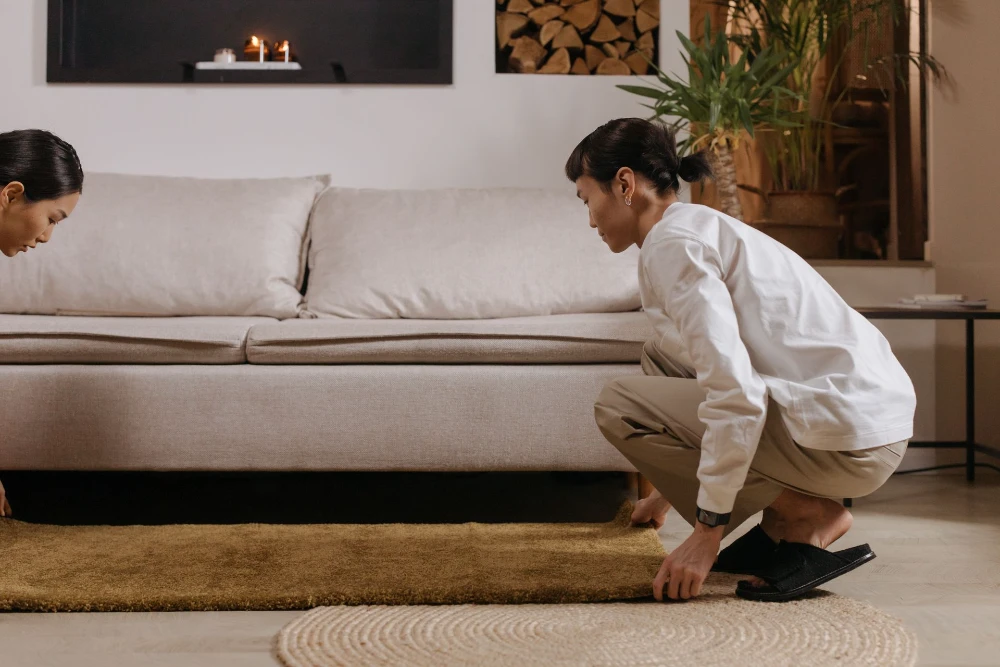
How to Install a Rug and Pad Without Losing Your Mind
Large rugs can be surprisingly awkward to position, especially once furniture is involved.
A simple approach works best:
- Clean the flooring first. Dirt or grit trapped underneath the pad can work against your efforts to protect the floor.
- Let the floor dry completely. Never trap cleaning moisture underneath a rug or pad.
- Lay the pad flat. Smooth out folds or wrinkles.
- Center it in the planned rug location.
- Place the rug over the pad.
- Check every edge. The pad should stay hidden beneath the rug.
- Trim if necessary.
- Position your furniture only after the rug is lying correctly.
For a large rug, an extra set of hands makes the job much easier.
Rather than dragging heavy furniture across the floor, lift pieces whenever possible or use appropriate furniture-moving tools.
My Quick Rug Pad Checklist
Before ordering, run through these questions.
1. What type of flooring do I have?
Check your flooring manufacturer’s care recommendations first. Avoid adhesive-backed pads and PVC, vinyl, foam, or rubber products that aren’t specifically identified as compatible and non-staining for your floor.
2. What kind of backing does my rug have?
A rug that already has substantial grip may need less help from the pad. A flatwoven or unbacked rug typically needs more.
3. Is this a high-traffic room?
A hallway runner needs to stay firmly in place. A large bedroom rug beneath a heavy bed has different requirements.
4. Do I want grip, cushioning, or both?
Decide this before shopping. It immediately narrows down your options.
5. How thick can the pad be?
Check doors, furniture, chair movement, and the existing thickness of the rug.
6. What size is my actual rug?
Measure it rather than relying exclusively on the size printed on the label.
7. Is the flooring finish fully cured?
If the floor is new or has recently been refinished, follow the manufacturer’s or refinisher’s instructions before covering it.
Common Rug Pad Mistakes to Avoid
A few small mistakes can turn an otherwise simple project into a frustrating one.
| Mistake | Better Approach |
|---|---|
| Buying a pad based solely on price | Check material and floor compatibility first |
| Using adhesive-backed products on hardwood without approval | Follow the flooring manufacturer’s recommendations |
| Choosing the thickest pad available | Match thickness to doors, furniture, and room use |
| Letting the pad extend past the rug | Trim it slightly smaller than the rug |
| Putting a pad over a damp floor | Let the flooring dry completely first |
| Ignoring the actual rug dimensions | Measure before ordering |
| Assuming every rubber product is identical | Look for materials specifically intended for your floor type |
| Forgetting to clean under the rug | Periodically lift rugs and remove trapped dust and grit |
Worth Looking At: Custom-Cut Pads
For anything that isn’t a standard rug size—which, to be fair, includes plenty of the most interesting vintage rugs and runners—custom sizing can make the process easier.
Dalton Rug Pad offers felt and natural-rubber pads cut to specified rug dimensions rather than requiring homeowners to trim a standard size themselves. According to the company’s product information, its hardwood-floor options are made without PVC or added adhesives.
That may be worth considering if your rug has unusual dimensions, you’d rather skip the trimming process, or you simply want the pad sized for the rug from the beginning.
A Small Detail That Makes a Big Difference
Some home upgrades are made to get attention.
A new light fixture becomes the focal point. Fresh paint transforms a room. New curtains make the windows look taller. A beautiful area rug can change the entire color story of a space.
A rug pad does none of that.
You won’t see it once the room is finished.
But that’s exactly the point.
The right pad quietly helps your rug stay where you positioned it, makes the floor more comfortable underfoot, and creates a protective layer between two pieces of your home that you probably spent a lot more money on: the rug and the hardwood beneath it.
And really, that’s the kind of home-improvement detail I love most—the one nobody notices because it simply works.
Choose the right material, make sure it’s compatible with your flooring, size it properly, and then forget about it.
Your rug can finally stay where you put it.
And you can stop straightening it every other day.