There’s a trick I learned after years of fussing over paint chips, accent walls, rug sizes, and coffee table styling.
The fastest way to make a room feel done is almost never the wall.
It’s the throw blanket tossed over the arm of the sofa.
I know how that sounds. Too simple. Too small. Almost too obvious. For the longest time, I treated blankets as an afterthought. I bought whatever was on sale, folded it into a basket, and forgot about it until someone got cold during a movie.
Then a stylist friend visited and rearranged my living room in about ten minutes.
She didn’t move the furniture. She didn’t suggest a new paint color. She didn’t ask me to replace the rug, swap the lamps, or buy a different sofa.
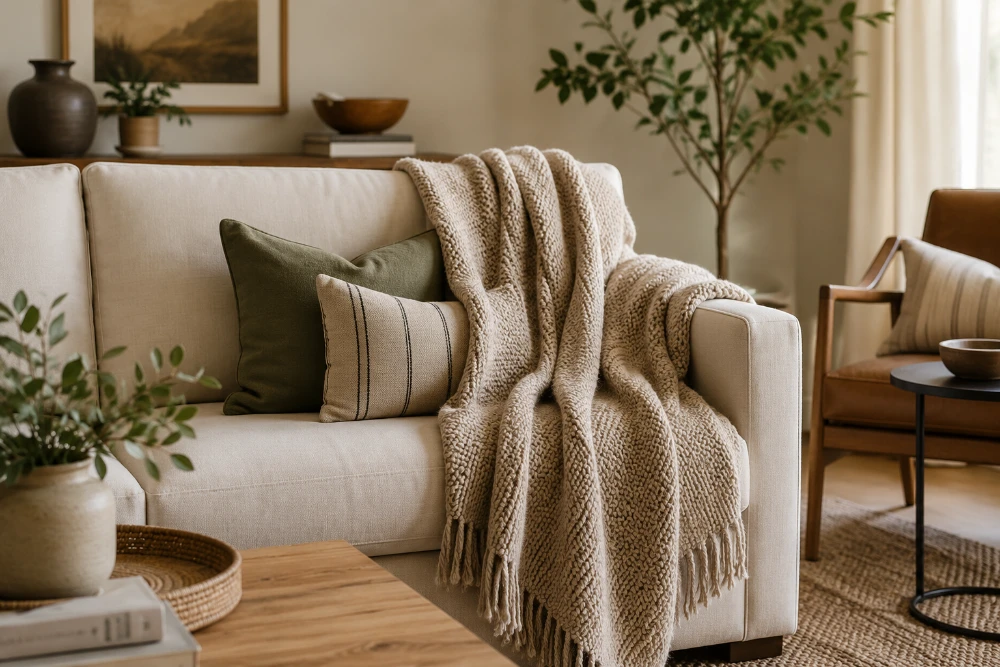
She simply took away my thin polyester throw and replaced it with a heavy, chunky-knit blanket in a warm oatmeal color. Then she draped it over the sofa arm with just enough looseness to feel relaxed.
Suddenly, the whole room had weight.
It had intention.
It looked finished.
That was the moment I realized something important about decorating. Most rooms do not feel unfinished because they are missing expensive furniture. They feel unfinished because they are missing texture, warmth, and softness.
A throw blanket adds all three.
Why One Throw Blanket Can Change an Entire Room
A room can have good furniture and still feel flat.
That happens more often than people think. You can have a clean-lined sofa, a decent rug, attractive lighting, and a nice coffee table, but something still feels off. The room might look empty, even when it is fully furnished. It might feel cold, even when the colors are right.
That missing piece is usually texture.
Texture gives the eye somewhere to land. It breaks up smooth surfaces. It softens hard lines. It makes a space feel less like a showroom and more like a home.
A flat sofa reads as unfinished no matter how nice the frame is. Drape something tactile over it, and suddenly the sofa feels layered, useful, and inviting.
That is the quiet power of a throw blanket.
It does not shout. It does not dominate the room. It simply pulls everything together.
The Throw Blanket Is the Easiest Finishing Layer
Interior design often gets treated like a major project. Paint the walls. Replace the flooring. Buy new furniture. Install new lighting. Add built-ins. Order custom curtains.
Those things matter, of course.
However, not every room needs a full makeover. Sometimes it needs one finishing layer.
A throw blanket is one of the easiest finishing layers because it works instantly. You do not need tools. You do not need measurements. You do not need to wait for shipping if you already own one.
You can style it in sixty seconds.
And nine times out of ten, the room will look more pulled-together than it did before.
That is why this small detail is so useful for homeowners, renters, stylists, and even small home-decor shops. A well-chosen throw blanket can shift the entire mood of a room without changing the room itself.
What Makes a Room Look “Finished”?
A finished room does not mean perfect.
Actually, perfect rooms often feel stiff. They look like nobody lives there. Every pillow is chopped. Every surface is polished. Every object feels placed but not loved.
A finished room feels complete, but still relaxed.
It has balance. It has warmth. It has a few layers that make it feel personal. Most importantly, it feels like someone thought about how the space would be used, not just how it would photograph.
A throw blanket helps create that feeling because it suggests comfort. It says someone sits here. Someone reads here. Someone watches movies here. Someone might pull this blanket over their legs at the end of the day.
That matters.
Rooms need function and feeling. A throw blanket delivers both.
Why Texture Matters More Than People Think
Texture is one of the most overlooked parts of decorating.
People usually start with color. They worry about whether the walls should be white, beige, sage, navy, or greige. Then they think about furniture. Then maybe art.
Texture often comes last.
But texture is what keeps a room from feeling one-dimensional.
A room filled with smooth surfaces can feel cold. Think of a leather sofa, a glass coffee table, painted walls, metal lamp bases, and flat printed pillows. Nothing is technically wrong. Still, the room may feel unfinished because every surface has the same visual energy.
Now add a chunky knit throw.
The space changes immediately.
The blanket creates contrast. It gives the room softness. It makes the sofa feel deeper and more inviting. It adds shadow, movement, and dimension.
That is why texture matters.
It is not just about how something feels in your hand. It is about how the whole room feels when you walk into it.
The Best Throw Blankets Have Visual Weight
One thing I have picked up over time is that weight matters more than price.
A cheap blanket that holds its fold often looks more expensive than a flimsy one that slides off the cushion. You do not need to spend a fortune. You just need a throw that has enough body to stay where you place it.
Flimsy blankets tend to collapse. They wrinkle in a messy way. They slide off the sofa arm. They can make the room look more cluttered instead of more styled.
A heavier throw behaves differently. It drapes. It folds. It pools slightly. It holds shape.
That makes it look intentional.
Good Throw Blanket Materials to Consider
| Material | Why It Works | Best For |
| Cotton | Breathable, washable, casual, and easy to style | Everyday living rooms and family spaces |
| Wool | Warm, textured, classic, and naturally substantial | Cozy rooms, reading corners, and colder climates |
| Dense knit | Adds instant texture and visual weight | Sofas, accent chairs, and bedroom benches |
| Linen blend | Relaxed, airy, and slightly rumpled | Light, coastal, or casual interiors |
| Fleece | Soft and affordable, but can look casual | Kids’ rooms, media rooms, and comfort-first spaces |
In general, I would choose cotton, wool, or a dense knit over slippery synthetics.
That does not mean every synthetic throw is bad. Some are soft and practical. However, shiny or overly thin synthetic blankets often look less polished because they do not hold a fold well.
For styling, structure matters.
Color Should Echo, Not Match
Another important lesson: color should echo, not match.
This is where many people go wrong. They buy a gray throw for a gray sofa, a beige throw for a beige chair, or a navy throw for a navy bed.
Matching seems safe.
But matching can make a room look flat.
It can also make the space feel like a furniture-store display, where everything came in one coordinated package. That is rarely the goal. A collected room feels more personal because the pieces relate to each other without being identical.
Instead of matching the couch exactly, pull a tone that already appears somewhere small in the room.
Look at the book spines on your shelf. Notice the color in a vase. Study the grain in your wood coffee table. Check the artwork, the rug, the lamp shade, or even the stitching on a pillow.
Then choose a throw blanket that echoes one of those tones.
That tiny connection makes the room feel thoughtful.
Not forced.
Throw Blanket Color Ideas
| Room Detail | Throw Color to Consider |
| Warm wood coffee table | Oatmeal, camel, rust, warm beige |
| Blue artwork | Soft navy, slate blue, denim, pale blue-gray |
| Black picture frames | Charcoal, ivory with black stitching, deep gray |
| Green plant-heavy room | Olive, moss, cream, warm white |
| Brass lighting | Honey, tan, muted gold, warm ivory |
| Neutral sofa | Textured cream, taupe, clay, soft brown |
The goal is not to create a perfect match. The goal is to create a quiet conversation between the throw and the rest of the room.
That is what makes the space look collected.
One Real Throw Beats Three Decorative Ones
I would rather have a single beautiful throw that I actually pull over my legs than a stack of stiff “for show” blankets nobody touches.
This is true for almost every room.
Too many decorative throws can start to feel fussy. They may look nice in a photo, but they often get moved, folded, shoved aside, or dropped on the floor. If a blanket cannot be used comfortably, it has limited value.
The best throw blankets are both beautiful and useful.
They look good on the sofa, but they also work on a chilly night. They add texture, but they do not feel precious. They can be styled, but they are not too delicate to touch.
That balance is important.
A home should support real life. The throw blanket should not make people nervous.
How to Style a Throw Blanket on a Sofa
Styling a throw blanket does not need to be complicated.
In fact, the more you fuss with it, the less natural it may look. A little slouch reads as lived-in. Too much perfection can feel stiff.
Here is the simplest method.
Take whatever blanket you have. Fold it loosely in thirds lengthwise. Then drape it diagonally over one arm of the sofa so one corner pools onto the seat.
Do not smooth it completely flat.
Let it relax.
Then step back.
The goal is not symmetry. The goal is softness, movement, and intention.
Easy Sofa Throw Styling Methods
| Styling Method | How to Do It | Best For |
| Diagonal arm drape | Fold loosely and drape over one sofa arm | Casual, lived-in rooms |
| Back cushion fold | Fold into a long rectangle and place over the sofa back | Clean, modern spaces |
| Seat corner pool | Let one end fall naturally onto the seat | Cozy, relaxed styling |
| Basket nearby | Roll or fold the throw in a woven basket | Family rooms and media rooms |
| Over chaise end | Drape across the end of a sectional chaise | Large sofas and open layouts |
The diagonal arm drape is the one I reach for most often because it feels effortless. It also breaks up the large block of a sofa, especially if the sofa is solid-colored.
How to Style a Throw Blanket on a Chair
Accent chairs can look bare without a throw.
This is especially true for leather chairs, wood-framed chairs, or simple upholstered chairs without much detail. A throw adds softness and can help connect the chair to the rest of the room.
For a chair, use a smaller throw or fold a larger one more tightly.
Drape it over the back if the chair has clean lines. For a more relaxed look, place it over one arm and let the end fall toward the seat.
If the chair is already patterned, choose a simple throw. If the chair is plain, choose something with more texture.
That contrast keeps the room balanced.
How to Style a Throw Blanket on a Bed
Throw blankets are not just for sofas.
On a bed, a throw can make the entire bedroom feel more finished. It creates a visual endpoint and adds softness at the foot of the bed.
This is especially helpful if your bedding is simple.
A white duvet, two pillows, and plain sheets can look clean but unfinished. Add a textured throw across the bottom third of the bed, and suddenly the bed looks layered.
For a polished look, fold the throw neatly across the foot of the bed. For a more relaxed look, spread it loosely so it looks slightly undone.
Both can work.
The right choice depends on the room.
Throw Blankets for Small Spaces
Small spaces need texture even more than large ones.
When a room is small, every detail matters. A throw blanket can add style without taking up floor space, which makes it especially useful for apartments, studios, reading nooks, and compact living rooms.
Choose a throw that adds warmth without overwhelming the furniture. Avoid anything too bulky if the sofa is small. Instead, look for a medium-weight cotton, waffle weave, or soft knit.
In a small space, the throw can also help define the room’s color palette.
For example, if your apartment has white walls, a beige sofa, and a wood coffee table, a warm clay or olive throw can add just enough color to make the room feel designed.
Throw Blankets for Neutral Rooms
Neutral rooms can be beautiful.
They can also become bland if everything is the same tone and texture.
A throw blanket helps prevent that.
In a neutral room, focus less on bold color and more on texture. Think chunky knits, ribbed cotton, soft wool, fringe, waffle weave, or subtle pattern.
You can stay within the same color family while still creating depth.
For example, a cream sofa with a cream throw may sound boring. But if the sofa is smooth linen and the throw is a thick cable knit, the combination can look rich and layered.
The difference is texture.
Throw Blankets for Colorful Rooms
If your room already has a lot of color, a throw blanket can either calm things down or tie everything together.
For a colorful space, avoid adding a totally unrelated shade unless you want the blanket to become the focal point. Instead, choose a color that already exists somewhere in the room.
Again, echo. Do not match too perfectly.
If your rug has small touches of rust, try a rust-colored throw. If your artwork includes muted blue, try a soft blue-gray blanket. If your pillows have green details, try olive or moss.
This approach makes the room feel layered rather than busy.
The Boutique Decor Lesson: Custom Texture and Palette
If you run a small home-decor shop, or you are a stylist building a signature look, this is also where custom comes in.
A lot of boutique brands do not buy off the rack at all. They have their throws made to spec, choosing their own weave, weight, and color story.
That used to sound like something only large retailers could do. However, custom blanket manufacturing has become more accessible for smaller orders, not just major brands.
That opens up interesting possibilities.
A shop can create a throw that matches its design point of view. A stylist can build a recognizable palette. A small brand can offer something customers cannot find in every big-box store.
Owning the texture and palette is a quiet way to make a space, or even a product line, feel unmistakably yours.
Why Custom Throws Can Work for Small Brands
| Custom Choice | Why It Matters |
| Weave | Controls the texture and overall feel |
| Weight | Affects drape, warmth, and perceived quality |
| Color palette | Helps create a recognizable brand look |
| Size | Allows better styling for sofas, beds, or chairs |
| Material | Supports comfort, durability, and price point |
For everyone else decorating at home, you do not need custom anything.
You need one good throw, placed with a little intention.
That is enough.
How to Choose the Right Throw Blanket
Choosing the right throw blanket is not about finding the most expensive one. It is about finding the one that works for your room and your life.
Start with how you want the room to feel.
Do you want cozy? Choose a chunky knit or wool blend.
Do you want casual? Choose cotton, waffle weave, or linen.
Do you want polished? Choose a dense, structured throw with clean edges.
Do you want soft and family-friendly? Choose something washable and durable.
Then look at the room’s existing colors. Pull a tone from something already present. Remember, the throw should connect to the space without disappearing into it.
Finally, check the weight.
Pick up the blanket if you can. Does it feel substantial? Does it fold nicely? Does it hold shape? Or does it slip, cling, or collapse?
The answers matter.
Common Throw Blanket Mistakes
A throw blanket is simple, but a few mistakes can make it less effective.
The first mistake is choosing a blanket that is too small. Tiny throws can look awkward on a full-size sofa or bed. They may feel more like a scarf than a layer.
The second mistake is choosing a fabric that is too shiny or slippery. These throws often slide off furniture and rarely look relaxed.
The third mistake is over-styling. A throw blanket should not look like it took twenty minutes to arrange. It should look natural.
The fourth mistake is matching everything too closely. Matching the throw to the sofa, pillows, and rug can make the room feel flat.
The fifth mistake is using too many throws at once. One strong throw usually works better than several weak ones.
Quick Throw Blanket Buying Checklist
Before buying a new throw, ask yourself these questions:
- Does it have enough weight to hold a fold?
- Does the color echo something already in the room?
- Is the material comfortable enough to actually use?
- Is it easy enough to clean for your lifestyle?
- Does the texture add something the room is missing?
- Is the size right for the sofa, chair, or bed?
- Does it look relaxed instead of stiff?
- Would you still like it next season?
If the answer is yes to most of these, it is probably a good choice.
The 60-Second Throw Blanket Test
Try this tonight.
Take whatever blanket you already have. Fold it loosely in thirds lengthwise. Drape it diagonally over one arm of the sofa so a corner pools onto the seat.
Do not smooth it flat.
Let it slouch a little.
Then step back and look at the room.
Notice what changed.
The sofa may look softer. The room may feel warmer. The seating area may look more complete. The blanket may also help connect colors that previously felt scattered.
That is the power of one small layer.
It does not require a shopping trip. It does not require a design degree. It does not require a weekend project.
It requires attention.
Why This Is the Cheapest Design Upgrade I Know
Some design upgrades are expensive. New sofas, area rugs, lighting, window treatments, and artwork can quickly add up.
A throw blanket is different.
It can be affordable, useful, and transformative at the same time. It is one of the few decor pieces that can change how a room looks and how it feels.
That is why it is the cheapest design upgrade I know.
It adds comfort. It adds texture. It adds color. It adds movement. It makes the room feel lived-in without making it feel messy.
Most importantly, it gives the space a sense of completion.
Final Thoughts: Start With the Layer You Can Touch
After years of overthinking paint chips and accent walls, I still love a good wall color. I still believe furniture matters. I still think lighting can make or break a room.
But when a room feels almost right and not quite finished, I look for the missing layer first.
Usually, it is texture.
And often, the easiest answer is a throw blanket.
Not three decorative blankets stacked in a basket. Not a stiff piece nobody uses. Not a perfectly matched throw that disappears into the sofa.
One good throw.
Something with weight. Something with texture. Something that echoes the room instead of copying it. Something you would actually use.
Place it with a little intention, then let it relax.
That is the trick.
Sometimes the smallest layer is the one that makes the whole room feel done.