This post contains affiliate links. As an Amazon Associate, I earn from qualifying purchases, at no extra cost to you. See our disclosure policy.
If you have ever struggled to find the right window treatment for a bathroom, bedroom, or any room where you need both natural light and privacy, you already know the problem. Blinds get dusty. Curtains block the view. Frosted glass gives you privacy but kills the light permanently. None of these solutions feel quite right.
Smart film is changing that. It is a thin adhesive film that applies directly to any existing glass surface and switches between clear and frosted with the press of a button. No more choosing between light and privacy. You get both — on demand.
More and more homeowners are ditching traditional window treatments entirely and switching to smart film. Here is everything you need to know about how it works, where it makes the most sense, and what it costs.
What Is Smart Film And How Does It Work?
Smart film uses PDLC technology — Polymer Dispersed Liquid Crystal. The film contains millions of tiny liquid crystals suspended between two thin layers. When electrical current runs through the film, the crystals line up and the glass becomes completely clear. Cut the power and the crystals scatter randomly, turning the surface into a frosted, opaque white.
The switch happens in under a second. There is no motor, no mechanism, and no moving parts. Just glass that changes state instantly when you flip a switch, press a button on your phone, or trigger it automatically on a timer.
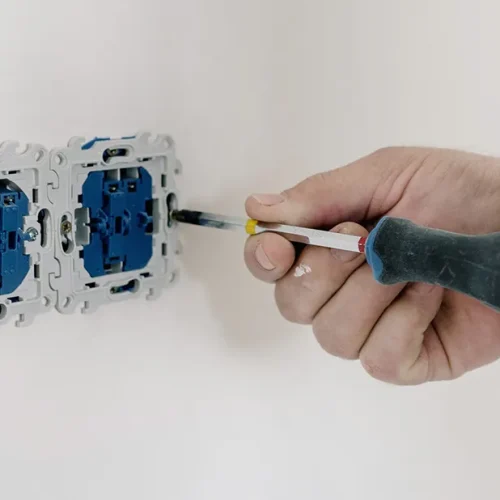
The film itself is self-adhesive and applies directly to your existing glass — similar to a window tint but with an electrical connection. A thin wire runs along the edge of the glass to a small transformer that plugs into a standard outlet or connects to your home wiring.
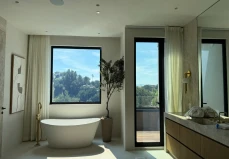
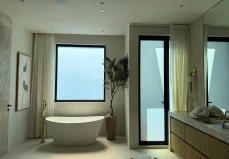
Residential bathroom — smart film off/clear (left) and smart film on/frosted (right), Los Angeles
Where Smart Film Works Best In A Home
Smart film works on any flat glass surface, but some rooms benefit more than others. Here are the most popular applications homeowners are choosing:
Bathrooms. This is the most common installation. Bathroom windows are notoriously difficult to treat — you want light, but you need privacy. Smart film solves both without curtains that collect moisture or blinds that warp over time. Shower enclosures and glass bathroom doors are also popular, letting you open up the space visually without sacrificing privacy when you need it.
Bedroom windows and glass doors. Smart film on bedroom windows or glass French doors gives you full blackout-style privacy at night and a clear open view during the day. Many
homeowners connect it to a smart home system so it frosts automatically at sunset.
Front doors and sidelights. Glass front doors look beautiful but can feel exposed. Smart film lets you keep the light flowing into your entryway while going fully private whenever you want. No more feeling like you are on display every time someone walks past.
Home offices. If your home office has a glass wall, partition, or interior window, smart film gives you an instant privacy screen for video calls without putting up a physical divider that makes the space feel closed off.
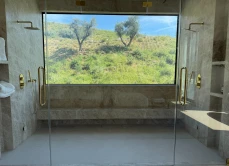
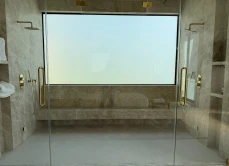
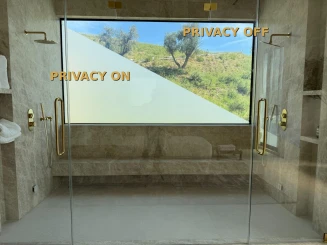
Shower enclosure smart film — clear (left) and frosted/private (right), Los Angeles
Smart Film Vs Traditional Window Treatments: A Real Comparison
It is worth comparing smart film directly against the alternatives so you can make an informed decision for your home.
Blinds and shades. These are the most common choice because they are cheap upfront. But they collect dust, require regular cleaning, break over time, and block light even when open. In bathrooms, moisture warps them. They also do nothing for the aesthetic of a modern, clean space.
Curtains and drapes. Better for bedrooms, but they take up visual space, require washing, and need a rod and hardware that may not suit every window. In smaller rooms, heavy curtains can make the space feel smaller.
Frosted or etched glass. This gives you permanent privacy but no flexibility. Once your glass is frosted, it is frosted forever. You lose the view and the light every single day, not just when
you need privacy.
Smart film. No ongoing maintenance, no replacement parts, no dusting, and no compromise between light and privacy. It adds a sleek, modern look that no curtain or blind can match. For bathrooms and glass doors especially, it is often the cleanest solution available.
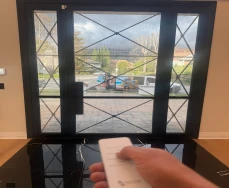
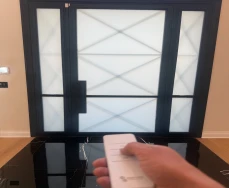
Residential front door — smart film off/clear (left) and smart film on/frosted (right), Los Angeles
Control Options: How You Operate Smart Film
One of the best things about smart film is how flexible the control options are. You are not locked into one way of operating it. Common options include:
Wall switch. The simplest setup. A standard toggle or rocker switch wired into the wall, just like a light switch. Flip it on and the glass clears. Flip it off and it frosts.
Remote control. A handheld remote that works from anywhere in the room. Good for bedrooms where you want to control the glass from bed.
Smartphone app. Connect the film to a Wi-Fi controller and operate it from your phone. You can also set schedules — frost automatically at 9pm, clear at 7am.
Smart home integration. Smart film can connect to Alexa, Google Home, or Apple HomeKit so you can control it by voice or include it in home automation routines alongside your lights and thermostat.
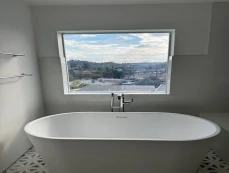
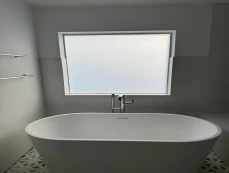
Bathroom window smart film — clear (left) and frosted/private (right), Eagle Rock, Los Angeles
Is Smart Film Right For Your Home?
Smart film is the right choice if you have existing glass you want to keep, you want privacy without permanently losing light or the view, and you want a clean modern look with no hardware on the glass surface.
It is particularly well suited to bathrooms, glass front doors, bedroom windows, and any interior glass where you currently use a blind or curtain out of necessity rather than preference.
If you are building new or replacing glass anyway, built-in smart glass is worth considering — it is more seamless and has no visible film edges. But for the majority of retrofit situations, smart film delivers the same result without replacing your existing glass.
The bottom line: if you have ever wished your windows could do more than just sit there, smart film is probably the upgrade you have been looking for.
FAQs
Smart film is a thin adhesive layer applied to glass that can switch between clear and frosted using electricity.
It uses PDLC (Polymer Dispersed Liquid Crystal) technology, where crystals align to become clear when powered and scatter to become opaque when off.
Yes, it is designed to be applied directly to existing glass surfaces without replacing them.
It is popular in bathrooms, bedrooms, front doors, offices, and glass partitions.
No, it allows light to pass through even when frosted, unlike curtains or blinds.
You can control it using a wall switch, remote, smartphone app, or smart home system.
No, it requires minimal maintenance since there are no moving parts or fabric to clean.
Yes, because it offers adjustable privacy, while frosted glass is permanently opaque.
No, it uses a small amount of power only when in the transparent (on) state.
Yes, it provides a sleek, minimal look and eliminates the need for traditional window treatments.
Learn More & Follow Smart View
Website: www.smartviewsmartglass.com
Projects: smartviewsmartglass.com/projects
Instagram: @lasmartview
Leo is the founder of Smart View Smart Glass & Film Solutions, a Los Angeles-based company specializing in PDLC smart glass and smart film installations for residential and commercial clients.