Los Angeles might be the hardest city in America to give one-size-fits-all decorating advice. A single block can hold a 1920s Spanish Revival, a Craftsman bungalow, a mid-century post-and-beam, and a glass-walled modern build, and the window treatment that flatters one can fight the architecture of the next. That’s why the blinds Los Angeles homeowners end up happiest with are usually chosen the same way a good outfit is: to suit the frame they’re on. Here’s a style-by-style guide.
Spanish Revival and Mediterranean
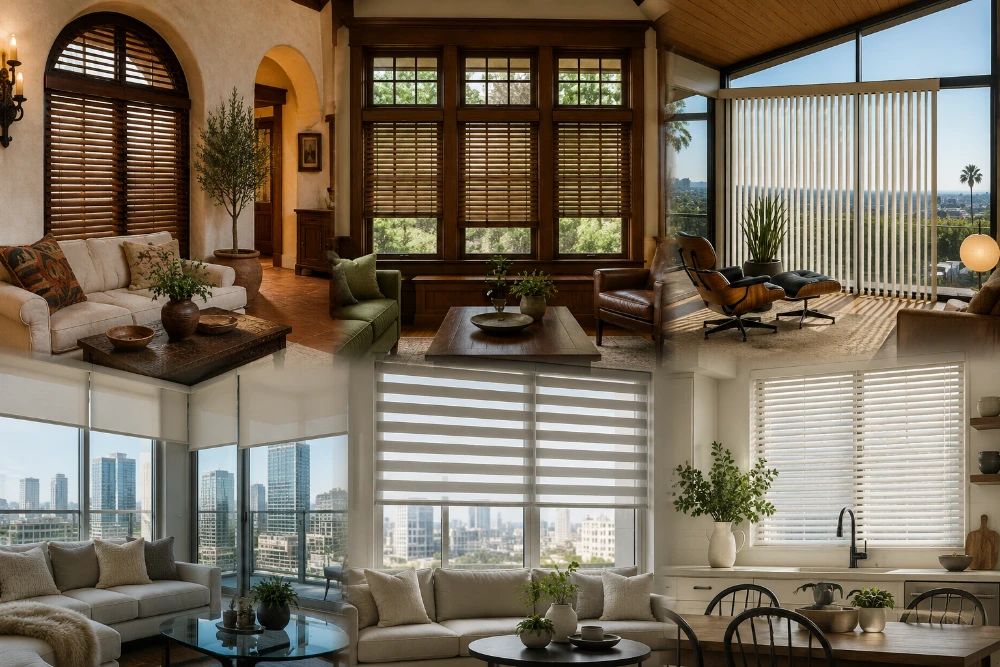
Those arched windows, wrought iron details, and warm plaster walls call for treatments with natural warmth. Real wood blinds in medium to dark stains are the classic match, echoing exposed beams and terracotta tones. Where arches make blinds tricky, woven wood shades bring the same organic character with more forgiving shapes. Skip anything glossy or stark white; these homes want texture.
Craftsman Bungalows
Craftsman homes are all about honest woodwork, so the safest move is harmony: wood blinds stained to complement (not necessarily match) the original trim. A two-inch slat suits the substantial window casings these houses typically have. If the room already carries plenty of wood, a linen-toned roman shade softens things without competing.
Mid-Century Modern
Clean lines demand clean treatments. Vertical blinds, long dismissed as dated, have quietly returned as the correct answer for the floor-to-ceiling glass and sliding doors these homes feature, with modern fabric vanes replacing the clattering plastic of memory. For standard windows, slim-profile blinds or simple roller shades preserve the architecture’s geometry. The rule here is restraint: the window wall is the star.
Contemporary Builds and Downtown Lofts
Big glass, city views, and harsh western sun define this category. Solar shades handle daytime glare while keeping the skyline visible, and zebra shades, with their alternating sheer and solid bands, offer adjustable privacy that suits open-plan spaces. In lofts with industrial bones, faux wood blinds stand up to the temperature swings of all that glass and concrete. Motorization earns its cost here, since these windows are often enormous, high, or behind furniture.
The Classic LA Ranch
The postwar ranch, LA’s most common house, is also its most flexible. Faux wood blinds are the workhorse choice: they read traditional or modern depending on color, shrug off kitchen and bathroom humidity, and cost less than hardwood. Layer drapery panels over them in living areas when the room needs softening.
Three LA-Specific Rules That Apply Everywhere
Whatever the architecture, this city’s conditions impose a few constants. First, UV protection is non-negotiable; the Southern California sun fades floors and furniture year-round, not just in summer. Second, think about heat: cellular shades on west-facing windows noticeably cut cooling costs during heat waves. Third, in a region of tight lots and close neighbors, layered treatments that separate light control from privacy control (a sheer plus a blind, for instance) solve the problem elegantly.
Getting the Match Right
Style-matching is easier with the fabrics and finishes in front of you, in your home’s actual light, which shifts dramatically between a shaded canyon house and a tenth-floor loft. Companies offering free in-home design consultations bring the samples to your rooms and handle measuring and installation, which matters in older LA homes where decades of settling mean few windows are perfectly square.
Get the pairing right and blinds stop being a utility purchase. They become the detail that makes the architecture look intentional, which in a city this stylistically crowded is the highest compliment a house can receive.