Smart design choices can turn a tight backyard into something functional and good-looking, without it feeling like a shoebox.
There’s a stubborn myth in residential landscaping that you need a big property to create a real outdoor space. It isn’t true. Some of the best yards I’ve worked around sit on lots most people would call “tiny” by suburban standards. The difference isn’t square footage. It’s design intention.
Urban homeowners across Montreal, Toronto, Vancouver, and plenty of other Canadian cities deal with the same thing: small lots, narrow side yards, backyards wedged between neighbours on both sides. The temptation is to accept the space as-is, throw down some sod and a few potted plants, and move on. But with actual planning, even a small yard can become a legitimate outdoor room.
Here’s how to think about small-yard design, and the specific strategies that make compact spaces feel bigger and more useful than they have any right to be.
Think In Zones, Not Open Space
The biggest mistake homeowners make with small yards is trying to keep everything as one open area. This actually makes a small space feel smaller. Your eye takes in the whole yard at once, registers the dimensions, and loses interest. There’s nothing to discover.
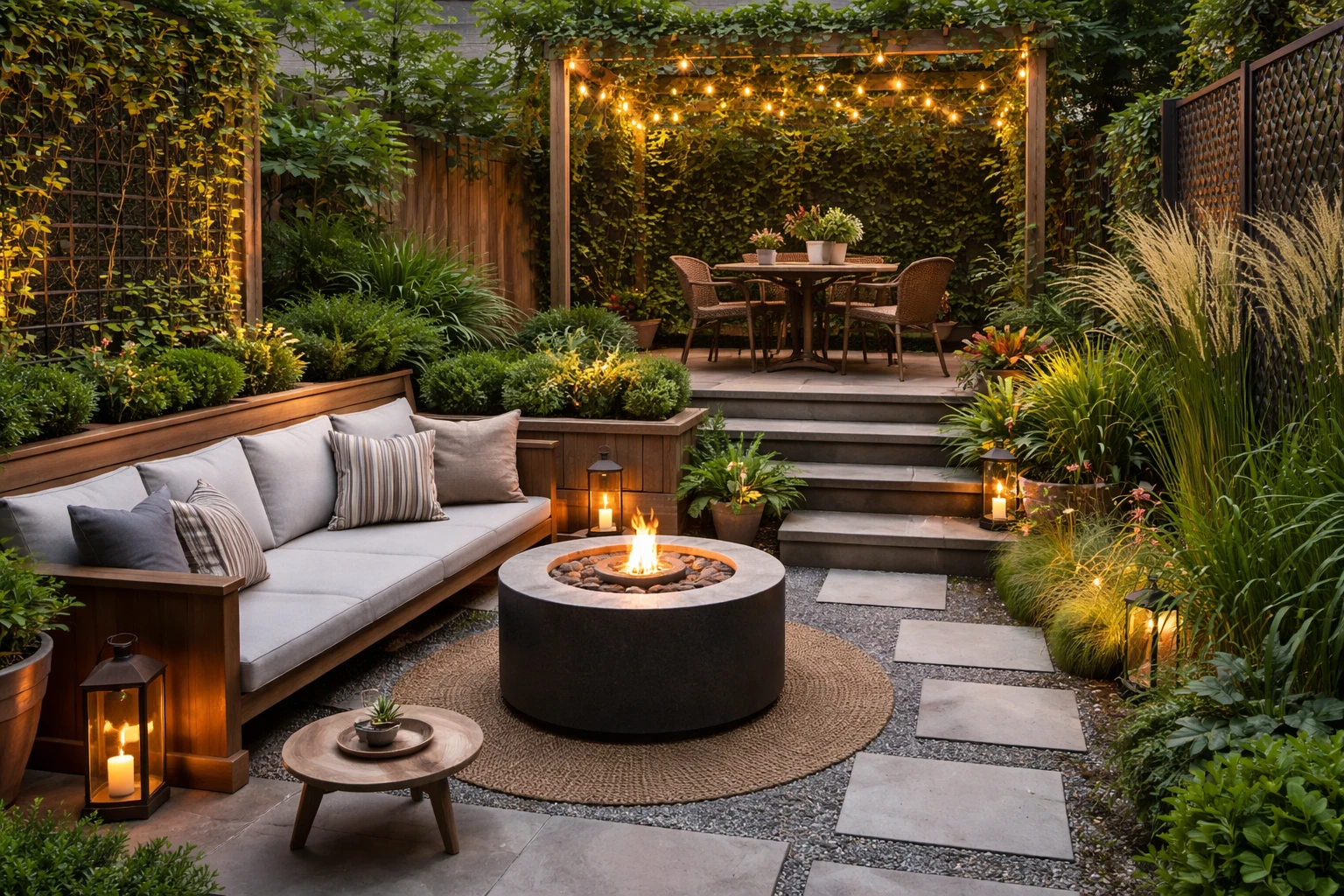
Instead, divide your yard into distinct zones. Even a yard as small as 15 by 20 feet can handle two or three functional areas:
- A dining or entertaining zone with a small patio, bistro table, or built-in seating.
- A green zone with a planting bed, container garden, or a strip of lawn.
- A transition zone with a short pathway or stepping stones connecting the other areas.
This creates the feeling of moving through a larger space. Each zone has its own purpose, and the transitions between them add visual depth that a flat open rectangle just can’t match.
Go Vertical
When ground space is limited, the walls and fences around your yard become prime real estate. Vertical gardening isn’t a passing trend. It’s a practical way to double or triple your planting area without losing a single square foot of ground.
A few options worth considering:
- Trellises and climbing plants. A cedar trellis with clematis, climbing hydrangea, or Virginia creeper adds height, colour, and privacy all at once.
- Wall-mounted planters. Modular systems that attach directly to fences or exterior walls, creating living walls of herbs or flowers.
- Tiered plant stands. One stand in a corner can hold six to eight pots in the footprint of a single planter.
- Hanging baskets. Suspended from pergola beams or fence posts, they put greenery at eye level and above.
The idea is straightforward: draw the eye upward to create a sense of height that counteracts the limited footprint.
Make Every Element Earn Its Spot
In a small yard, nothing gets a free pass. Everything should serve more than one purpose if possible.
- Retaining walls as seating. If your yard has any grade change, a low retaining wall (45 to 60 centimetres high) can double as bench seating. Cap it with smooth stone or composite for comfort, and you’ve just eliminated the need for separate patio chairs.
- Storage benches. Outdoor benches with built-in compartments hold cushions, tools, or kids’ toys. Seating and organization in one piece of furniture.
- Raised planters as dividers. A raised bed placed in the right spot can divide your yard into zones while also growing your herbs and tomatoes.
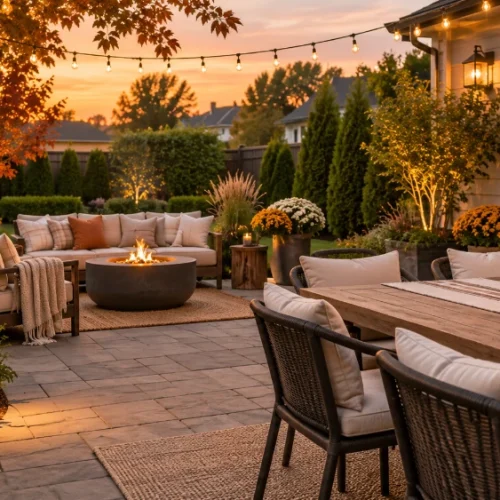
- Fire pits with covers. A small gas fire pit with a flat cover becomes a coffee table when you’re not using it.
The goal is fewer individual items competing for space, without giving up what you actually need.
Material Choices Have Outsized Impact
The hardscaping materials you pick matter more in a small yard than a large one. I’ve seen this trip people up repeatedly.
- Use fewer materials, not more. Mixing five different surfaces in a compact area creates visual noise. Two or three materials that work together is the sweet spot.
- Light-coloured pavers open up the space. Darker materials absorb light and can make a small area feel boxed in. Lighter tones like sand, cream, or light grey reflect light and create a more open feeling.
- Extend indoor flooring lines. If your patio sits against a sliding door or French doors, choose a paver colour and pattern that echoes your interior flooring. This blurs the boundary between inside and outside, and both spaces feel bigger because of it.
- Think about drainage. In a small yard, there’s less ground to absorb water, so drainage matters. Permeable pavers or gravel sections let water filter through rather than pooling on the surface.
Planting For Small Spaces (And Common Mistakes)
Plant selection is where a lot of small-yard projects go sideways. That beautiful Japanese maple from the nursery becomes a space-eating canopy within three years. Always choose plants with the mature size in mind:
- Columnar and narrow-habit trees. Varieties like columnar oak, fastigiate hornbeam, or Swedish columnar aspen grow up rather than out. They add height and structure without eating lateral space.
- Dwarf shrubs. Compact versions of popular shrubs (dwarf hydrangea, compact spirea, dwarf boxwood) give you the same look at a fraction of the size.
- Perennials over annuals. Perennials come back each year and don’t require seasonal replanting space. Pick varieties with long bloom periods for sustained colour.
- Ornamental grasses. Something like Karl Foerster feather reed grass adds movement and texture in a narrow, vertical footprint.
Layer your plantings: low groundcover at the front, mid-height perennials in the middle, taller grasses or shrubs at the back. This creates depth even in a narrow bed.
Lighting Changes Everything
Landscape lighting is probably the most underused tool in small-yard design. After dark, the boundaries of your yard disappear. Good lighting defines the space on your terms, drawing attention to what you want people to notice and letting the rest fall into soft shadow.
- Uplighting on trees or architectural features pulls the eye upward and creates focal points.
- Path lighting marks walkways and zone transitions.
- String lights or festoon lighting overhead create a ceiling effect that makes the yard feel like an actual room, not just an outdoor corridor.
- Accent lighting in planters or along retaining walls adds depth.
In my experience, this is the single upgrade that gets the biggest reaction from people seeing a finished small yard for the first time. The yard that felt cramped during the day suddenly feels intimate and intentional at night.
Privacy Without The Box Effect
Privacy is usually the top concern in urban yards. Neighbours are close, sight lines are short. But heavy privacy solutions like tall solid fences or thick hedges can make a small yard feel like you’re sitting at the bottom of a well.
The trick is balancing privacy with openness:
- Semi-transparent screens. Horizontal slat fences, lattice panels, or decorative metal screens block views without completely cutting off light and airflow.
- Layered plantings along fence lines. A mix of evergreen and deciduous shrubs at varying heights softens the fence line and adds depth instead of creating a flat green wall.
- Focal points that pull attention inward. A water feature, fire pit, or one striking planter in the centre of the yard draws the eye away from the boundaries.
The Power Of Restraint
The most important principle in small-yard design is restraint. It’s tempting to pack in every feature you like: a patio, a garden, a water feature, a fire pit, a play area, a dining space. But a small yard with too many elements feels cluttered, no matter how nice each piece is on its own.
Pick two or three features that matter most to you and do them well. Leave some open space on purpose. A compact yard that does a few things right will always feel more inviting than one trying to do everything at once.
Small yards aren’t limitations. They’re a different kind of design problem, and one that rewards precision and intention. When they’re done well, people walk in and forget how small the lot actually is.
Denis does residential landscaping in Montreal. More at montrealpaysagementpro.com.