The First Surface Every Visitor Touches Is the One Most Buildings Forget
Walk into any well-run office, hotel, school, hospital, or retail store, and the entrance does a lot of quiet work. Visitors form their first impression of the building in roughly seven seconds, and most of that impression is shaped by what they see, smell, and feel underfoot. Yet the rectangle of floor that catches every shoe, every wet sole, and every dropped piece of debris often gets the least design attention in the building.
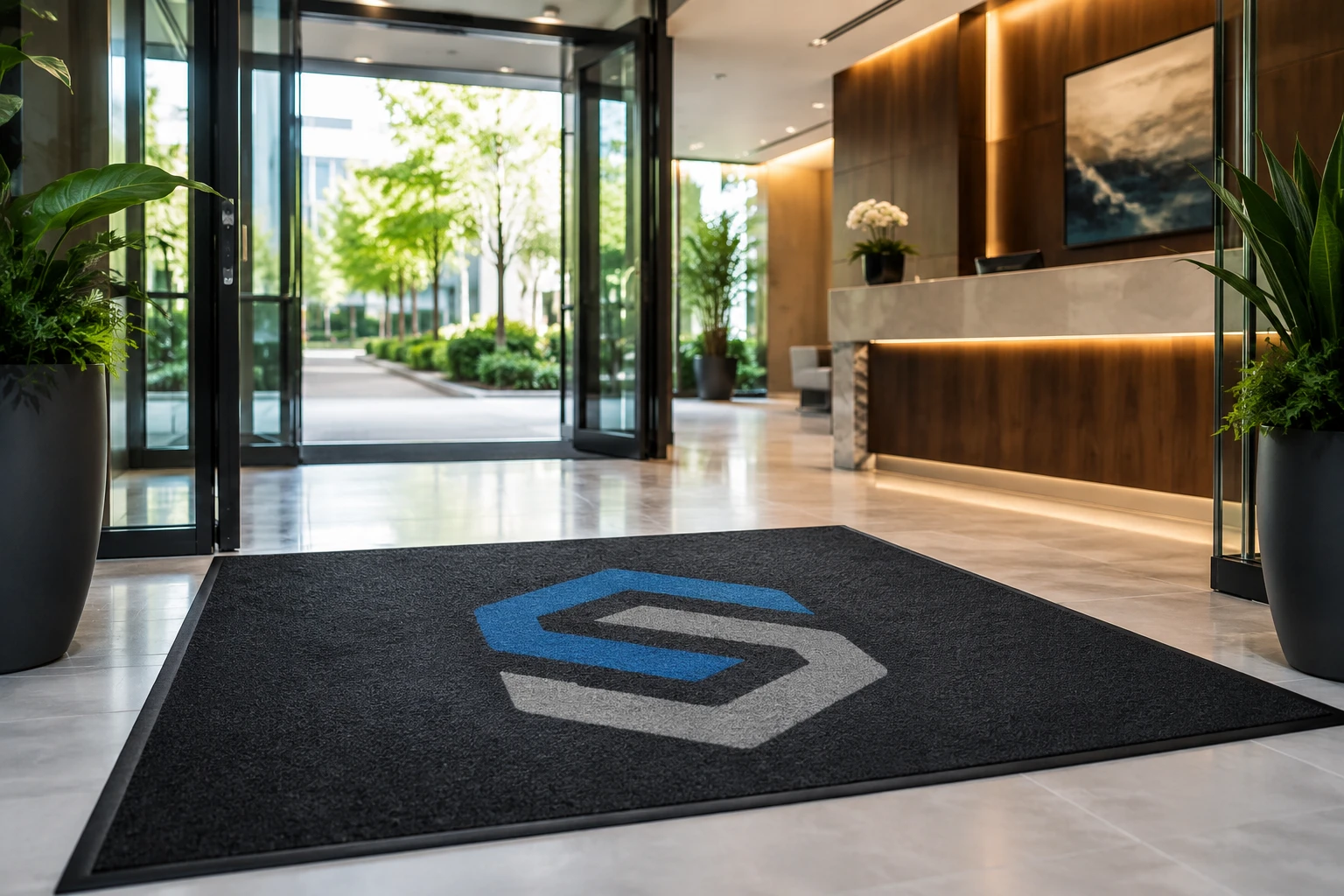
That gap is what custom logo mats close. They are working surfaces, entrance mats engineered to scrape soil, hold moisture, and protect the flooring behind them — and they are also branded surfaces, displaying a logo, a wordmark, or a full-color graphic to every person who walks in. When the two functions are combined into one product, a few square feet of entrance floor becomes some of the most valuable branded real estate in the building.
The case for them is stronger in 2026 than it has been in years. Hybrid work has reduced the volume of foot traffic but raised the stakes of every visit. Procurement teams are tightening budgets and looking for marketing assets with measurable life spans. Facility managers are reading the same building-safety guidance that’s been circulating since the pandemic, which puts entrance hygiene closer to the top of the priority list than it used to be. Custom logo mats sit at the intersection of all three pressures.
What a Custom Logo Mat Actually Does
A well-built entrance mat is a piece of engineering. The carpet face is usually a high-twist nylon or polypropylene fiber chosen for two competing properties: it has to scrape grit off shoes, and it has to hold onto water without releasing it back as people walk over it. Premium commercial entrance mats can hold around 1.5 gallons of water per square yard before they need to be vacuumed or air-dried. The rubber backing, typically a nitrile compound, is what keeps the mat from migrating across the floor as feet hit it at angles, and the bi-level surface (raised ridges paired with lower channels) is what allows trapped soil to drop below the walking plane so it isn’t ground back into the carpet by the next pair of shoes.
On top of that engineered surface, modern dye-sublimation and high-definition digital printing make it possible to display a logo at print resolutions of 76 DPI or higher with photo-quality color. Inlaid construction goes further: solid-color shapes are cut from UV-resistant fiber and bonded into the mat field, producing a logo that won’t fade in direct sunlight and lasts the full service life of the carpet itself. The choice between print and inlay isn’t aesthetic; it’s a function of where the mat will live and what kind of weather it has to survive.
Why Brand Visibility on the Floor Outperforms Most Other Surfaces
Brand-visibility studies on signage tend to focus on eye-level placements: window decals, wall graphics, and monitor screens. Floor placement is consistently underrated. There are three reasons it shouldn’t be.
- Forced field of view. People look down as they enter a building. They are checking their footing, especially in poor weather. A logo on the floor has captive attention that a wall graphic does not.
- Repeated daily impressions. Every employee, contractor, and visitor sees the entrance multiple times a week. A high-quality mat with a five- to eight-year service life delivers thousands of brand impressions per occupant before it needs to be replaced, at a cost-per-impression most paid media channels can’t match.
- Subliminal trust signals. A clean, sharp, well-fitted logo mat tells a visitor the organization cares about its environment. A worn-out generic doormat sends the opposite signal, often before anyone has said a word.
This last point is where logo mats earn their keep in industries where trust is part of the product. Healthcare, professional services, hospitality, and financial services, anywhere the visitor is implicitly evaluating whether the organization is competent, benefits disproportionately from the cue that a custom mat sends.
Safety, Cleanliness, and the Quiet ROI of Soil Containment
Beyond branding, the operational case for entrance mats is the one most facility managers know cold. The Carpet and Rug Institute and ISSA, the worldwide cleaning industry association, have long published estimates that 70 to 80 percent of soil and moisture in any building is tracked in on shoes. The cost of removing that soil after it has been ground into interior flooring is several times the cost of trapping it at the door. Industry guidance recommends 12 to 15 feet of entrance matting to capture the majority of debris before it travels into the building, three to four full strides on a properly sized scraper-and-wiper combination.
Slip-and-fall incidents are the second piece of the operational equation. Wet entrances are one of the most common causes of premises liability claims in commercial buildings. A high-quality entrance mat with a nitrile rubber backing and a slip-resistant surface materially reduces that risk, and many mats are certified for slip resistance by the National Floor Safety Institute. Translate that into facility risk language, and a custom logo mat becomes a piece of safety equipment with a logo printed on it, easier to justify in a procurement review than a pure branding spend.
Real-World Use Cases That Illustrate the Point
Multi-location retail. A retailer with 50 stores rolling out a new visual identity needs the brand to land consistently at every entrance. Custom logo mats produced from the same vector file, in the same standard sizes, with PMS-matched colors, give every store the same first impression at a fraction of the cost of repainting facades or replacing signage.
Schools and universities. School entrances see thousands of feet per day during the academic year. A logo mat with a school crest at the main entrance does double duty: it reinforces school identity for prospective families touring the campus, and it captures the seasonal soil load that wears out gym floors and corridor tile.
Hospitals and clinics. Healthcare entrances need to handle both wheelchair traffic and aggressive cleaning protocols. A logo mat with ADA-compliant beveled edging and a launderable nitrile backing meets both requirements while presenting the institution’s identity to every patient and visitor.
Hotels and hospitality. Hospitality is the industry where the brand-visibility argument is least controversial. Lobby floors are a stage. A custom logo mat at the lobby entrance is the equivalent of a curtain rising on a property, and a wet, dirty lobby floor is the curtain falling on a guest’s stay.
Industrial facilities. Plant entrances and warehouse doors benefit from a different mat profile, heavier rubber backings, deeper scraping ridges, and larger overall sizes, but the same logo customization works. A branded mat at an industrial entrance reinforces safety culture for employees and signals professionalism to auditors and visitors.
Maintenance: The Part That’s Almost Always Underestimated
Custom logo mats reward routine maintenance and punish neglect. Daily vacuuming during peak season removes the dry soil before it grinds into the fiber. Periodic hot-water extraction or off-site laundering, depending on the backing, restores the mat to near-new appearance. Rotating mats end-to-end every quarter evens out wear in the highest-traffic zones. Mats that get this kind of care commonly last the full quoted service life. Mats that don’t can lose their visual quality inside a year, which is when buyers conclude (incorrectly) that the product didn’t deliver.
Key Takeaways
- Entrance mats are working surfaces first and brand surfaces second; both functions matter, and a properly specified custom logo mat does both.
- The brand-visibility math favors floor placement: forced field of view, repeated daily impressions, and a multi-year service life produce a low cost per impression compared to most paid media.
- Entrance mats reduce slip risk, contain soil before it spreads into the building, and lower the downstream cost of cleaning interior flooring, a quiet operational ROI on top of the brand value.
- Specification matters: face weight, backing, printing method, and pile height should be matched to the location, not selected by price alone.
- The ROI assumes maintenance. Vacuuming, periodic deep cleaning, and rotation are what make a five-to-eight-year service life real instead of theoretical.
In a market where buyers are scrutinizing every line item and every brand surface, a custom logo mat is one of the few assets that earns its place by doing two jobs at once. It’s the rare branded touchpoint that protects the floor under it, traps the dirt above it, and sends a quiet signal about the organization that chose to put it there.
FAQs
Custom logo mats combine branding with floor protection by displaying a company logo while trapping dirt, moisture, and debris at entrances.
Yes. Because people naturally look down when entering a building, logo mats create repeated daily impressions in a high-attention area.
A high-quality commercial mat can last five to eight years when properly maintained and cleaned regularly.
No. Offices, schools, hospitals, hotels, and industrial facilities all benefit from branded entrance mats for both safety and presentation.
Yes. Mats with slip-resistant rubber backing help absorb moisture and improve traction near entrances during wet conditions.
Most commercial mats use nylon or polypropylene fibers with nitrile rubber backing for durability, moisture retention, and slip resistance.
Printed mats use digital graphics for detailed images, while inlaid mats use cut fiber pieces for longer-lasting color and better UV resistance.
Daily vacuuming and periodic deep cleaning are recommended to maintain appearance, performance, and overall lifespan.
Many commercial-grade mats include low-profile beveled edges designed to support ADA accessibility and wheelchair traffic.
They perform multiple functions at once: branding, soil containment, floor protection, and safety improvement, all with long-term daily exposure.