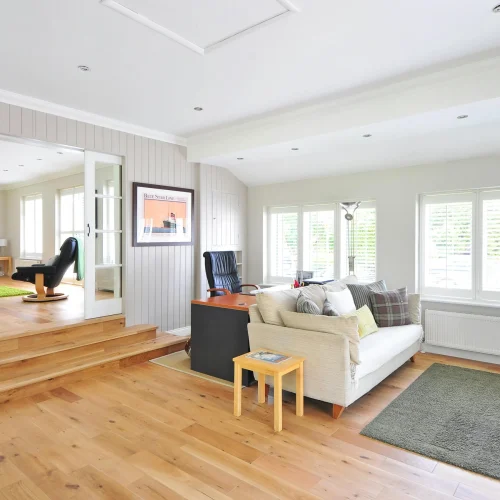
Living in the city comes with a well-known compromise: you gain access to culture, work, and excitement, but you usually lose square footage.
Whether you are in a studio apartment in New York or a condensed urban flat in London, the battle for floor space is real. For years, the advice for small-space living was simply “buy smaller stuff.” Get a tiny sofa. Get a tiny table. Live a tiny life.
But that advice is outdated.
In 2025, the solution isn’t about shrinking your lifestyle; it is about upgrading your environment. Enter the era of Smart Furniture. This isn’t just about putting a Bluetooth speaker in a chair; it is a fundamental design shift where furniture becomes multi-functional, adaptive, and tech-integrated.
Smart furniture is proving that you don’t need a mansion to live luxuriously; you just need furniture that works as hard as you do. Here is how intelligent design is rewriting the rules of small-space living.
The Invisible Tech Revolution (Killing the Cable Clutter)
If you look around a typical small living room, what creates the most visual chaos? It is rarely the furniture itself—it’s the wires.
We live in a digital age. We have smartphones, tablets, smartwatches, and laptops, and they all need power. In a small room, having power strips snaking across the floor and chargers cluttered on tabletops makes the space feel messy and claustrophobic.
This is where the new wave of “Tech-Ready” furniture steps in.
Modern design is moving towards seamless integration. Imagine a nightstand that doesn’t just hold a lamp, but charges your phone the moment you set it down on the surface. Imagine a coffee table that serves as a charging hub for your guests without a single visible cable. Innovators in this space, such as POVISON, have recognized that modern homeowners need furniture that actively participates in their digital lives, embedding wireless charging pads and motion-sensor lighting directly into sleek, minimalist designs.
By eliminating the need for external chargers and messy extension cords, you reduce “visual noise.” In a small apartment, clarity equals spaciousness. When surfaces are clear of wires, the room immediately feels 20% bigger.
The “Transformer” Effect: Adaptable Dining
The dining area is often the first casualty of small-space living. Many renters sacrifice a proper dining table because they can’t justify a large 6-seater taking up space that is only used for dinner parties twice a year.
However, eating dinner on the sofa every night can feel depressing.
Smart furniture solves this with advanced mechanical engineering—specifically, the rise of the Sintered Stone Extendable Table.
Old-school drop-leaf tables were often clunky, difficult to operate, and looked cheap. The new generation of smart extendable tables uses smooth, silent rail mechanisms.
- Daily Mode: In its compact form, it is a sleek 4-person table that fits perfectly in a breakfast nook or a corner of the living room.
- Party Mode: When guests arrive, a single person can effortlessly slide the mechanism to reveal hidden leaves, expanding the surface to seat 6 or 8 people comfortably.
This allows you to “rent” space from your own apartment. You utilize the floor space for flow and movement 90% of the time, but you still possess the capacity to host a full Thanksgiving dinner when needed. It is the ultimate flex for the modern host.
Lighting as a Spatial Expander
Lighting is the secret weapon of interior design, especially in tight quarters. Dark corners make a room shrink.
Traditionally, adding light meant buying floor lamps or table lamps, which—you guessed it—take up precious floor and surface space.
Smart furniture is now incorporating Ambient LED Lighting directly into the architecture of the piece. You will see this most effectively in modern TV stands and media consoles. These units often feature built-in, motion-sensor, or app-controlled LED strips tucked beneath the cabinet or behind glass panels.
This serves a dual purpose:
- Mood & Atmosphere: It creates a cinematic experience for movie nights without needing extra fixtures.
- Floating Effect: Under-cabinet lighting creates an optical illusion that the furniture is floating. This reveals more floor space to the eye, making the room feel airier and less grounded by heavy, blocky objects.
The “Double-Duty” Storage Philosophy
In a small home, every object must justify its existence. If a piece of furniture only does one thing, it is arguably wasting space.
Smart furniture design embraces the “Double-Duty” philosophy.
- The Lift-Top Coffee Table: It looks like a standard low profile table, but the top lifts up to desk height. Suddenly, your living room is a comfortable home office, with hidden storage underneath for your laptop and notebooks.
- The Media Wall: It’s not just a stand for the TV. It is a cable management system, a display case for collectibles, and a closed storage unit for clutter.
The intelligence here lies in the concealment. Small spaces get overwhelmed by “stuff.” Smart furniture provides accessible storage that hides the mess, maintaining the minimalist aesthetic that is crucial for keeping a small room feeling serene.
Material Intelligence: Durability in High-Traffic Zones
In a large house, you might have a “formal living room” that nobody touches. In a small apartment, you live on your furniture. You eat on the coffee table, you work at the dining table, and your pets jump on the sofa.
Smart living also means choosing Smart Materials.
This is why we are seeing a shift away from delicate veneers towards robust materials like Sintered Stone. As a material, it is practically indestructible—heat resistant, stain-resistant, and scratch-proof. In a small space where the dining table might double as a prep counter for cooking or a desk for crafting, having a surface that won’t be ruined by a hot pan or a spilled glass of wine is a game-changer.
It reduces the anxiety of living in your own home. You don’t have to be precious with it; you can just live.
Conclusion: Future-Proofing Your Home
The trend towards smaller urban living spaces isn’t slowing down. As our cities become denser, our private spaces will likely become more compact.
But “compact” does not have to mean “cramped.”
By adopting smart furniture, you are essentially hacking your floor plan. You are removing the clutter of cables, you are gaining the utility of a dining room without the footprint, and you are adding storage without adding bulk.
Smart furniture allows you to reclaim your space. It transforms a static, crowded room into a dynamic, adaptable machine for living. So, the next time you are shopping for your apartment, don’t just ask “Does it fit?” Ask, “What else can it do?”