Fluorescent tube lights have been a default choice in homes, offices, schools, and commercial buildings for decades. They were efficient for their time, relatively affordable, and widely available. But today, they’re increasingly viewed as outdated. Rising energy costs, frequent maintenance, flicker issues, and environmental concerns have pushed many property owners to look for better solutions. That’s where LED replacement options for fluorescent tube lights come in, especially for homeowners searching for the best fluorescent light alternatives for home offices where comfort and visual clarity matter just as much as efficiency.
Switching from fluorescent to LED isn’t just a simple bulb swap in every case. There are multiple replacement paths, each with its own cost, installation requirements, and long-term implications. Understanding these options is the key to choosing the right upgrade for your space, budget, and timeline.
Understanding Fluorescent Tube Lighting
Before exploring LED replacements, it helps to understand what you’re replacing. Fluorescent tube lights come in several common formats, typically identified by a “T” number. T12 tubes are the oldest and least efficient, with a larger diameter and higher power draw. T8 tubes are slimmer and more efficient, while T5 tubes are smaller still and often used in high-output commercial settings.
Fluorescent lighting relies on a ballast to regulate current and start the lamp. Over time, ballasts fail, causing flickering, buzzing, delayed startup, or complete light loss. Even when the tube itself is still functional, a failing ballast can force a fixture repair or replacement. Fluorescent lamps also contain mercury, which creates disposal challenges and environmental risk if handled improperly. A detailed technical overview of how fluorescent lamps operate.
Why LED Replacements Make Sense
LED technology eliminates many of the weaknesses built into fluorescent systems. LEDs use significantly less energy to produce the same or higher light output. They turn on instantly, even in cold environments. They don’t flicker, hum, or rely on gas excitation to produce light. Most importantly, they last far longer.
From an efficiency standpoint, LEDs often consume 30 to 60 percent less electricity than fluorescent tubes. In buildings where lights operate eight, ten, or even twenty-four hours a day, the savings compound quickly. The U.S. Department of Energy consistently identifies lighting upgrades as one of the fastest-return efficiency improvements available, especially when replacing older fluorescent systems.
Environmental impact is another major driver. Fluorescent lamps require special handling at end of life due to mercury content. LEDs contain no mercury and reduce overall waste through longer service life. This shift aligns with broader federal energy and environmental goals focused on reducing hazardous materials and improving building efficiency.
Overview of LED Replacement Paths
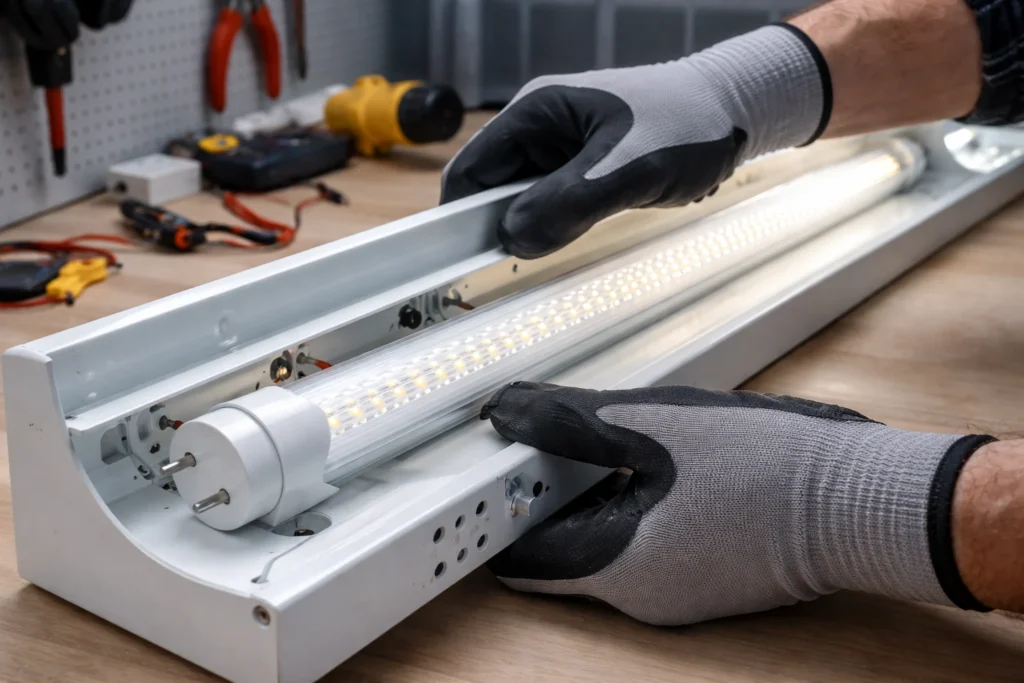
There are four primary ways to replace fluorescent tube lights with LED solutions:
• Plug-and-play LED tubes that operate on existing ballasts
• Ballast-bypass LED tubes that connect directly to line voltage
• LED tubes that use external drivers
• Complete replacement of fluorescent fixtures with LED fixtures
Each option serves a different purpose. Some prioritize ease of installation. Others focus on reliability, performance, and long-term cost reduction. The right choice depends on how long the building will remain in service, whether electrical modifications are acceptable, and how much downtime can be tolerated.
Type A LED Tubes: Plug-and-Play Replacements
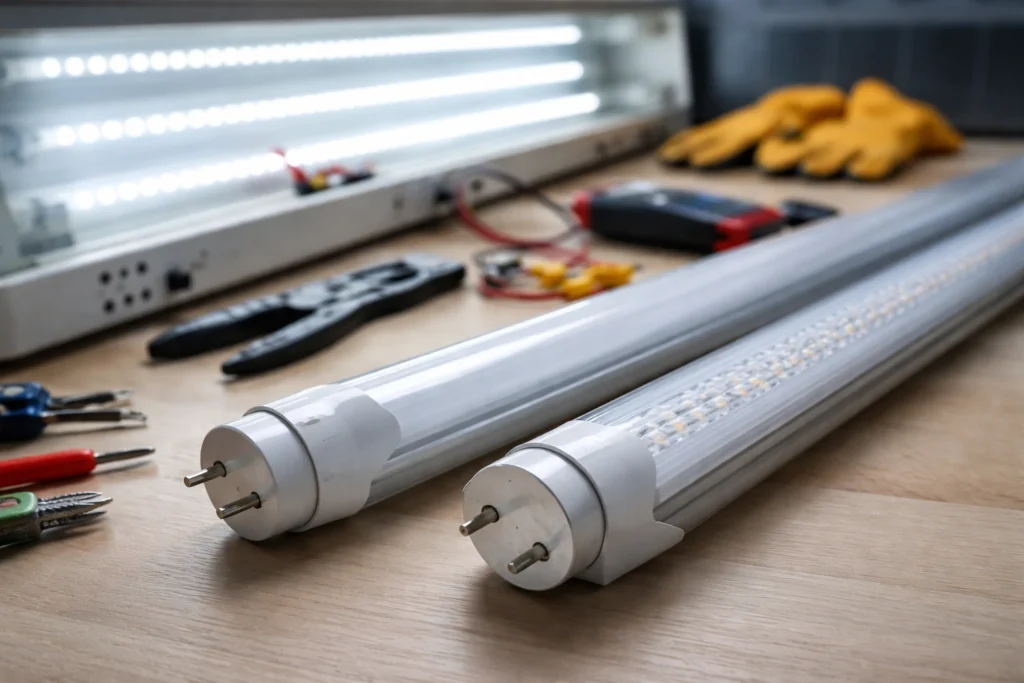
Type A LED tubes are commonly marketed as plug-and-play solutions. These lamps are designed to work with existing fluorescent ballasts. Installation typically involves removing the fluorescent tube and inserting the LED tube, without rewiring the fixture.
The biggest advantage is speed. Labor costs are low, disruption is minimal, and upgrades can be completed quickly across large spaces. This makes Type A LED tubes attractive for leased buildings, schools, or offices where electrical modifications are restricted. The downside is dependency on the ballast. If the ballast fails, the LED tube stops working even if the LED itself still has useful life remaining. Compatibility can also be an issue, as not all LED tubes are compatible with all ballast models.
Type B LED Tubes: Ballast Bypass Solutions
Type B LED tubes eliminate the ballast entirely. During installation, the ballast is removed or disconnected, and the fixture is rewired to supply power directly to the LED tube.
This approach removes one of the most failure-prone components of fluorescent lighting systems. Without a ballast, there is less heat buildup, fewer electrical losses, and improved overall reliability. Over time, maintenance costs drop significantly. Type B installations require more upfront labor and typically involve an electrician, especially in commercial settings. Fixtures must also be clearly labeled after installation to indicate that they are wired for LED-only operation.
Type C LED Tubes: External Driver Systems
Type C LED tubes use a dedicated external driver rather than a fluorescent ballast. The driver regulates power specifically for LED operation and often supports advanced lighting controls.
These systems deliver excellent performance, consistent light output, and compatibility with dimming, sensors, and building automation systems. Because the driver is separate, it can be replaced independently if it fails. Type C solutions are more expensive and complex to install, making them most suitable for large commercial, institutional, or industrial facilities.
Hybrid LED Tubes: Type A/B Options
Hybrid LED tubes are designed to operate either with an existing ballast or on direct line voltage. This flexibility allows building owners to phase upgrades over time.
Initially, the tubes can be installed as plug-and-play. Later, when ballasts fail or renovations occur, the fixtures can be rewired without replacing the lamps. Hybrid tubes tend to cost more and require careful labeling to avoid confusion. They work best in environments where future plans are uncertain but immediate energy savings are desired.
Replacing the Entire Fluorescent Fixture with LED
In many cases, replacing the entire fluorescent fixture with a purpose-built LED fixture provides the best long-term results. Integrated LED fixtures are designed as complete systems, offering improved light distribution, reduced glare, and a cleaner appearance.
LED troffers, linear strip lights, and wraparound fixtures eliminate legacy components entirely. Maintenance requirements are minimal, and service life often exceeds ten years. Although fixture replacement has a higher upfront cost, it often delivers the strongest return on investment in renovated or newly occupied spaces.
Key Factors When Choosing an LED Replacement
Lumens matter more than wattage. Color temperature influences comfort and productivity. Color rendering index affects visual clarity. Certifications ensure safety and performance. Compatibility with existing fixtures and wiring should always be verified before purchase.
Installation and Safety Considerations
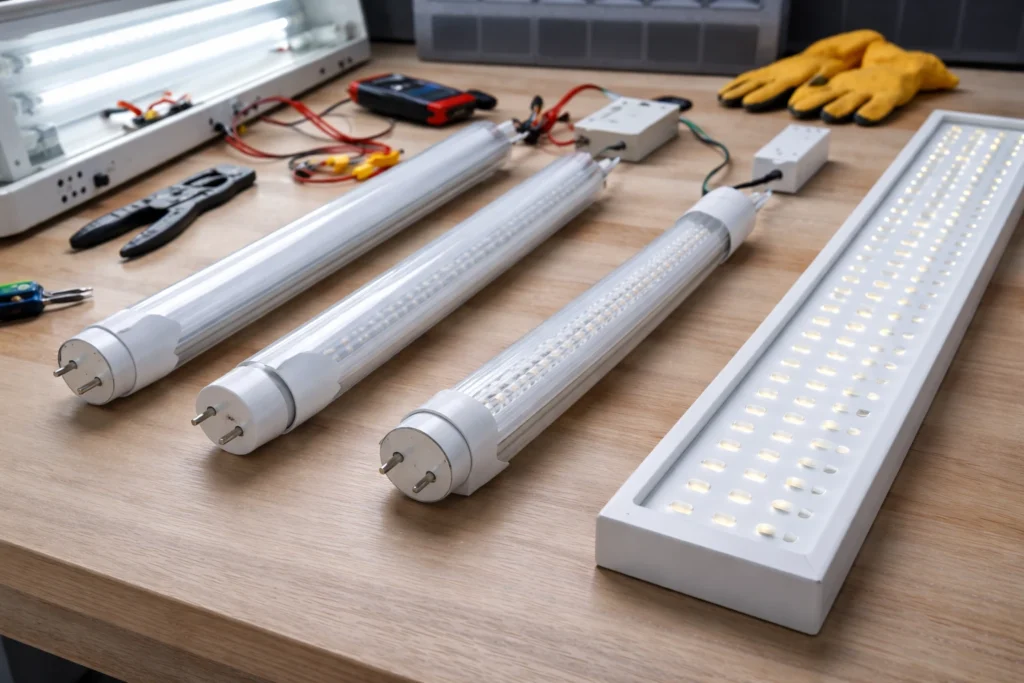
Ballast-bypass installations must follow electrical codes and include proper labeling. In commercial buildings, installation planning should minimize downtime and ensure compliance with local regulations.
Cost and Return on Investment
While LED upgrades require upfront investment, reduced energy use, longer lifespan, and lower maintenance costs drive rapid payback. In many applications, ROI is achieved within one to three years.
Common Mistakes to Avoid
Using incompatible components, ignoring light quality specifications, skipping safety labels, and choosing the cheapest option without evaluating longevity are common pitfalls.
The Future of Fluorescent Replacements
Fluorescent lighting continues to be phased out in favor of LED technology. LEDs offer better efficiency, safer materials, and smarter control options. Choosing the right LED replacement option today positions buildings for lower costs and better performance well into the future.
FAQs
Type B LED tubes are often the best long-term option because they remove the ballast and reduce future maintenance.
Yes, Type A plug-and-play LED tubes work with existing ballasts and require no rewiring.
Yes, LEDs provide flicker-free light, better color quality, and improved comfort for extended work sessions.
LED tubes typically use 30–60% less energy while delivering equal or better brightness.
Yes, when done correctly and labeled properly, ballast bypass installations are safe and code-compliant.
LED tubes can last 40,000–50,000 hours or more, often double or triple the lifespan of fluorescent tubes.
Neutral white (4000K) is ideal for focus, while soft white (3000K) works well for a warmer feel.
Most LED tubes are designed to fit standard fluorescent fixtures, but compatibility should always be verified.
Yes, LEDs contain no mercury and reduce waste due to their longer lifespan.
Fixture replacement is best during renovations or when improved light distribution and aesthetics are priorities.