Older duct systems are commonly blamed for comfort issues on the most general possible level. If rooms are stuffy, airflow is weak, or temperatures oscillate between one end of the building and the other, many building owners assume the only viable option is to replace the entire system.
This is an expensive assumption, and it is also wrong. For building managers, facility managers, and building owners, it is worthwhile to consider older duct systems before making costly replacement decisions. Flow obstructions in duct systems can be caused by a variety of factors, including poor initial designs, wear and tear, and renovations. However, many of these problems can be solved without replacing the entire duct system. A competent HVAC technician will begin by identifying where the airflow is obstructed, then work to resolve the issue and enhance comfort.
Small Duct Problems Add Up
1. Older Duct Systems Hide Small Failures
Older duct systems rarely fail in one dramatic moment. More often, comfort declines because several smaller problems build up over time. A crushed flex run, an aging connection leaking into an attic, a return path that no longer functions well, or a branch duct that was poorly modified during a renovation can each restrict airflow enough to affect comfort without drawing immediate attention. The system still runs, but rooms respond slowly and unevenly.
That is why broad assumptions about “old ducts” are not useful. In many properties, the real issue is not that the entire distribution system is unusable. It is that specific restrictions have accumulated in ways that reduce delivery and circulation. Many teams evaluating Las Vegas HVAC Contractor Services or similar retrofit-focused work are really trying to solve that exact problem: how to restore comfort by correcting hidden airflow bottlenecks rather than defaulting to a full system replacement before the actual cause is understood.
2. Comfort Complaints Usually Point Somewhere
Restrictions typically present themselves in patterns. One room is always warmer than the others in the summer. Another room feels stale if the door is shut. A far room never seems to catch up with the thermostat. The living area near the air handler is always over-cooled, while the other rooms are always lagging behind. These complaints are important because they tend to indicate where airflow issues are occurring, rather than simply complaints about a lack of consistency.
A professional and disciplined HVAC service provider not only hears complaints about the rooms, he also understands them. Complaints about rooms help pinpoint where the restriction may be occurring and whether it is related to supply air, return air, balancing, or building-envelope issues that may be making the restriction more difficult. It is not enough for the service provider simply to hear complaints about the rooms and the lack of consistent heating and cooling. He must understand where the problem is occurring and which rooms are affected.
3. Static Pressure Reveals System Stress
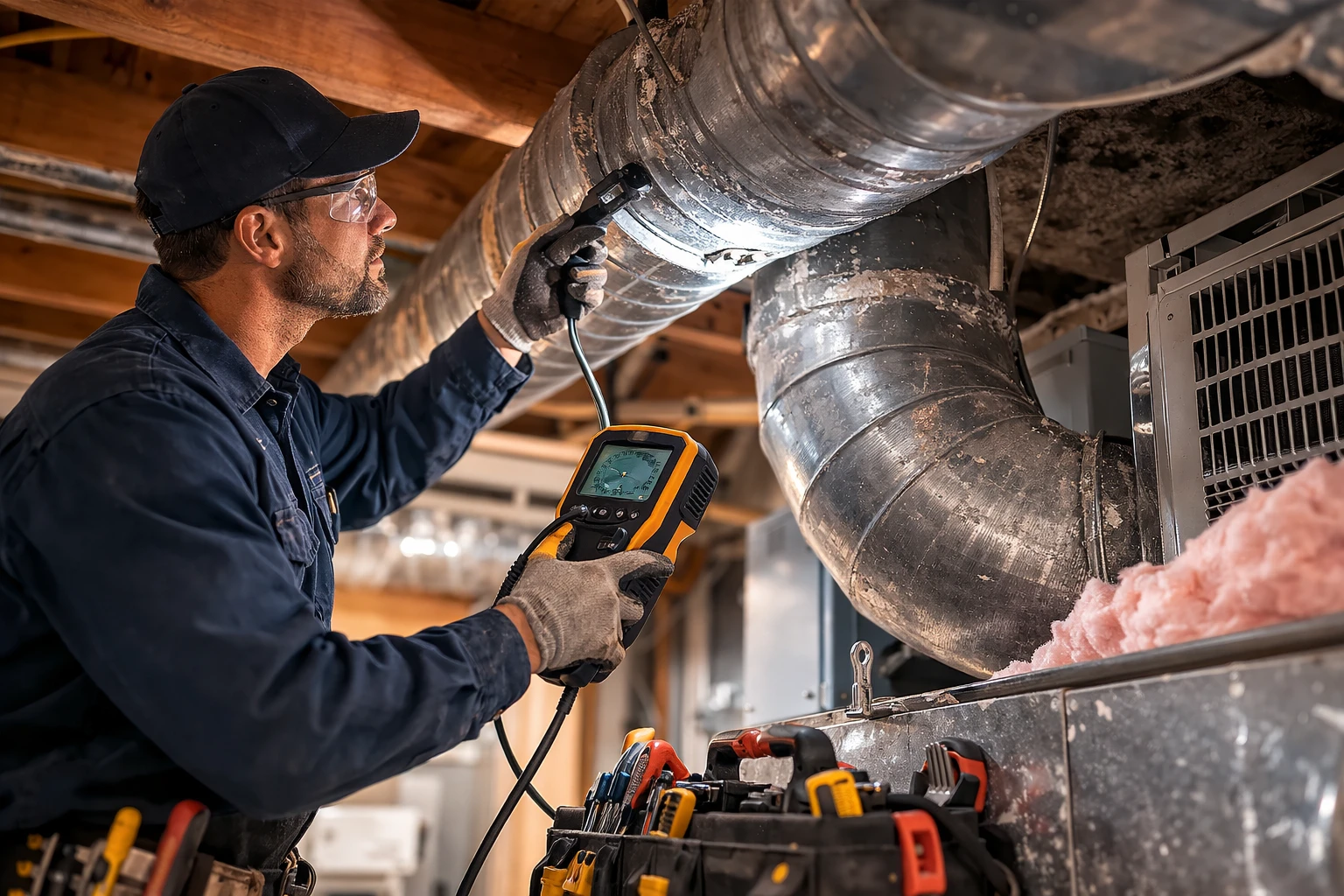
One of the more obvious ways to identify airflow issues in an existing duct system is through static pressure testing. High static pressure can often indicate that the air handler is being forced to work against resistance, and that resistance can result from a variety of causes, including dirty filters, restrictive ducting, undersized return ducts, closed dampers, plugged coils, and physically constricted ducts, among others.
This is important, as comfort issues are often evaluated from the thermostat out, rather than asking the more important question of whether the system can even move air. Static pressure provides a direct window into a system’s stress. It can also confirm that a system is being forced to work through unnecessary resistance, as well as whether a comfort issue may actually be a distribution issue rather than a system capability issue.
4. Returns Often Cause Hidden Restrictions
Supply vents are often the first area to receive attention, but issues with return air are often the key factor affecting the performance of an older duct system. Without the ability to return the air to the system, it does not circulate quickly, and the rooms are not comfortable, even though the supply registers are technically delivering conditioned air. This is often the case in older homes and properties, particularly if the returns were originally undersized, there are too many door openings, or the rooms have been reconfigured since the original ductwork was installed.
A contractor working on an older system will often examine the return air pathways, as they are a key component of the system’s performance. Without a good return air, there can be pressure imbalances, stale rooms, noisy air movement, and temperature issues. The return air pathways are often a key component in improving the performance of the entire system without necessarily replacing the entire ductwork.
5. Duct Damage Restricts More Than Volume
Older duct systems may have physical damage that affects airflow, but the homeowner may not be aware of it. A sagging flexible duct, for example, may be kinked. A metal duct may be separated at joints, and it may contain obstructions. Insulation liners may be damaged. Repairs may have resulted in awkward transitions, too many bends, and crushed ducts within walls and ceilings. All of these may be restricting airflow, meaning less air may be reaching the room.
A competent and practical contractor does not automatically assume that the airflow is not working well simply because the ducting is old. What he or she is looking for is where the airflow path is restricted. This may be done quite easily by making repairs and replacing certain sections of the ducting, rather than replacing the whole system, which may be perfectly good except for certain sections and transitions.
6. Past Renovations Change Airflow Dynamics
One reason for airflow problems in an older duct system is that the building itself changes over time. There are additions to the building, changes to the wall layout, changes to the attic, the enclosure of porches, and the opening up of the floor plan. The duct system, to begin with, might have been marginal. It might have been marginal before the building changes. It certainly isn’t right after the changes. This is where judgment comes into play. The contractor looking at the airflow problem must consider that some of the issues he is seeing may not be due solely to the ducts’ age. The branch he is looking at might have originally been serving a different room. The return might have been closed off. The room over the garage might be putting a load on the system that it was never designed to handle. The comfort level is greatly enhanced by not necessarily thinking of the ducts as having to be replaced because of age.
7. Air Balancing Can Restore Room Comfort
The older systems tend to go out of balance even when all the major parts are working correctly. Some rooms have too much air flow simply because they are close to the air handler and have less resistance. Others have too little airflow simply because they are longer, more resistant, and perhaps not well configured to start with. The end result is all too familiar: one part of the building is comfortable, and another part never seems to settle.
Balancing the airflow is one of the best ways to address the problem. It allows the contractor to compare airflow in each room and adjust dampers and conditions to improve distribution. It is one of the best methods to improve comfort without necessarily replacing the entire system. The truth is, the system is not necessarily incapable of conditioning the building. It simply cannot distribute the conditioned air in the proportions the rooms actually need.
Indoor Comfort Depends On Diagnosis First
While old duct designs can be problematic, it’s not necessarily true that old means replace. Restrictions in the airflow are typically caused by one of several factors, including high static pressure, weak return air, damaged ducts, leaks, unbalanced systems, renovation mismatches, and maintenance-related blockages. A competent heating, ventilation, and air conditioning professional can help improve indoor comfort by identifying restrictions and addressing them, enabling the existing duct system to be improved.
For property managers, managers, and owners, the takeaway is that, before agreeing to replace the ducts, it’s useful to understand the performance of the existing duct system and where it’s restricted. Indeed, many old duct designs still have life left, and it’s simply a matter of removing the restrictions and improving the existing system rather than replacing it.
FAQs
Common signs include uneven temperatures between rooms, weak airflow from vents, stale air in closed rooms, and HVAC systems that run longer than usual.
Yes. Many airflow issues come from localized restrictions like crushed ducts, leaks, or poor balancing, which can often be repaired without full duct replacement.
Technicians typically use tools such as static pressure gauges, airflow meters, and visual inspections to identify areas where air movement is being restricted.
Static pressure testing reveals how much resistance the air handler is facing, helping technicians identify blockages, undersized ducts, or airflow restrictions.
Return ducts allow air to circulate back to the HVAC system, and if they are undersized or blocked, the system cannot move air efficiently throughout the building.
Yes. Structural changes like added rooms, enclosed spaces, or altered layouts can disrupt the original airflow design and create new restrictions.
Damage such as crushed flex ducts, loose connections, or internal obstructions can significantly reduce the volume of air reaching certain rooms.
Air balancing adjusts airflow across different rooms to ensure each area receives the correct amount of conditioned air, improving overall comfort.
Not necessarily. Many problems stem from maintenance issues, poor design, or modifications rather than the age of the ducts themselves.