There’s something about moving into a dorm that feels both exhilarating and terrifying. You’re stepping into your own space your first true home away from home but that space is usually… tiny. Like, “I blinked and already walked from the door to the window” tiny. Dorm rooms have this magical ability to be both empty and cluttered at the exact same time. One minute everything is organized, the next minute your bed looks like a laundry mountain and your desk disappears under textbooks and snacks.
The good news? A small dorm doesn’t have to feel cramped or chaotic. With some creativity, a bit of strategy, and a willingness to rethink how you use every inch, you can make even the smallest room feel surprisingly spacious and functional. Throughout college, I learned (sometimes the hard way) how to squeeze storage into places I didn’t even know existed. And once you get the hang of it, it actually becomes fun like solving a real-life puzzle where the prize is your sanity. If you’re staring at your dorm layout wondering how in the world everything you own is supposed to fit, don’t worry. Let’s walk through some storage strategies that actually work, especially when your room is more “cozy shoebox” than “comfortable studio.”
Start by Rethinking the Space You Think You Don’t Have
One of the biggest mindset shifts with dorm living is realizing how much space is hiding in plain sight. The trick isn’t finding completely new space it’s using what’s already there in smarter ways.
Look at your room with fresh eyes:
- What’s vertical that you could use?
- What’s empty under furniture?
- What’s currently “decorative” that could turn functional?
- What could stack, fold, attach, or hang?
Dorm rooms aren’t designed to be spacious, but they are designed to be hacked. Once you treat every surface, corner, and dead zone as potential storage, you’ll start to see possibilities everywhere.
Under-Bed Storage: The Dorm Room Holy Grail
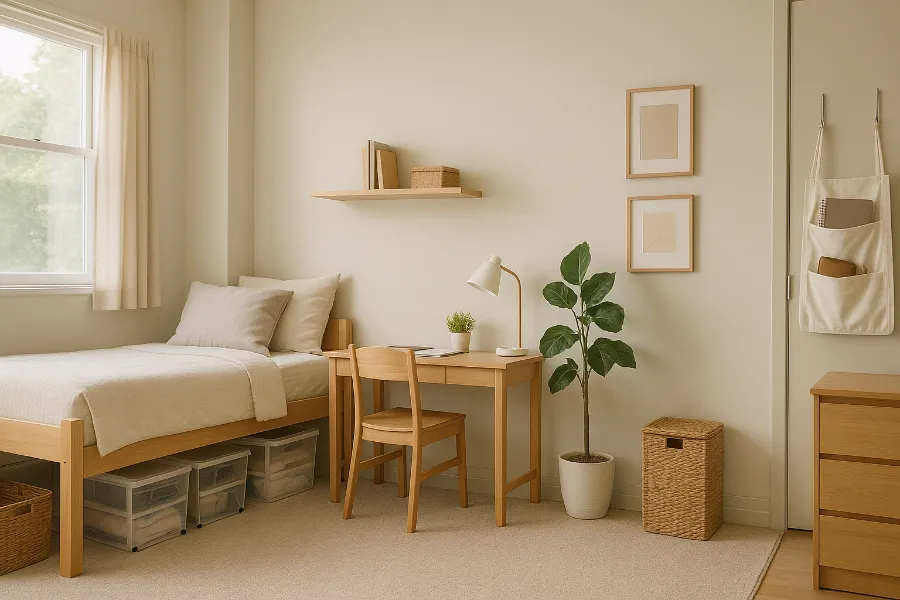
Whether your bed is adjustable or fixed, the space underneath it is pure gold. I’m convinced that half of dorm living success comes down to how well you use this zone.
If your bed adjusts:
Raise it as high as your housing rules allow (some campuses let you loft it fully, others limit the height). The higher the bed, the more storage real estate you gain.
If your bed doesn’t adjust:
Don’t panic. Bed risers are inexpensive, easy to install, and instantly unlock extra inches that make all the difference.
Once you’ve got your height sorted, it’s time to organize intelligently. Clear bins are a great start they let you see exactly what’s inside without having to play archaeologist. If you want your room to look more polished, go for matching fabric bins or rolling drawers.
Use the under-bed area for:
- Bulkier clothing like hoodies or winter gear
- Backstock snacks
- Cleaning supplies
- Spare linens or towels
- Kitchen items you don’t need daily
- Shoes you don’t wear as often
One underrated tip: put things you won’t need often toward the back. Keep daily or weekly items up front so you’re not crawling under there every other day.
Lofting the bed adds even more potential. You can place cube organizers, a small dresser, or even a secondary mini workstation beneath it—turning your dorm into a customized micro–living system.
Maximize the Back of Every Door (Yes, Every Door)
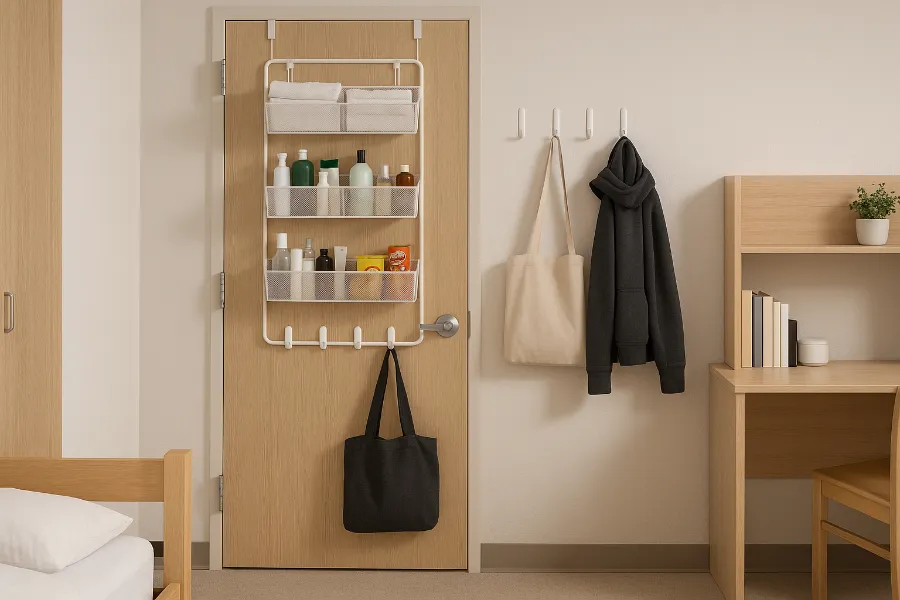
Dorms come with at least three doors: your entry door, your closet door(s), and your bathroom door if you’re in a suite. That’s three major vertical storage surfaces waiting to be used.
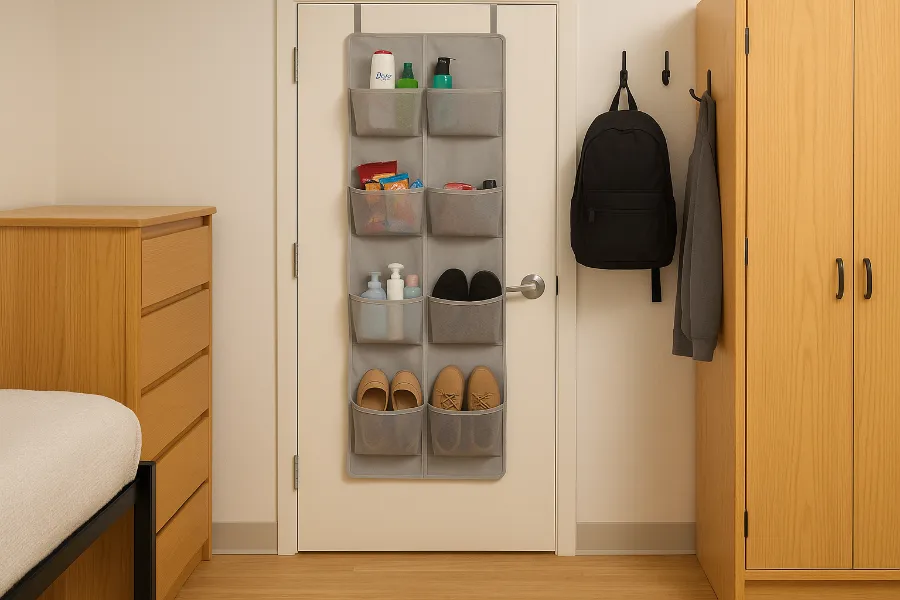
Over-the-door organizers are lifesavers for:
- Shoes
- Toiletries
- Snacks
- School supplies
- Cleaning items
- Makeup
- Hair tools
- Electronics
And if pockets aren’t your thing, go for hooks. Command hooks let the back of your door become a hanging station for bags, jackets, robes, lanyards, keys, and more.
This method is so efficient that it’s often cited in discussions of small-space optimization within fields like architectural ergonomics a term you’ll occasionally see referenced in complex spatial-planning studies such as the United States Department of Energy’s building efficiency .
Make Your Closet Do More Than… Just Be a Closet
Dorm closets sometimes feel like someone took a regular closet, shrunk it in the wash, and hung it back up. But with a few smart additions, they can work surprisingly well.
A few essentials:
1. Add a second clothing rod
A tension rod or extension rod doubles your hanging space instantly.
2. Use slim velvet hangers
Uniformity + space saving = instant closet glow-up.
3. Add hanging shelf organizers
These transform vertical emptiness into usable compartments for sweaters, jeans, shoes, or tech gear.
4. Use the closet floor
Add a shoe rack, stackable drawers, or storage cubes.
5. Use the inside of the door
More hooks, more pockets, more function.
Dorm closets demand efficiency—and you’d be surprised how much you can fit when each vertical inch is used wisely.
Desk Storage: Turning Your Study Zone Into a Productivity Haven
Your desk becomes mission control in a dorm room. It’s where homework, snacks, skincare, and chaos all collide. Keeping it organized matters.
Some ideas:
Use a desk hutch or riser.
This adds a second level of storage above your workspace.
Add drawer dividers.
Never underestimate the power of giving your pens, chargers, and sticky notes their own compartments.
Use wall space above the desk.
Command shelves and wire grids let you push storage upward, freeing desk space.
Control your cables.
Cables tangle fast in small spaces. With cable clips and a mounted power strip, your desk stays neat and visually calm.
Think Vertically Because Walls Are Storage, Too
Your walls are the most underutilized real estate in a dorm. Command hooks, small shelves, wall pockets, and pegboards transform walls into functional storage zones.
Ideas include:
- Hanging baskets
- Jewelry organizers
- Hat racks
- Lightweight shelving
- Storage grids
- Laundry bag hooks
And if you want to understand how vertical space management connects to the concept of space-efficient modularity, you might appreciate the Wikipedia entry on modular furniture systems, which breaks down how multi-piece configurations maximize utility in tight environments.
Cube Shelves: The Dorm MVP
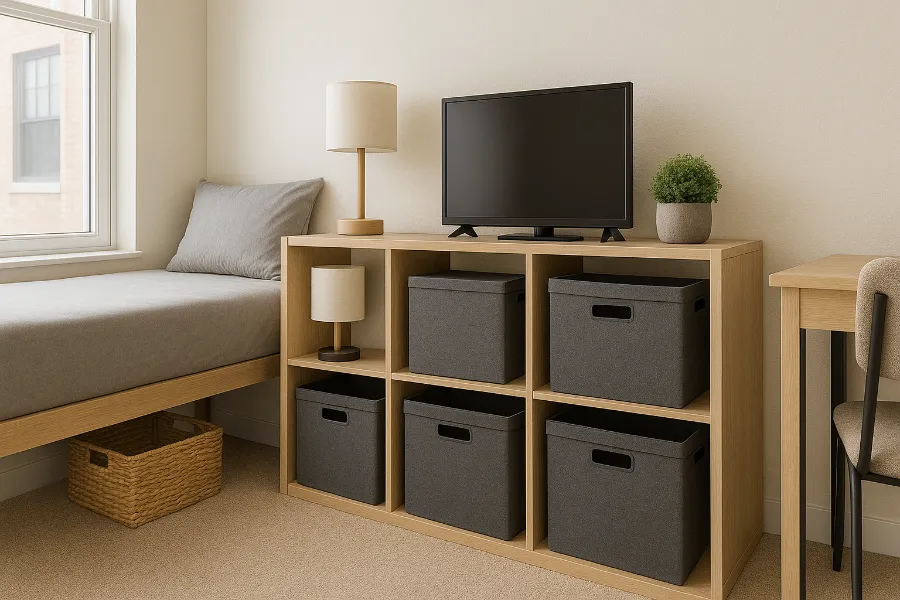
Cube organizers are the Swiss Army knives of dorm furniture. They work horizontally, vertically, under the bed, beside the desk literally anywhere.
Use them as:
- A nightstand
- A TV stand
- A pantry
- A clothing organizer
- A decor display
- A storage center
Pair them with matching fabric bins for a clean, cohesive look.
Suitcases, Backpacks, and Totes = Hidden Storage
Your empty bags are wasted space unless you use them for storage.
Suitcases can store:
- Off-season clothes
- Extra bedding
- Extra towels
- Textbooks from previous semesters
- Miscellaneous personal items
Backpacks and totes can hold smaller items or rarely used accessories and hang neatly on wall hooks.
Multifunctional Items Are the Secret Weapon
Dorm spaces reward items that pull double duty. Think:
- Storage ottomans
- Mirrors with shelving
- Bedside caddies
- Foldable drying racks
- Lap desks with compartments
- Trays that double as organizers
The more each piece can do, the less clutter you accumulate.
Use Micro-Zones to Make Your Room Feel Bigger
Dividing your room into mini-zones helps your mind and your belongings stay organized.
Some zones that work well:
- Sleep zone
- Study zone
- Snack zone
- Clothing zone
- Storage zone
- Get-ready zone
Even in a small room, zones create flow and reduce clutter.
Embrace Collapsible Everything
Items that fold flat are pure magic in dorm life.
Choose collapsible versions of:
- Hampers
- Laundry baskets
- Trash cans
- Storage crates
- Drying racks
- Under-bed organizers
When something collapses, it practically disappears perfect for small spaces.
The Decorative Storage Trick: Pretty + Functional
Skip the decor that only looks good but contributes nothing. Instead:
- Use woven baskets
- Display items in decorative boxes
- Install floating shelves
- Use trays for grouping items
- Add stylish organizers
This keeps your room aesthetic while still giving everything a home.
Regular Decluttering Is Your Best Friend
Even the most well-organized dorm will accumulate clutter. Make it a habit to declutter weekly. A 15-minute Sunday reset works wonders put things back, toss trash, organize your desk, and restock snacks.
Don’t Be Afraid to Rearrange Mid-Semester
Your storage needs will change throughout the semester. What works in September might not work during finals week. Rearranging isn’t a failure it’s adapting. Some of the best setups happen because you decide to change everything at 11 p.m. out of pure frustration… and it ends up being genius.
The Bottom Line
Maximizing a small dorm room isn’t about achieving perfection. It’s about making your space fit you your routines, your habits, and your belongings. With thoughtful storage, smart furniture choices, and a willingness to rethink how you use each inch, even the tiniest dorm can feel spacious and functional. If anything, small spaces push you to be more creative, more intentional, and more resourceful you learn quickly what belongs and what doesn’t. And ultimately, that’s the charm of dorm living: turning a miniature room into a place that genuinely feels like yours.
FAQs
Use slim hangers, shelf dividers, hanging organizers, and a second tension rod to double your hanging capacity.
Add bed risers and use clear bins, rolling drawers, or fabric totes to store bulky items, clothes, or snacks.
Yes lofting your bed creates a large, functional zone perfect for cube organizers, a mini dresser, or extra seating.
Use a desk hutch, wall-mounted organizers, drawer dividers, and cable clips to keep everything neat and accessible.
Cube shelves, storage ottomans, bed caddies, and modular organizers are ideal because they multitask and fit small layouts.
Install removable hooks, pegboards, wall grids, and small floating shelves to store items vertically and free up floor space.
They’re perfect for toiletries, shoes, snacks, cleaning supplies, or accessories you want easy access to.
Keep them inside suitcases, under-bed bins, or top-shelf storage boxes to save daily-use space.
Use drawer trays, stackable bins, acrylic organizers, or small baskets to keep tiny items grouped and visible.
A weekly 10–15 minute reset helps prevent clutter buildup and keeps your room feeling open and organized.