When upgrading a bedroom, most people prioritize replacing expensive furniture, but the true secret that distinguishes a “standard bedroom” from a “designer-level masterpiece” often lies in the mastery of spatial proportions.
As championed by DIY Home Decor in the realm of bed frame risers and Alaskan King mattresses, elevating the visual center of the room is key to creating a sense of luxury. However, once the height of the bed is increased, the visual balance of the room will falter if the window treatments remain unchanged. To balance the impact of high-volume furniture, the most effective method is to introduce architecturally structured Pinch Pleat Curtains.
1. Why are Pinch Pleat Curtains the “Unsung Heroes” of Bedroom Upgrades?
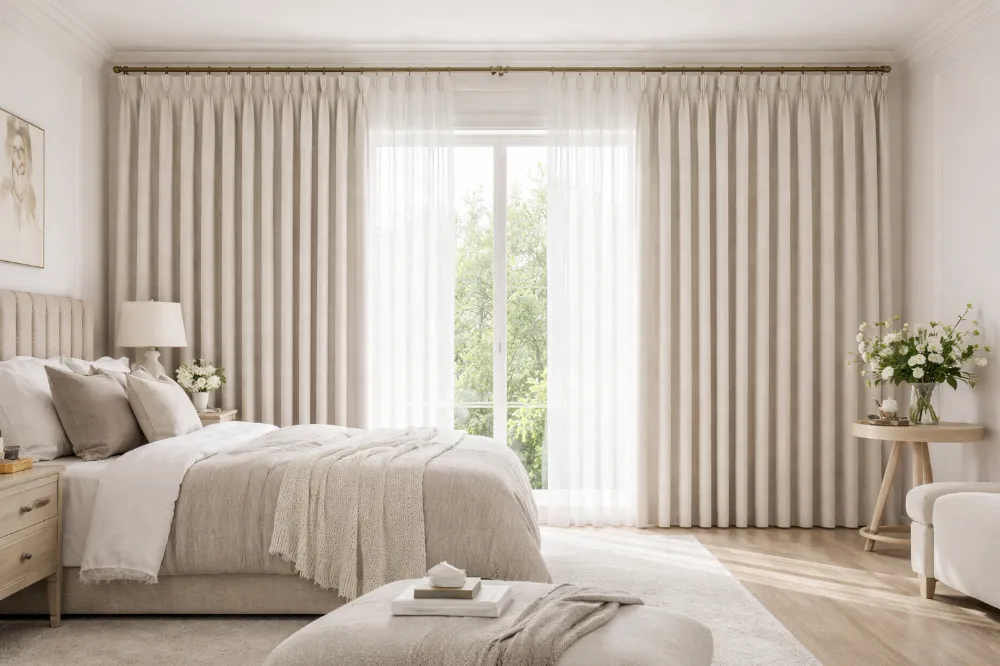
Standard curtains often appear loose and cluttered when drawn, and inconsistent fabric bunching can create a “budget” feel. In contrast, pinch pleat curtains inject a sense of vertical order through fine pleats permanently sewn at the top.
- Structured Visual Stretching: The crisp, upright lines created by the pleats act like “visual tracks” that guide the eye upward. This compensates for the wall space seemingly “shortened” by a raised bed, making the ceilings appear significantly higher.
- More Than Fabric—They Are Decor: They eliminate the need for cumbersome valances. The rhythmic shadows produced by the pleats themselves serve as a high-end textural decoration, perfectly aligning with the Quiet Luxury aesthetic sweeping through 2026.
- Stability of Form: Because the pleats are locked in place with stitching, they maintain a perfect, equidistant wavy flow no matter how frequently they are opened or closed—a professional quality that rod-pocket curtains simply cannot replicate.
2. Expert Buying Points: The Hard Data That Determines Quality
To ensure your investment looks worth every penny, you must move beyond the “buying a piece of fabric” mindset when choosing pinch pleat curtains and focus on these professional parameters defined by industry standards:
Fullness Ratio — Say No to “Thin” Curtains
This is the watershed between a “custom look” and a “cheap look.” Off-the-shelf curtains usually only have a 1.5x width, which causes the fabric to be forced flat when closed, losing all sense of depth and shadow.
- Designer’s Advice: To achieve that deep, symmetrical wave, custom pinch pleats typically require a fullness ratio of 2.0x to 2.5x, with 3.0x recommended for high-end master suites.
- Calculation Example: For a 60-inch wide window, a 2.5x fullness ratio means you need 150 inches of total fabric width. This ensures the curtains maintain rich, voluminous pleat textures even when fully closed.
Fabric Weight (GSM) — The Vitality of the Drape
High-standard pleats require enough physical weight to support them; otherwise, the pleats will “flare out” rather than hang vertically.
- Core Indicator: It is recommended to choose heavyweight fabrics of 350+ GSM, such as high-density linen blends, heavyweight cotton-linen, or velvet.
- Texture Test: High-GSM fabrics not only ensure that the pleats stay straight and crisp from top to bottom but also significantly increase the “tactile value” of the space.
The Designer’s Core Recommendation
To achieve this level of flawless proportional control, selecting custom pinch pleat curtains is the foundation for professional-grade styling. This craftsmanship locks in the fullness ratio of every single pleat through precise factory sewing, providing structural integrity and long-term durability that off-the-shelf options simply cannot provide.
3. Spatial Logic: Reshaping Windows with the “High and Wide” Principle
Once you have chosen the right product, installation is the final, crucial step. We follow the golden rule of the interior design world: “High and Wide”:
- Pulling Upward (High): The curtain rod should not be mounted directly against the window frame; instead, it should be installed 2 to 4 inches below the ceiling. This “floor-to-ceiling” hanging method creates the visual illusion of a taller window and corrects proportional flaws in the bedroom.
- Extending Outward (Wide): The curtain rod should extend 6 to 15 inches beyond the left and right sides of the window frame.
- The Importance of Stack Back: This extension is designed to reserve sufficient “stacking space.” When you draw the curtains open, the thick pleats will stack neatly against the wall rather than blocking the glass. This not only makes the window look twice as grand but also maximizes natural light.
4. 2026 Design Trends: The Evolution of the Senses
In 2026, the bedroom is evolving from a mere “sleeping area” into a “sensory healing space.”
- Colors: Mocha Mousse and Organic Neutrals: Introducing warm neutrals like Mocha Mousse can perfectly balance the pink and green bedroom palettes loved by SYL readers, creating an organic, modern feel.
- Tactility and Biophilic Design: 2026 trends emphasize the raw texture of natural fibers. The combination of pinch pleat craftsmanship with linen fabrics creates a “healing” light-and-shadow effect through the refraction of light between the folds.
- Functional Alignment: Acoustics and Thermal Energy: The multi-layered fabric stacking inherent to pinch pleats provides excellent noise reduction and thermal insulation properties. When paired with professional Blackout Lining, it significantly reduces ambient noise and maintains a constant room temperature. This is not just a visual upgrade, but a systemic reconfiguration of the sleep environment.
Conclusion: An Aesthetic Investment in the Details
A bedroom upgrade is more than just replacing furniture; it is a recalibration of the room’s soul. Pinch pleat curtains transform a window from a mere architectural opening into a visual centerpiece through precise proportional reshaping and an obsession with craft details. When you decide to move from basic light blocking to professional pinch pleats, you are investing in more than just fabric—you are investing in a more refined, orderly, and intentional living space. Trim and tailored, these curtains are the true hallmark of a designer bedroom.
FAQs
Pinch pleat curtains feature evenly sewn pleats at the top, creating structured folds that look tailored and high-end.
They add vertical structure, improve visual balance, and create a calm, designer-level aesthetic ideal for rest spaces.
Yes, their vertical pleats naturally draw the eye upward, enhancing the perception of ceiling height.
A fullness ratio of 2.0x to 2.5x delivers a rich, custom look, while 3.0x suits luxury master bedrooms.
Heavyweight fabrics over 350 GSM help pleats hang straight and maintain their crisp structure.
Custom curtains ensure proper fullness, precise pleat spacing, and long-term durability.
Mount curtain rods 2–4 inches below the ceiling to achieve a floor-to-ceiling visual effect.
Extend the rod 6–15 inches on each side to allow full stacking and maximize natural light.
Yes, their layered fabric construction improves sound absorption and thermal efficiency.
Absolutely they align perfectly with modern, quiet-luxury, and biophilic design trends.