If you are choosing between European oak and American white oak flooring, you are not comparing a bad option to a good one. You are comparing two premium oak looks that overlap in some ways but still create a noticeably different result once they cover an entire room. According to Flooring Titan, both are durable, both are widely used in flooring, and both belong to the white oak family. The real difference usually comes down to color tone, grain character, consistency, and how much natural movement or variation you want to see in the floor.
One detail is worth clearing up right away. “European oak” is not always one single species in flooring language. In practice, it commonly refers to European white oaks such as Quercus robur and closely related Quercus petraea, while “American white oak” usually refers to Quercus alba and related North American white oaks. That matters because published technical values can vary a bit depending on which European source species or grading standard you are looking at.
The look is where most homeowners notice the difference first
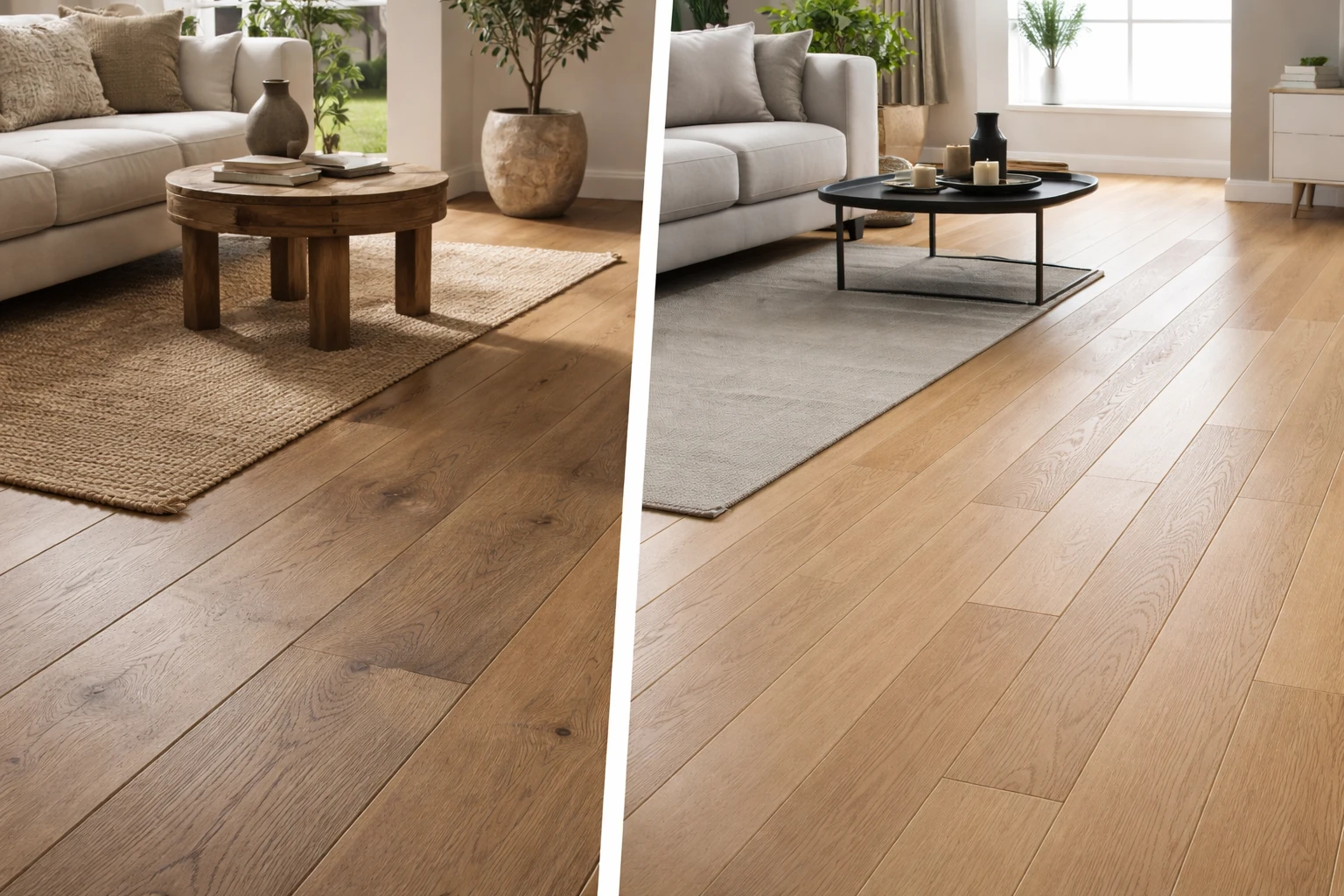
European oak usually reads a little more relaxed and character-rich. The Wood Database describes English oak, a common European reference species, as light to medium brown with an olive cast, and notes that quartersawn sections can show prominent ray fleck. It also describes the texture as coarse and sometimes uneven or irregular. In real rooms, that often translates into a floor that feels a little older, a little softer, and a little more organic.
American white oak usually looks cleaner and a bit more uniform. AHEC describes it as whitish to light brown in the sapwood and light to dark brown in the heartwood, with mainly straight grain and medium to coarse texture. That straighter, more even look is one reason American white oak works so well in interiors that lean modern, tailored, or understated.
This is why the two floors can feel different even when both are finished in light natural tones. European oak often shows more visible variation from board to board, while American white oak tends to feel more controlled and consistent. Neither look is better on its own. It depends on whether you want the floor to feel more edited or more expressive.
European oak often feels more textured and natural
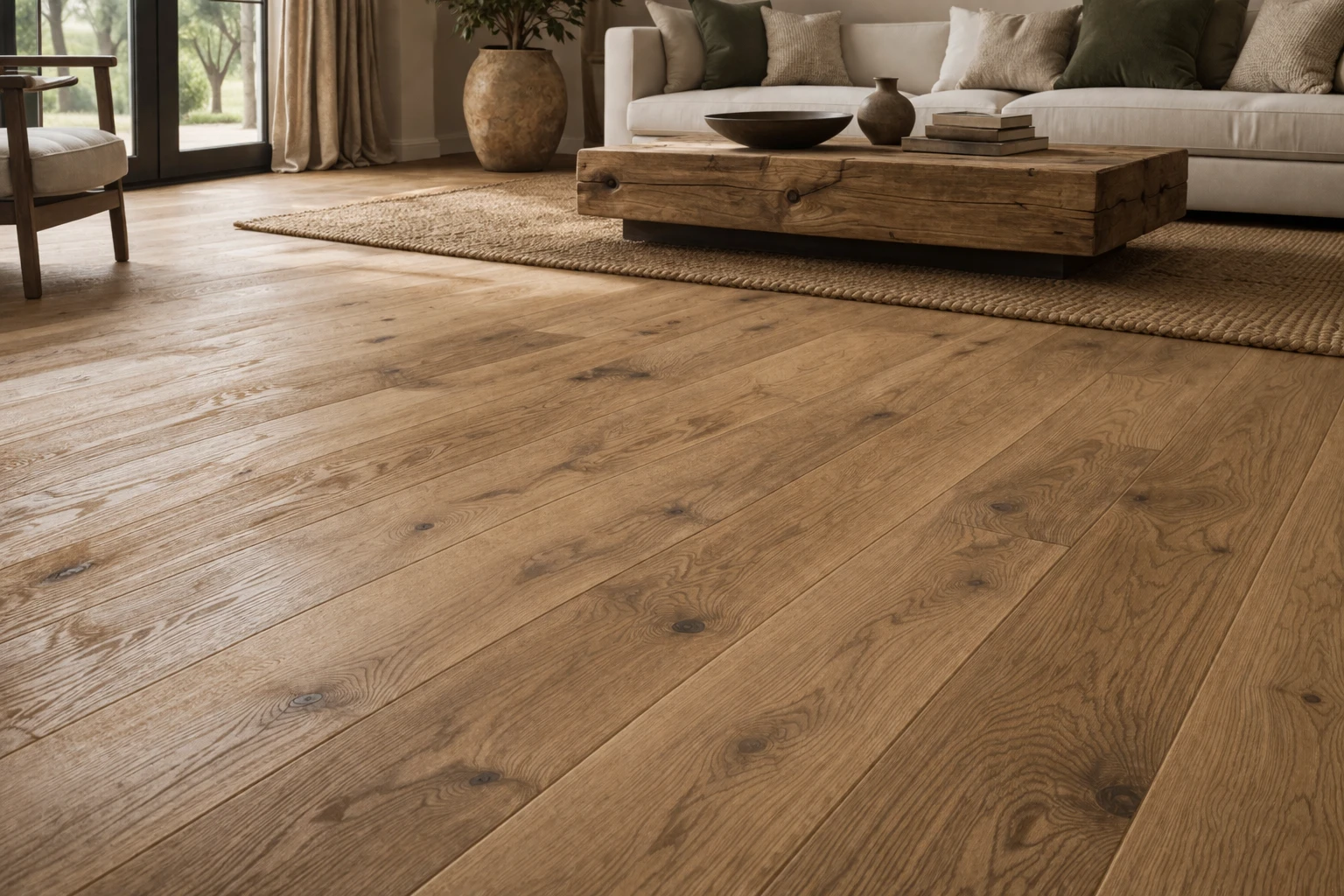
Many homeowners are drawn to European oak because it rarely looks flat. Even in cleaner grades, it often carries a slightly wavier grain personality and a softer visual rhythm. That gives the floor warmth without forcing it into a red or orange direction. The olive-brown cast that appears in English oak is part of why European oak works so well with muted, natural, smoked, and earthy finishes.
It also tends to suit wide-plank flooring especially well from a design standpoint. When the boards are wider, that extra grain character becomes part of the appeal instead of something you are trying to hide. That is one reason European oak is so often associated with wide-plank, natural-finish interiors. The character reads as intentional rather than busy.
American white oak usually looks more uniform and versatile
American white oak is often the safer choice when you want a cleaner baseline. Its grain is generally straighter, and its appearance is easier to keep visually consistent across a larger area. That does not mean it looks plain. It still has medullary rays and classic oak character. But compared with European oak, it usually feels more restrained.
That restraint can be a major advantage. If you want your floor to support the room rather than dominate it, American white oak often does that beautifully. It fits traditional homes, modern homes, and transitional interiors without pulling too strongly in one stylistic direction.
On paper, American white oak is usually a little harder
If you look at published wood-property data, American white oak usually comes out ahead in hardness and weight. The Wood Database lists white oak at about 47 lbs/ft³ and 1,350 lbf on the Janka scale, while English oak is listed around 42 lbs/ft³ and 1,120 lbf. AHEC also says structural testing in Europe confirmed that American white oak has greater inherent fibre strength than European oak.
That difference is real, but it should not be exaggerated. European oak is still a durable flooring wood. Sessile oak, another European white oak, is described by The Wood Database as sharing many of the same traits as American white oak and is rated as having very good resistance to decay. So the practical takeaway is not that one is tough and the other is fragile. It is that American white oak usually has a modest edge in hardness, while the European oak still performs well in residential flooring.
Both handle moisture better than many homeowners realize
Because both woods are in the white oak family, they share one of the qualities that make white oak flooring so respected. White oak heartwood is known for pores that are blocked or less open, which helps resist liquid penetration. USDA wood references explain that white oak pores are typically plugged with tyloses, making the wood far less permeable to liquids. AHEC says the heartwood of American white oak is not porous and is suitable for barrels and exterior use. English oak is also described as having abundant tyloses and very good resistance to decay.
That does not mean either floor is waterproof. It means both have a better natural moisture story than more porous woods such as red oak. In a normal home, that gives both species a strong performance foundation, especially when paired with proper finishing, proper humidity control, and good installation practices.
Movement and stability are not as simple as marketing makes them sound
A lot of flooring content makes this topic sound black and white. It is not.
AHEC notes that American white oak is stable when dry, but also says it has high differential radial and tangential shrinkage and can be susceptible to movement in humid conditions if not properly dried and handled. European oak also has meaningful shrinkage values in published data. So neither wood should be treated like a no-movement material. Both are real oak, and both will respond to indoor humidity.
What usually changes in real projects is not just the species, but the format. European oak is commonly sold in wide-plank engineered flooring, and engineered construction can help control movement better than solid wide boards. That sometimes leads people to think the species itself is dramatically more stable, when part of the benefit is actually coming from the product construction.
Price and sourcing usually favor American white oak in the U.S.
If you are buying flooring in the United States, American white oak often has the advantage in terms of availability and price. It is domestic, familiar, and broadly stocked. European oak is imported, and WOCA notes that it is typically a little more expensive in North America for that reason.
That does not automatically make European oak overpriced. Many buyers are willing to pay more because they want that specific visual character. But if you are trying to control budget while still getting a premium oak floor, American white oak often gives you a very strong value position.
Which one should you choose?
Choose European oak if you want more visible character, a slightly softer and more natural visual mood, and a floor that feels a little more design-forward from the start. It tends to work especially well in wide planks, muted finishes, and interiors where texture matters as much as color.
Choose American white oak if you want a cleaner, more uniform look, a modest bump in hardness, and easier sourcing in the U.S. market. It is one of the safest high-quality choices you can make because it fits so many types of homes and finishes without looking out of place.
The simplest way to frame it is this. European oak usually wins on character. American white oak usually wins on consistency and value. Both are strong flooring choices. The better one is the one that matches the mood you want in the room and the budget you want to live with.
FAQs
The main difference is visual—European oak has more character and variation, while American white oak looks cleaner and more uniform.
No, European oak typically refers to species like Quercus robur and Quercus petraea rather than just one tree type.
Both are durable, but American white oak has a slight edge in hardness based on Janka ratings.
Yes, European oak typically displays more grain variation and natural character from board to board.
American white oak is often preferred for modern spaces due to its cleaner and more consistent look.
Yes, both have natural moisture resistance due to tyloses in their pores, but neither is waterproof.
Not significantly—both can move with humidity changes, though engineered formats can improve stability.
Its natural grain variation looks more intentional and appealing in wider boards.
American white oak is usually more affordable because it is domestically sourced.
Choose European oak for character and texture, or American white oak for consistency, versatility, and value.