Stairways are one of the most common locations for home accidents. Falls on stairs can lead to injuries that range from minor bruises to serious fractures. While stairs are a functional necessity in most homes, they can present significant hazards, especially for older adults, young children, or anyone with mobility challenges. The good news is that many stair-related accidents can be prevented with straightforward, cost-effective modifications that homeowners can implement themselves.
Making your stairs safer doesn’t require a full renovation or professional contractors for every change. Many effective safety improvements involve simple additions or adjustments that take just a few hours to complete. These modifications work by addressing the primary risk factors: poor visibility, inadequate grip, unstable support, and physical obstructions. By tackling these issues systematically, you create a safer environment for everyone who uses your stairs.
Why Stair Safety Matters More Than You Think
Falls on stairs present serious risks that increase with age, as balance, vision, and reaction time naturally decline. However, children and adults in otherwise good health also face dangers on poorly maintained or inadequately equipped stairs. Emergency departments treat approximately 1 million stair-related injuries annually in the United States, highlighting how common these accidents are. Factors like carrying items, rushing, or simply not paying attention can turn a safe staircase into a hazard zone.
Beyond the immediate physical injuries, stair falls can lead to long-term consequences. A serious fall might result in reduced mobility, fear of using the stairs, or even the need to relocate to a single-story home. For older adults, the risks are particularly severe stair falls in the home contribute to hundreds of deaths annually in countries like the United Kingdom, along with hundreds of thousands of injuries. These outcomes affect independence and quality of life. Investing time in preventive modifications protects not only your physical safety but also your ability to age in place comfortably.
Assess Your Stairs Before You Start
Before making any modifications, take time to evaluate your current staircase. Walk up and down slowly, paying attention to areas where you feel unsteady or where visibility is poor. Check whether handrails exist on both sides and whether they feel secure when you grip them. Look for worn carpeting, loose boards, or uneven steps that might catch your foot.
Examine the lighting at different times of day. Stairs that seem well-lit during the afternoon might be dangerously dark at night or early morning. Note any items stored on or near the stairs that could become tripping hazards. This assessment helps you prioritize which modifications will have the greatest impact on safety.
Install Sturdy Handrails on Both Sides
Handrails are one of the most critical safety features for any staircase. Many older homes have handrails on only one side, which limits support options and can be problematic for people who favor one hand over the other. Installing handrails on both sides gives users consistent support regardless of which direction they’re traveling.
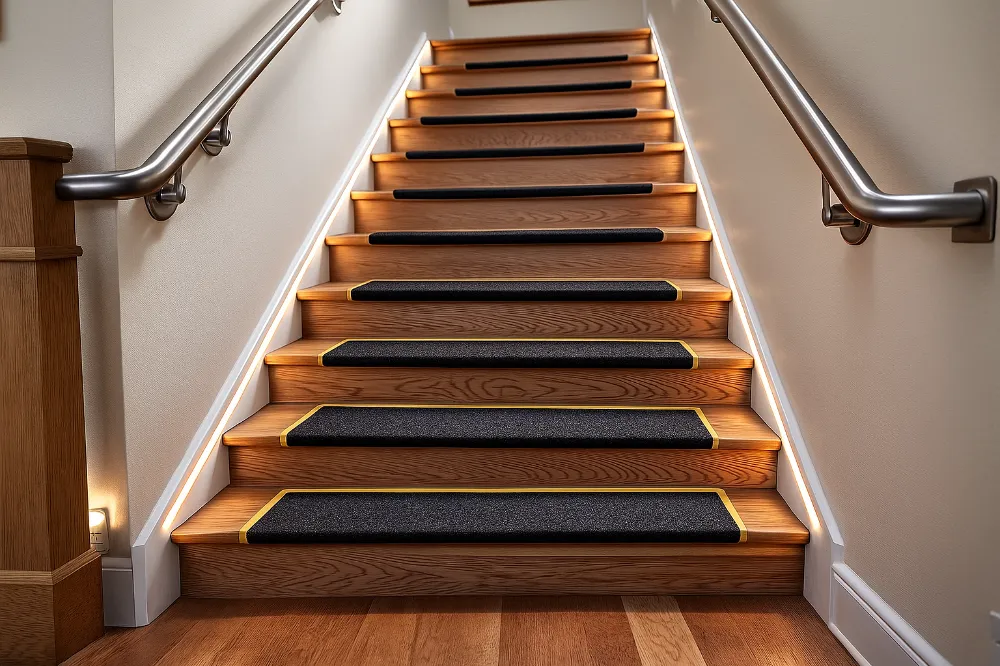
When installing handrails, position them at a comfortable height, typically between 34 and 38 inches from the stair tread surface. Ensure the rails are securely anchored into wall studs or blocking rather than just drywall. The handrail should extend beyond the top and bottom steps to provide support when stepping on or off the staircase. Choose materials that are easy to grip and won’t become slippery when wet.
For households with members who have significant mobility limitations, DIY handrails may not fully address access challenges. In these situations, making homes safer with modern mobility technology like stair lifts can restore independent movement between floors without the physical demands of climbing. These solutions work alongside handrails and other safety modifications to create a comprehensive approach to stair accessibility.
Add Non-Slip Treads to Every Step
Slippery steps are a leading cause of stair accidents. Non-slip treads create friction between your shoes and the stair surface, reducing the likelihood of your foot sliding forward or backward. These treads come in various materials, including rubber, adhesive strips, and carpet-style options that suit different stair types.
For wooden stairs, adhesive-backed treads are straightforward to install and provide immediate traction improvement. Simply clean each step thoroughly, peel off the backing, and press the tread firmly into place. Make sure the treads cover the full width of each step and are positioned consistently. For carpeted stairs that have become worn and slippery, consider replacing the carpet or adding rubber-backed stair runners that grip both the step and your footwear.
Improve Lighting from Top to Bottom
Adequate lighting transforms stair safety by allowing you to see each step clearly and identify potential hazards. Poor lighting ranks among the top contributors to stair falls. The goal is to eliminate shadows and ensure every step is visible from both directions.
Install light fixtures at both the top and bottom of the staircase, controlled by three-way switches so you can turn lights on before descending or ascending. Consider adding motion-sensor lights that activate automatically when someone approaches the stairs. LED strip lights installed along the handrail or under the nose of each step provide subtle but effective illumination without harsh glare. Night lights are especially valuable for middle-of-the-night trips. If you’re planning broader home updates, you might also explore simple ways to modernize your home that incorporate improved lighting throughout your space.
Mark the First and Last Steps Clearly
The first and last steps are where many falls occur because people misjudge where the stairs begin or end. Visual markers help your eyes and brain register the transition between level floor and staircase. High-contrast tape, paint, or tactile strips applied to the edge of these steps create clear boundaries.
Choose colors that stand out against your existing stair material. Yellow, white, or reflective tape works well on dark stairs, while black or dark blue suits lighter surfaces. The marking should extend across the full width of the step and be positioned at the very edge where your foot makes contact.
Remove Clutter and Secure Loose Carpeting
Keeping stairs clear seems obvious, but clutter accumulates easily. Shoes, bags, toys, and other items left on steps become tripping hazards. Establish a household rule that stairs remain completely clear at all times. Designate storage areas at the top and bottom of the staircase for items that need to be carried up or down.
If your stairs are carpeted, check regularly for loose areas, worn spots, or lifting edges. Loose carpeting can catch your toe and cause a fall. Use carpet tacks or adhesive to secure any problem areas immediately. If the carpet is extensively worn, replacing it may be more effective than repeated repairs.
Consider Adding a Second Handrail for Extra Support
Some staircases, particularly wider ones, benefit from a center handrail in addition to rails on both walls. This configuration provides support no matter where on the staircase someone is walking. Center handrails are especially helpful for people who need to grip with both hands for stability.
Installation of a center handrail requires mounting posts at the top and bottom of the staircase. This modification is more involved than wall-mounted handrails but significantly improves safety for users with balance concerns.
Use Contrasting Colors to Define Each Step
Visual contrast helps the eye distinguish one step from another, reducing the risk of missteps. Stairs that are all one color can appear as a flat surface, making depth perception difficult. Adding contrasting tape or paint to the edge of each tread creates visual definition.
This modification is particularly valuable for individuals with vision impairments or depth perception challenges. The contrast doesn’t need to be dramatic; it just needs to be noticeable enough that each step edge is clearly defined.
Maintain Your Modifications Regularly
Safety modifications only work if they’re properly maintained. Set a schedule to inspect your stairs quarterly. Check that handrails remain secure, treads haven’t lifted or worn through, and lighting still functions properly. Replace batteries in motion-sensor lights and LED strips as needed. Following a seasonal home maintenance checklist can help you stay on top of these regular inspections alongside other important home tasks.
Clean stairs regularly to prevent the buildup of dust, dirt, or spills that can create slippery conditions. Address any new damage or wear immediately rather than waiting for it to become a serious hazard.
For older adults or individuals recovering from surgery or illness, maintaining stair safety can become physically challenging. In these situations, professional support from providers like the Friends & Family Home Care team can help ensure that safety checks are performed consistently and that stairs remain properly maintained. Home health aides assist with daily tasks that include monitoring the home environment for hazards, helping to keep stairways clear and functional for safe use.
When to Call a Professional
While many stair safety modifications are suitable for DIY installation, some situations require professional help. Structural issues like loose steps, damaged stringers, or unstable railings need expert assessment and repair. If you’re uncomfortable working with electrical wiring for lighting improvements, hire a licensed electrician.
Homes with particularly steep, narrow, or irregularly shaped stairs may benefit from professional design consultation to determine the most effective safety modifications. The investment in professional services is worthwhile when it ensures proper installation and long-term safety. For more complex projects, consider reviewing easy DIY projects to update your house to understand which tasks you can confidently tackle yourself versus those that need expert attention.
Final Thoughts
Improving stair safety through DIY modifications is one of the most practical investments you can make in your home. These changes protect everyone who uses your stairs while allowing you to maintain independence and comfort in your living space. Start with the modifications that address your most significant risk factors, then work through additional improvements over time. The effort you put into making your stairs safer today can prevent serious injuries and enhance your home’s livability for years to come.
FAQs
Installing sturdy handrails on both sides provides the most significant safety improvement for most staircases.
Non-slip treads typically cost between $1 and $5 per step, depending on material quality and style.
Battery-powered motion-sensor lights and LED strips are safe DIY options that don’t require electrical wiring.
Quarterly inspections help you catch wear or damage early and maintain effective safety features.
Handrails should be positioned between 34 and 38 inches above the stair tread surface for optimal support.
Carpeted stairs can provide better traction, but only if the carpet is in good condition and properly secured.
Building codes vary by location, but most jurisdictions require handrails on at least one side for residential stairs.
Motion-sensor lights at both ends of the staircase and LED strip lighting along the handrail dramatically improve visibility.
Steep stairs may require professional evaluation for structural modifications or alternative access solutions.
Most high-quality contrast tapes remove cleanly, but test on an inconspicuous area first to ensure compatibility with your stair finish.