Railings are quite a paradox in home design. On one hand, they are a must for safety; on the other, they can totally change the look of a room. Regular, builder-grade railings are a bit dull. They only meet safety code requirements but dont bring any charm to the home. On the other hand, custom railings cleverly handle both aspects, they give you the best safety performance and at the same time they become a significant part of the home design, both interior and exterior, instead of being just utilitarian necessities.
One can visibly see the gap between standard and custom when looking at two such projects side by side. Generic railings are like minimum code, compliant dimensions and materials are mainly chosen for their low cost. Custom job takes into account not just the safety requirements of the family, the architectural style, but also how the railing will be visually perceived from different perspectives. Such a thorough approach inevitably leads to results that exceed the performance of the commodity ones in every aspect.
Safety Performance Beyond Minimum Code Compliance
Building codes set out the minimum safety standards that should be followed to avoid the worst situations but they are not designed to address the specific safety needs of each household. Custom railing design gives an opportunity to take into account the needs that a generic installation simply overlooks planning for a home with small children or elderly residents, or a person with a disability, and how the spaces will be lived in on a daily basis.
Handrail height and positioning are very important for safety but are given very little consideration in the standard installations. Adults of different heights will find different positions of handrails comfortable and safe. Kids going up and down the stairs will need a lower rail than standard adult, height installations do not offer. Custom design focuses on these differences instead of making a compromise on everybody that has to adapt to the same solutions which are not good for the majority of users.
Architectural Integration That Enhances Property Design
Railings should be the architectural style of a home that they are part of, not a generic element that could have been placed anywhere. A properly designed railing can help to preserve the character of the period in a historic home, giving a contemporary look to a modern house, or provide the transition element between two styles of the same home that feature different architectural styles.
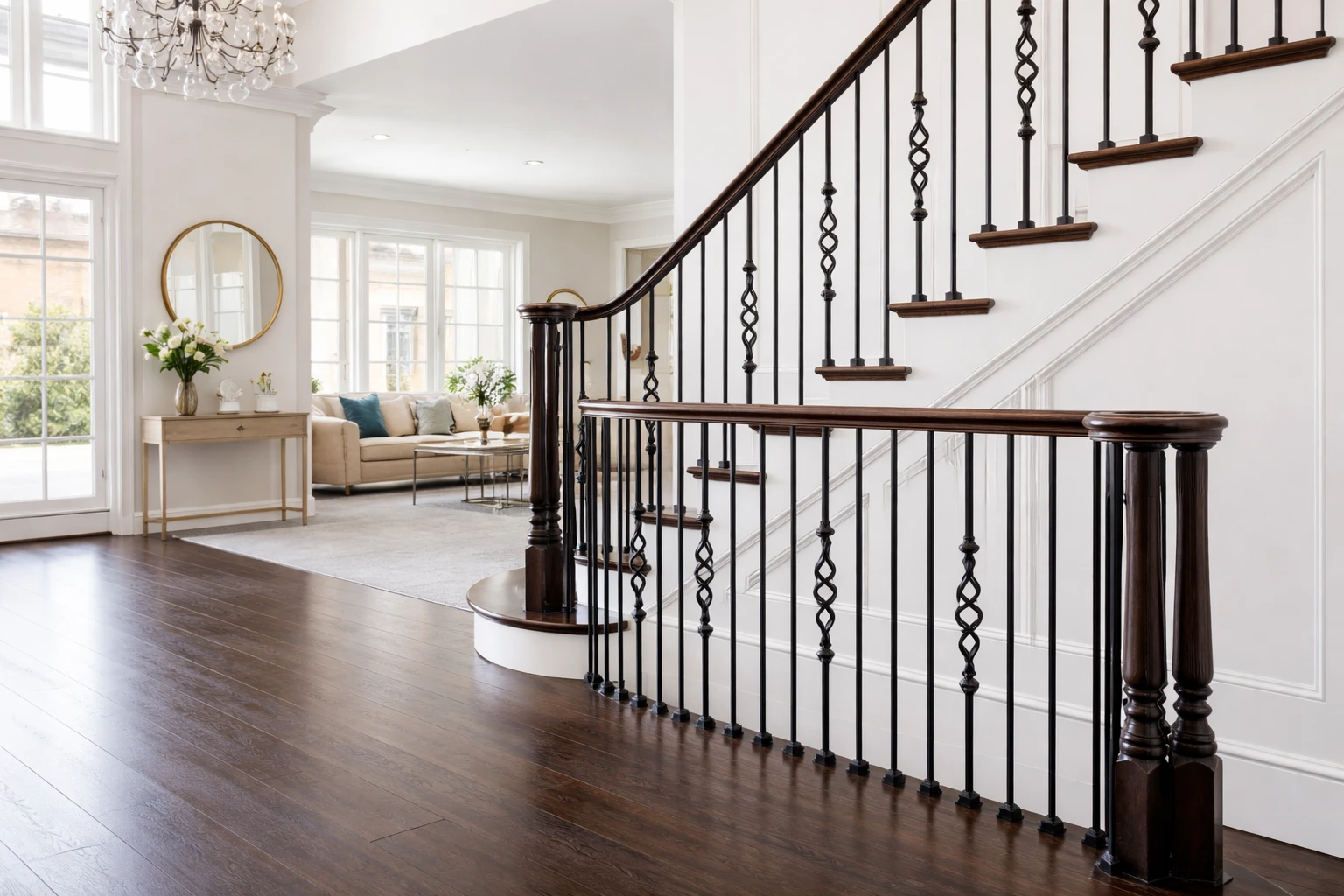
The materials chosen for railings can give a dramatic first impression. A wooden railing made of a kind of wood and in a finish that is compatible with the flooring, trims, and cabinetry can give a smooth flow to the whole interior design. A metal railing, in a finish that reflects the shape and color of the fixture, lighting, or hardware, can unite the design schemes that without it might have seemed discordant. Glass panels offer a modern style with transparency that not only lets more light in but also allows better sightlines, which is something that traditional balusters cannot do.
Custom Solutions for Challenging Spaces
Standard railing systems are designed with the assumption that the installation conditions will be simple straight runs, standard angles, and level surfaces. Generic solutions do a poor job or simply cannot accommodate real homes’ complications that are frequently presented by real homes. Custom fabrication addresses these problems to a greater extent than letting compromise installations that look wrong and may not even be safe.
Curved staircases need railings that closely follow the compound curves of the stairs rather than approximating the curves by several straight sections. The accuracy of the curve matters not only visually but also for the functionality of the handrails that should flow continuously through the curves without the addition of abrupt changes in direction which, besides, a user might lose their grip. Custom fabrication is capable of producing such complex geometries correctly instead of settling for an approximation.
Where railings meet floors, landings, or adjoining railings at non-standard angles, the problem needs to be solved correctly. Standard systems use generic angle fittings that often don’t match site-specific conditions precisely. Custom work measures actual angles and fabricates components that fit correctly, producing clean intersections rather than gaps, overlaps, or obviously forced connections that advertise poor workmanship.
Outdoor installations face environmental challenges that standard interior railings aren’t designed to handle. Exposure to moisture, temperature fluctuations, and UV radiation requires material selection and finish treatments that will perform across years of weathering. Specialists like sihandrails understand these requirements and specify accordingly rather than treating exterior railings as simple extensions of interior work.
Material Options and Performance Characteristics
Wood railings bring a cozy feel and a traditional touch that a lot of homeowners like to see in their interiors, and they can even be used in some exterior situations. Which type of wood is chosen will determine not only the look but also the durability of the railing. Hardwood species such as oak and maple are very resistant to wear thus ideal for stairs where there is heavy traffic, but softer wood species may be fine for areas where there is less usage. How a wood finish is handled plays a crucial role in how much the wood will need to be cared for and how its look will evolve with time.
Metal railings can look like just about anything from elaborate wrought iron to stark stainless steel. Hence, the decision should be based on the home’s overall style and the specific functional requirements of each place. Steel can offer great strength even when it is used in very thin sections. Aluminum is a suitable choice for outdoor use as it has good resistance to rust. Bronze and brass, being materials that are quite different from the usual ones, add to the look but come with a higher price tag.
Return on Investment and Property Value
Top-caliber tailored railings are authentic home upgrades that raise the market value of a property, not just down the street. The real estate agents who talk about the subject have pointed out that the presence of tastefully designed railings can be conveyed through the creation of a first positive impression and the overall appearance of a property, the aspects which have been proven to influence buyer evaluation and, eventually, the prices of the final sale.
Besides, the safety features brought about by the custom railings to a home can evidently be quantified in cases of involvement of families with small kids and/or senior persons. The avoid changes of harm by the design of the structure and the manner of use, delivering an economic benefit; formula, wise, the change might not be precisely quantifiable (the exact value of the changes indeed is difficult to be calculated), but it definitely is more than the amount the customer agrees to pay for the personalized/additional work as compared to the generic alternatives. The safety return on investment (ROI) in this case is valid even if it does not affect the market price at the time a property is put up for sale.
Selecting the Right Fabrication Partner
The level of skill and quality standards of a fabricator is what makes custom railings really give their potential benefits or just be more expensive than the generic ones without giving you any significant improvement. Vetting potential fabricators thoroughly is a sure way of not making costly mistakes and at the same time, getting results that justify your working capital.
Looking at a portfolio is the best way to see a firm’s ability to design and quality standards even better than through marketing materials or price quotes.
Similarly, viewing the finished projects is the way to see a fabricator’s work in material selection, finish quality, connection details, and the overall refinement that separates superlative work from just good execution.
References should be requested, and previous clients should be contacted to get a sense of their experience beyond what carefully curated portfolios reveal.
FAQs
Yes. Custom railings can be designed to exceed minimum building code requirements and accommodate specific household needs such as children, seniors, or individuals with mobility concerns.
Absolutely. Even fully customized railings must comply with local building codes, but they can be designed to go beyond the minimum safety standards.
It depends on the location and design goals—hardwoods like oak are durable for interiors, while aluminum or stainless steel are ideal for outdoor environments due to corrosion resistance.
Yes, when built with tempered or laminated safety glass, they are extremely strong and provide both safety and unobstructed visibility.
With proper material selection and maintenance, custom railings can last decades, especially when fabricated with high-quality finishes and installation techniques.
Well-designed custom railings can enhance first impressions and architectural cohesion, which may positively influence buyer perception and resale value.
Yes. Custom fabrication allows railings to precisely follow curved or complex stair geometries, ensuring both safety and visual continuity.
They typically cost more upfront, but the added durability, design integration, and safety performance often justify the investment.
Consider your home’s architectural style, daily usage patterns, safety needs, and long-term maintenance preferences before selecting materials and design details.
Review their portfolio, inspect past projects if possible, check references, and ensure they understand both safety compliance and architectural integration.