If you spend time in regional Australia recently, and you talk to a cafe owner who is unable to hire employees, a nurse who has to drive an hour to work in each direction, or a tradesperson with months of bookings, you will likely have noticed it: housing (or the lack of it) is becoming part of everyday life. Off-site construction will not change everything, but it will eliminate some of the largest bottlenecks that have prevented the appearance of new homes in the areas where they are most needed.
The key to its success lies in its application to the correct sites, to the correct types of houses, and to the correct local “last-mile” planning, because the issues of regional housing shortages cannot simply be discussed within the context of building problems. They are an organizational issue.
Why the Regional Housing Crisis is Unique
The housing shortage is challenging in the city, but crippling in a regional town. Squeezed by low vacancy rates, it is not only the renters who lose as local employment suffers due to loss of applicants; some hospitals fail to fill rosters and small businesses reach a limit since a new employee has no home.
And the squeeze has been real. In recent data, rental affordability has continued to decline further in the regional areas of Australia, and in some areas is now less affordable than in their capital-city equivalents as incomes tend to be lower, and the levels of rent have generally increased. Very low rental vacancy rates (in its quoted figures 1.7 percent) in the regions have also been noted as pointed out by the Regional Australia Institute, which is one reason why “just build more” becomes a desperate discussion in the pub, the council meeting and the school pick-up line.
However, this is where most people miss the point: regional housing is more difficult to provide because labor, subcontractors, materials, inspections and even the number of builders willing to accept a project are all stretched—often 3-5 hours away. So despite having funding, the schedule can be derailed.
What is Off-Site Construction? (Modular vs. Prefab)
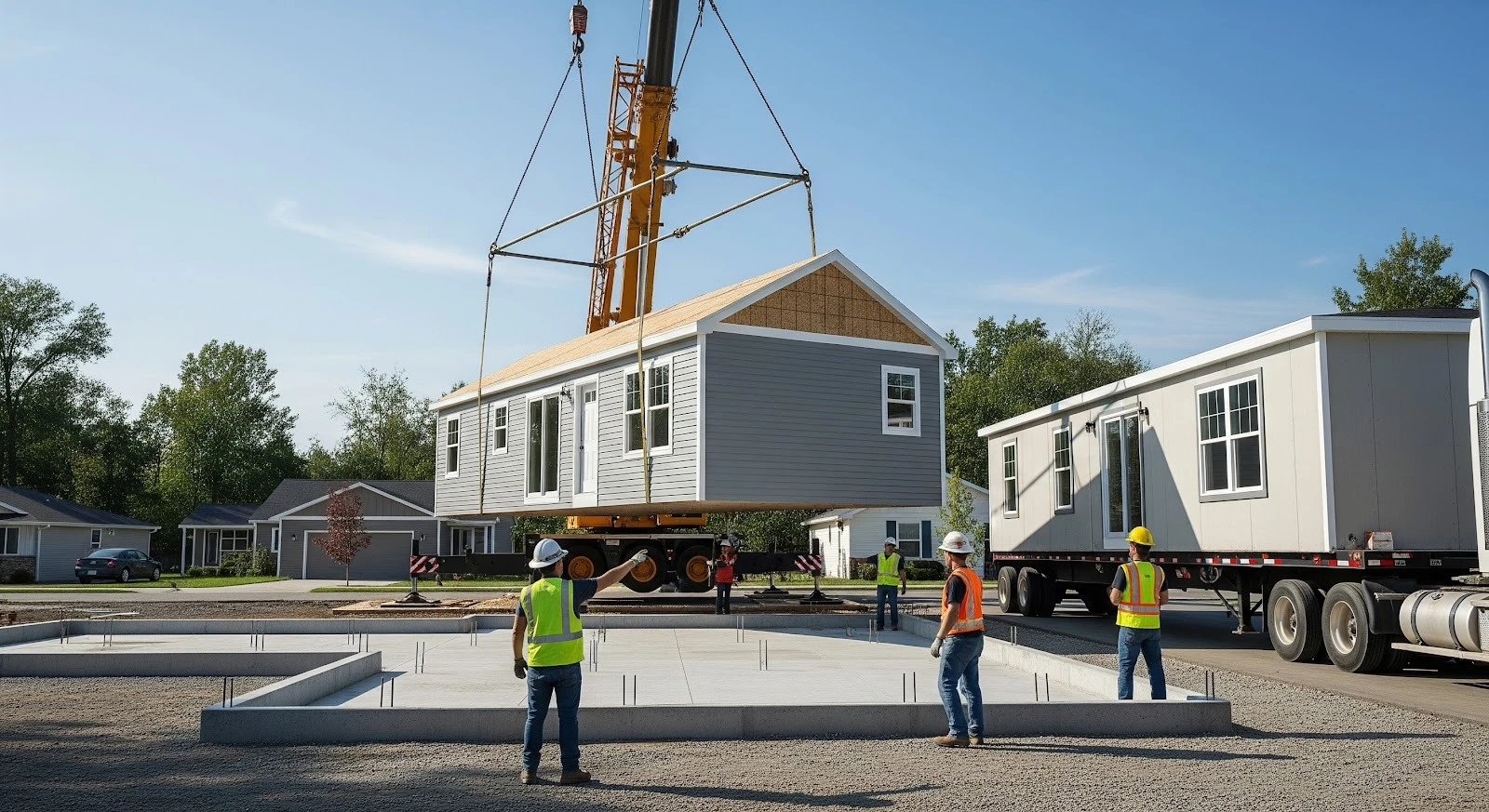
Off-site construction is an umbrella term which describes the construction of sections of a house (or even nearly an entire house) in what can be termed a factory, and then the delivery and assembly on-site. Consider modular constructions (complete rooms or even boxes), panel based constructions (walls and floors constructed as panels), or a combination of both in which major parts can be made elsewhere and completed in place.
This is the place where individuals tend to jump directly to prefab houses—but the greater thing is not the stereotype or the aesthetic. It is the workflow: you are moving part of the labor to a more controlled environment where rain delays, site access problems and “the plumber did not turn up” issues are not bringing the schedule to a crawl.
Properly done, off-site construction may also be carried out in parallel: as the site is being prepared (earthworks, services, slab), the building is being fabricated elsewhere. The reason behind this is because off-site techniques are promoted as quicker than conventional construction, and some projects in the industry have reported that 30-50 percent less on-site construction time occurs.
Best Use Cases for Off-Site Housing in Regional Areas
Off-site is successful when the issue is speed and repeatability.
Where it Accelerates Delivery
- Housing to workers and services: When a regional health service requires 10 homes for the rotating staff, a standardised design fast to be delivered is more crucial than a personalised finishing. The social worth of keys in doors is enormous.
- Minor subdivisions with foreseeable lots: In cases where you have several identical blocks, off-site providers will be in a position to generalise designs and minimise rework. Less tailored detailing typically refers to fewer delays.
- Remote or weather-prone locations: In the case of a town with a limited good building season, minimizing on-site time can be a useful benefit and not merely a “this-would-be-a-good” feature.
- Regions with sustained trade shortages: Off-site can minimize the hours of specialist trade required on-site which can come in handy when your area has two sparkies and they are both in demand.
Where it May Struggle (Limitations)
- Very bespoke houses on difficult locations: The steep blocks, odd bushfire needs, or a complicated architectural design may be still done off-site but the advantages are reduced when every module is a one-off.
- Constraint of long-distance transport: The big modules must travel. When the road network requires small roads, load-limited bridges, or expensive escorts, expenses soar very fast.
- Towns that are averse to “cookie-cutters” results: There are communities with a deep local character. In the event the off-site is synonymous with a lack of design, the backing of the community may be lost.
The most practical approach to it: off-site construction is most robust when you are attempting to produce good homes, fast, in large volumes—not when attempting to produce a modified dream home in which you constantly need to make alterations along the way.
5 Ways to Scale Off-Site Construction in Australia
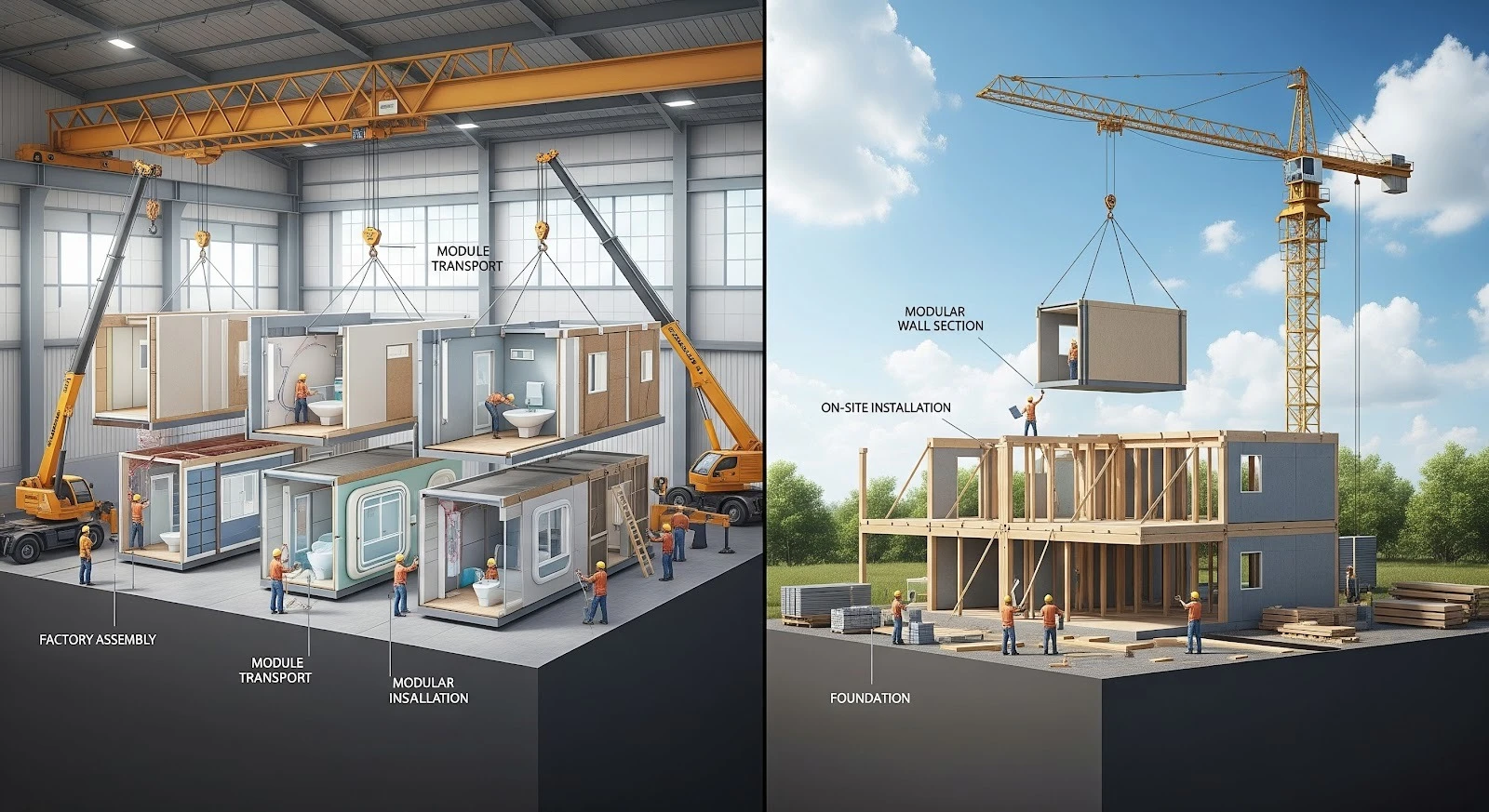
Off-site construction has the benefit that it can construct faster, but has no means of repairing broken inputs on its own. A couple of factors must fall into place in case regional Australia wants it to leave a mark.
1) Reward speed planning (that does not compromise quality).
A lot of latency precedes a swing of a hammer. Off-site is much feasible with councils and state systems that can pre-approve a collection of compliant designs—or repeat building fast. When every individual home must be re-invented in the approvals, the factories will not stand to benefit from standardisation.
2) Finance and insurance that are aware of the process.
Off-site construction is not always congruent with the old school payments on progress. When a huge portion of value is generated in a factory early, lenders and insurers require processes which capture the reality. It is essential as it prevents buyers from getting stuck in the construction process even in cases where it is sound.
3) Installation and finishing capability, locally.
Someone also has to undertake site works, connect services, build kitchens, complete decks, and final compliance even when the components are factory-built. There will not be many towns where the winning model will be to “drop a house from the sky.” It will be manufactured centrally, assembled locally, and local trades will remain engaged (local money, local).
4) More in line with the housing targets and actual demand.
Australia has established a big housing agenda, with a National Cabinet target of 1.2 million new well-located homes within 5 years of 1 July 2024. However, independent reporting on the topic of the State of the Housing System has cautioned that Australia is set to fall short of that target and identified the capacity and productivity issues in the construction sector as one of the limits.
There, off-site can also come in—not as a new product, but a capacity multiplier. Even in the Australian property market, where sentiment swings and interest rates can change the mood overnight, the structural issue is that supply struggles to keep up when the delivery system is stretched.
Conclusion
Off-site construction can certainly contribute to alleviating the housing shortage in the regions of Australia, however, only when it is considered as a delivery strategy, rather than a buzzword. It is particularly efficient in the projects which require to occur on a small scale, numerous lots, and less on site trade hours and less weather pauses.
The most realistic alternative is not the one when the off-site substitutes the traditional building. It’s off-site fills the gaps the traditional building cannot cover quickly enough so the towns of regions can retain much-needed workers, contribute to local development, and provide people with a decent chance to find a place to live without the need to pause their lives.