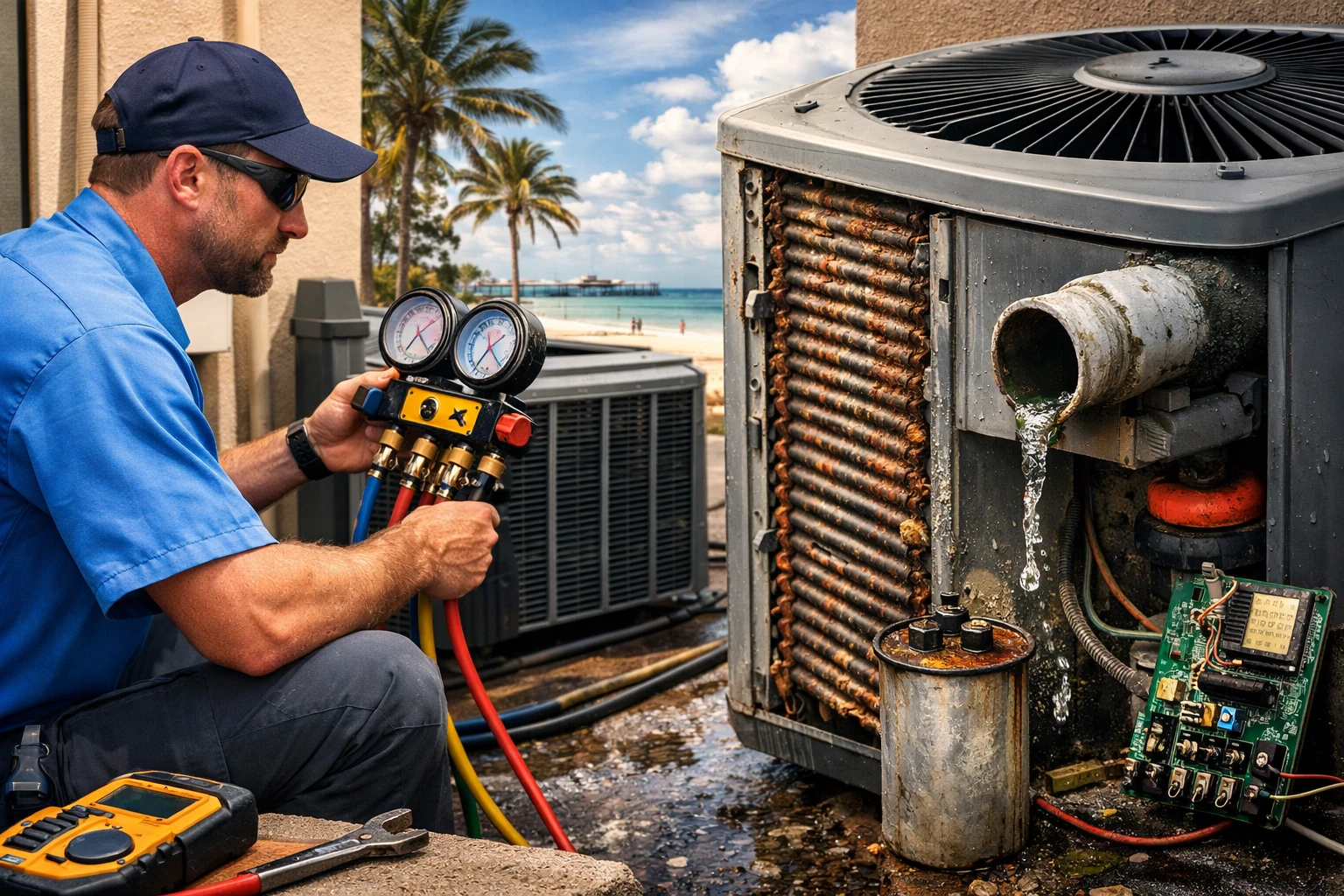
In Clearwater’s subtropical climate, where summer temperatures regularly exceed 90°F and humidity hovers near 75%, a functioning air conditioning system isn’t optional—it’s essential for health and safety. Yet many homeowners wait until their AC fails completely before seeking professional help, often during the worst possible time: the peak of summer.
Professional AC repair and maintenance do more than restore comfort. They prevent costly emergency breakdowns, improve indoor air quality, and can reduce energy bills by up to 15%. This guide examines what Clearwater homeowners need to know about AC repair services, common system failures, and how to choose qualified contractors in the Tampa Bay area.
Common AC Problems in Clearwater’s Climate
Florida’s coastal environment creates unique challenges for air conditioning systems. Salt air accelerates corrosion of outdoor components, while constant humidity promotes mold growth in ductwork and drain lines. Understanding these regional issues helps homeowners recognize problems early.
The most frequent AC failures in Clearwater include:
- Refrigerant leaks: Corroded coils allow refrigerant to escape, reducing cooling capacity and forcing the compressor to work harder. The EPA estimates that a system low on refrigerant can increase energy costs by 20%.
- Clogged condensate drains: High humidity means AC systems in Florida remove gallons of moisture daily. When drain lines clog with algae or debris, water backs up and can damage ceilings or trigger safety shutoffs.
- Capacitor failures: The intense heat in attics and outdoor installations degrades capacitors faster than in cooler climates, often causing the system to struggle starting or run inefficiently.
- Thermostat malfunctions: Incorrect placement near heat sources or direct sunlight causes false readings, leading to short cycling and uneven temperatures.
Addressing these issues promptly prevents minor problems from escaThree Guys A/C & Electricallating into complete system failures. Clearwater homeowners can address AC problems from Three Guys A/C & Electrical, Mahle Cool Air, or Blair’s Air Conditioning for climate-specific repair solutions.
The Real Cost of Deferred Maintenance
Skipping annual AC maintenance might save $100 in the short term, but the long-term costs are substantial. Research from the Air Conditioning Contractors of America shows that neglected systems lose approximately 5% of their efficiency each year, while properly maintained units retain up to 95% of their original efficiency.
Regular professional service delivers measurable benefits:
- Lower utility bills: Clean coils and proper refrigerant levels reduce energy consumption. A well-maintained 3-ton AC unit can save $200-400 annually compared to a neglected system.
- Fewer emergency repairs: Technicians catch worn belts, failing capacitors, and refrigerant leaks before they cause breakdowns. Emergency repairs typically cost 2-3 times more than scheduled maintenance visits.
- Extended equipment life: AC systems in Florida face harsh conditions. With proper care, a quality unit should last 12-15 years; without it, expect replacement after 8-10 years.
- Improved indoor air quality: Regular filter changes and coil cleaning reduce allergens, mold spores, and particulates circulating through your home.
When AC Emergencies Strike: Immediate Steps
AC failures don’t follow business hours. When your system quits on a 95-degree Saturday afternoon, knowing what to do before the technician arrives can prevent further damage and help you stay safer in the heat.
Take these immediate actions:
- Check the obvious first: Verify the thermostat is set to “cool” and the temperature setting is below room temperature. Confirm the circuit breaker hasn’t tripped and the outdoor disconnect switch is on.
- Inspect the air filter: A completely clogged filter can cause the system to shut down. If it’s visibly dirty, replace it—this alone sometimes restores function.
- Clear the outdoor unit: Remove any debris, leaves, or vegetation blocking airflow around the condenser. Maintain at least two feet of clearance on all sides.
- Document the problem: Note any unusual sounds, smells, or error codes before the system stopped. This information helps technicians diagnose issues faster.
- Manage indoor heat: Close blinds, use fans, and stay hydrated. If temperatures become dangerous, especially for elderly family members or those with health conditions, consider relocating temporarily.
Having access to 24-hour emergency AC repair is crucial in Florida’s climate. Prolonged exposure to extreme indoor heat poses serious health risks, particularly for vulnerable populations.
AC Installation Considerations for St. Petersburg Homes
Installing a new air conditioning system represents a significant investment—typically $5,000-12,000 for a complete residential system. Making informed decisions during installation affects comfort and operating costs for the next 12-15 years.
Critical installation factors include:
- Proper sizing: Oversized units cycle on and off frequently, failing to dehumidify properly and wearing out faster. Undersized systems run constantly without achieving comfortable temperatures. Professional contractors perform Manual J load calculations to determine the correct capacity for your home’s square footage, insulation, window area, and orientation.
- SEER ratings: Florida’s climate justifies investing in higher-efficiency equipment. While the federal minimum is 14 SEER, units rated 16-20 SEER significantly reduce operating costs.
- Ductwork assessment: Even the most efficient AC system underperforms with leaky or poorly insulated ducts. Studies show that typical duct systems lose 20-30% of conditioned air. Quality contractors inspect and seal ductwork as part of installation.
- Humidity control: In St. Petersburg’s humid climate, consider systems with enhanced dehumidification or variable-speed air handlers that remove more moisture than single-stage units.
Beyond equipment selection, maximize efficiency through home improvements:
- Programmable thermostats: Smart thermostats learn your schedule and adjust temperatures automatically, reducing runtime when you’re away without sacrificing comfort when you’re home.
- Air sealing and insulation: Sealing air leaks around windows, doors, and penetrations prevents conditioned air from escaping. Adequate attic insulation (R-30 to R-38 in Florida) reduces heat gain.
- Window treatments: Solar screens, reflective films, or cellular shades on south and west-facing windows significantly reduce cooling loads.
The Electrical Component: Often Overlooked, Always Critical
Air conditioning systems are complex electrical appliances. The outdoor condenser alone draws 15-20 amps, while the entire system involves multiple motors, capacitors, contactors, and control boards. Electrical problems account for roughly 40% of AC service calls.
Professional electrical service matters for several reasons:
- Safety: Faulty wiring, loose connections, or failing components create fire hazards. Capacitors store dangerous electrical charges even when power is off. Only trained technicians should handle AC electrical repairs.
- System protection: Voltage irregularities, inadequate wire sizing, or improper grounding damage expensive components like compressors and control boards. Proper electrical service includes checking voltage, amperage, and connections.
- Code compliance: Electrical work must meet National Electrical Code and local requirements. Unpermitted or improper work can void insurance coverage and create liability issues when selling your home.
- Efficiency: Corroded connections increase resistance, causing motors to draw more current and generate excess heat. This reduces efficiency and shortens component life.
During routine maintenance, qualified technicians test electrical components, measure voltage and amperage, inspect wiring for damage, and verify proper grounding—preventive measures that avoid costly failures.
Maintaining Comfort Through Professional Service
Reliable air conditioning in Clearwater isn’t about luxury—it’s about maintaining a safe, healthy home environment in one of the country’s hottest, most humid regions. Professional AC repair and maintenance protect your investment, reduce operating costs, and ensure your system performs when you need it most.
The key takeaways for Clearwater homeowners:
- Schedule annual maintenance: Spring service appointments prepare your system for summer’s demands and catch problems before they cause breakdowns.
- Address problems promptly: Strange noises, weak airflow, or rising utility bills signal developing issues. Early intervention prevents minor repairs from becoming major expenses.
- Choose qualified contractors: Verify licensing, insurance, and references. Quality service costs more upfront but saves money through proper repairs and longer equipment life.
- Invest in efficiency: Whether maintaining an existing system or installing new equipment, prioritize energy efficiency. Lower operating costs offset higher initial investment within a few years.
Your air conditioning system works hard in Florida’s demanding climate. Professional service ensures it continues protecting your family’s comfort and safety year after year.
FAQs
You should schedule professional AC maintenance at least once a year, ideally in spring before peak summer heat begins.
Refrigerant leaks, clogged condensate drains, capacitor failures, and thermostat issues are the most frequent problems due to heat and humidity.
Yes, Clearwater’s coastal salt air accelerates corrosion on outdoor components, which can lead to refrigerant leaks and electrical failures.
Low refrigerant, dirty coils, clogged filters, or thermostat malfunctions are common causes of reduced cooling performance.
Yes, routine maintenance improves efficiency, lowers energy bills, prevents emergency repairs, and extends system lifespan.
With proper maintenance, most systems last 12–15 years, but neglected units may need replacement in 8–10 years.
Check the thermostat, breaker, and filter first, then call a licensed technician and take steps to reduce indoor heat.
A qualified contractor should perform a Manual J load calculation to determine the proper system capacity.
Yes, faulty wiring, failing capacitors, or voltage irregularities can reduce efficiency and cause system breakdowns.
Regular maintenance, sealing air leaks, upgrading insulation, and using a programmable thermostat can significantly reduce energy bills.