Most feng shui bed position advice gives you one rule: put the bed where you can see the door, keep a solid wall behind the headboard, and make sure your feet don’t point toward the entrance. That rule is real. It comes from the form school tradition of feng shui an ancient Chinese art and practice for arranging living spaces and environmental psychology research confirms that people sleep better when they have a clear sightline to the room’s entry point.
But that rule leaves you with a problem. In most bedroom layouts, two or three walls satisfy the “see the door” requirement. The commanding position tells you what to avoid, but it does not tell you which of those remaining walls is actually best for your bed. Your bed is the most important piece of furniture in the room, and where you place it determines whether the bedroom plays a restorative role or works against you. Bedroom feng shui goes deeper than most guides suggest.
We ran a classical compass analysis on a one-bedroom apartment in San Diego using traditional feng shui systems that most feng shui bed placement guides never mention. The wall that looked like the most natural choice tested as the worst option. A less obvious wall scored highest on both personal energy alignment and structural energy flow. Here is what we found and why it matters for anyone looking to feng shui the bedroom beyond basic layout tips.
The Commanding Position: Why It’s Necessary but Not Sufficient
The commanding position sometimes called the command position is the one feng shui bed position rule every school agrees on: locate the bed so you can see the bedroom door without being directly in line with it. A solid wall should support the headboard behind you. You want a diagonal view to the entrance, not a straight shot from the foot of the bed to the doorway. This placement creates a sense of security that allows the body to fully recharge during sleep.
Placing the bed directly in line with the door is what classical feng shui calls the coffin position. The direct path of energy flowing from the doorway toward the body disrupts restful sleep. The command position is one of the most essential feng shui principles for any bedroom. But in the San Diego bedroom we analyzed, three walls satisfied the command position. All three gave a clear diagonal view to the door with a solid headboard wall behind the bed. Form school alone could not pick the winner.
How Classical Compass Analysis Answers the Question Form School Cannot
Classical feng shui treats compass direction the way structural engineering treats load-bearing walls it is structural, not decorative. The system we used, He Chong, maps 12 Earthly Branches to 12 compass sectors around any building. Your birth year determines your personal branch, and the system calculates how each sector relates to yours: San He (Three Harmony), Liu He (Six Harmony), Six Clash, or neutral.
A harmony sector supports your energy while you sleep. A clash sector creates ongoing opposition, working against you during the six to eight hours you spend in one position every night. The second system, Zi-Wu Oblique Flow, works independently of personal birth data. It identifies structural energy positions based on compass orientation: two fixed malefic positions at the Zi and Wu compass points, and four auspicious positions called the Four Repositories. When both systems flag the same spot as good or bad, the signal is strong.
The Case Study: A One-Bedroom in San Diego Facing East
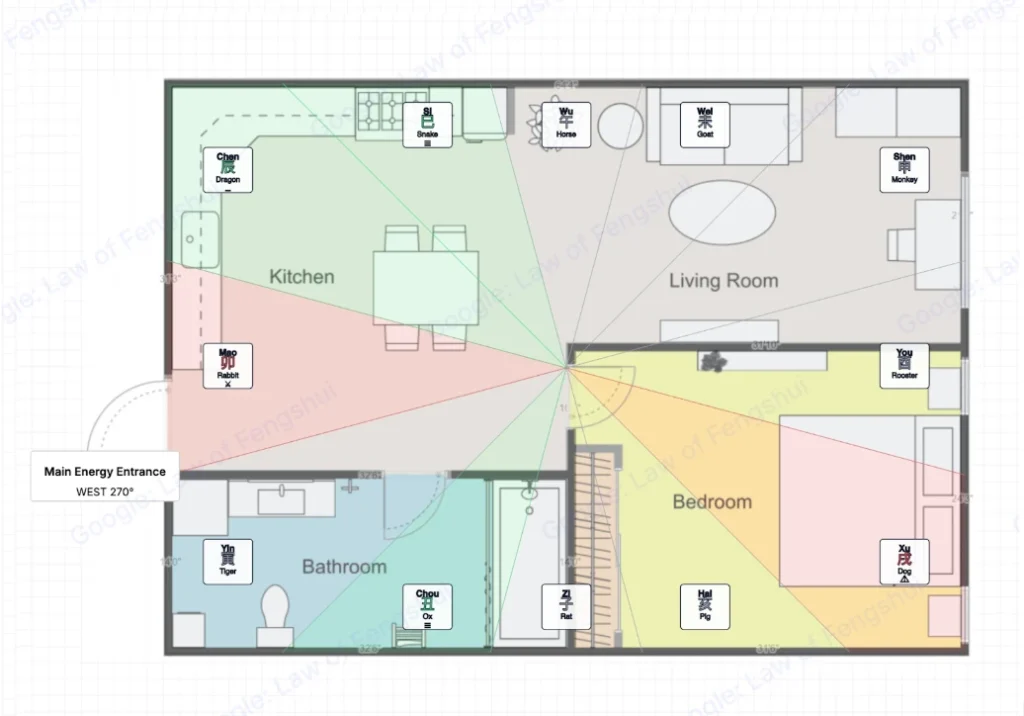
The apartment has its main energy entrance on the west wall at 270 degrees, with the sitting direction at west (You/Rooster, 酉). The bedroom occupies the lower-right portion of the floor plan.
The resident, Jenna, was born in 1993 a Rooster year (You/酉 branch). Her He Chong profile maps harmony and clash across all 12 compass sectors:
- San He (Three Harmony): Ox and Snake sectors form the Metal triad with Rooster. These are Jenna’s strongest supportive zones.
- Liu He (Six Harmony): The Dragon sector is Jenna’s Six Harmony partner a gentler but steady compatibility.
- Six Clash: The Rabbit sector sits in direct opposition to Rooster a Wood-Metal clash described as “severe punishment.” Positioning your bed in a Six Clash sector channels negative energy toward you during sleep. It is the worst sector for sustained exposure.
What the Bedroom Analysis Showed
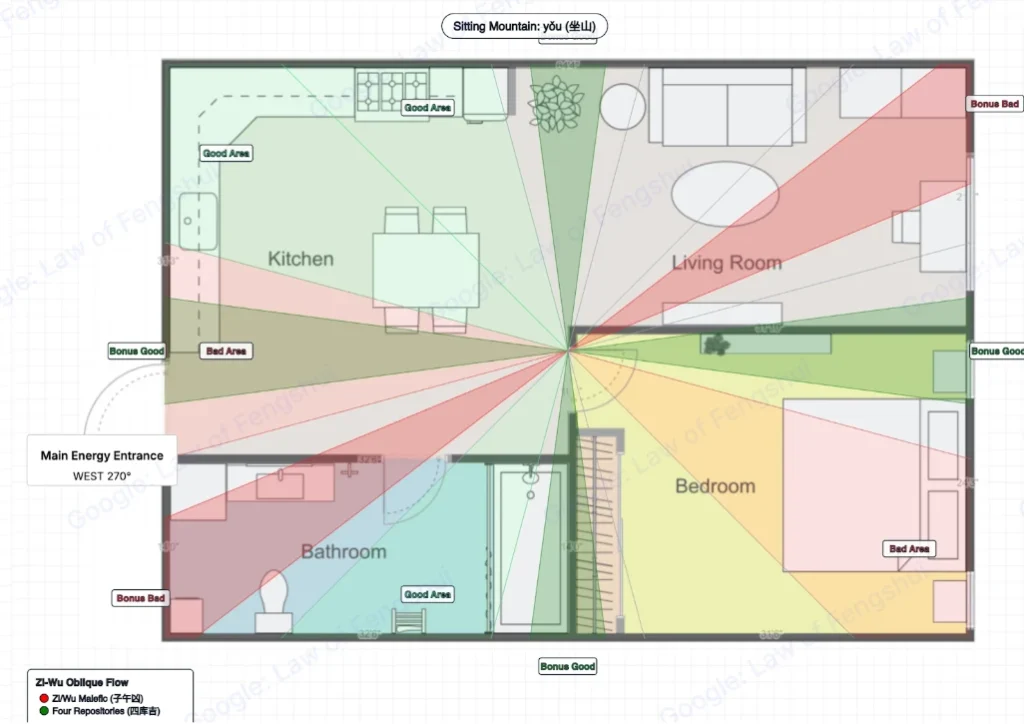
We activated the “Find Best Bedroom Spot” overlay, which maps He Chong sectors onto the bedroom itself and combines them with Zi-Wu Oblique Flow data. The result divides the bedroom into clearly labeled zones: Good Area, Bad Area, and Bonus Bed positions where both systems agree.
The Bad Area
One section of the bedroom falls in the Rabbit (Mao, 卯) compass sector Jenna’s direct Six Clash direction. Sleeping with your headboard in your personal clash sector compounds the effect over thousands of hours. What makes this finding sharp is that the wall in the Bad Area satisfies the commanding position perfectly you can see the door, the headboard rests against a solid wall. Form school says it looks fine. The compass data says otherwise.
The Good Area
Other sections fall in harmony zones sectors aligned with Jenna’s San He triad partners (Ox and Snake) or her Liu He partner (Dragon). When you place your bed with its headboard in one of these sectors, the flow of energy is energetically supportive. The positive energy from a harmony sector compounds across thousands of sleeping hours. The Zi-Wu Oblique Flow overlay reinforced this: the Four Repositories overlap with parts of the bedroom’s good zones. When personal harmony and structural energy both point to the same wall, the recommendation becomes unambiguous.
The Bonus Bed Positions
The strongest finding was in the corners labeled “Bonus Bed” where He Chong harmony and Zi-Wu Four Repositories converge. Both systems independently flag the same corner as favorable, where Rooster-Ox-Snake Metal triad harmony meets a structurally auspicious position.
The wall you would pick first by instinct the cleanest sightline, the most balanced room feel was in the clash zone. The wall the compass analysis identified as best required a less conventional placement. This is the gap that compass-level feng shui bed placement fills. Form school narrows the options to two or three walls. Compass analysis identifies which is personally and structurally aligned and for Jenna, the difference was sleeping in a Three Harmony zone versus a direct Six Clash zone, every night.
Ba Gua Sectors and Bed Facing Direction
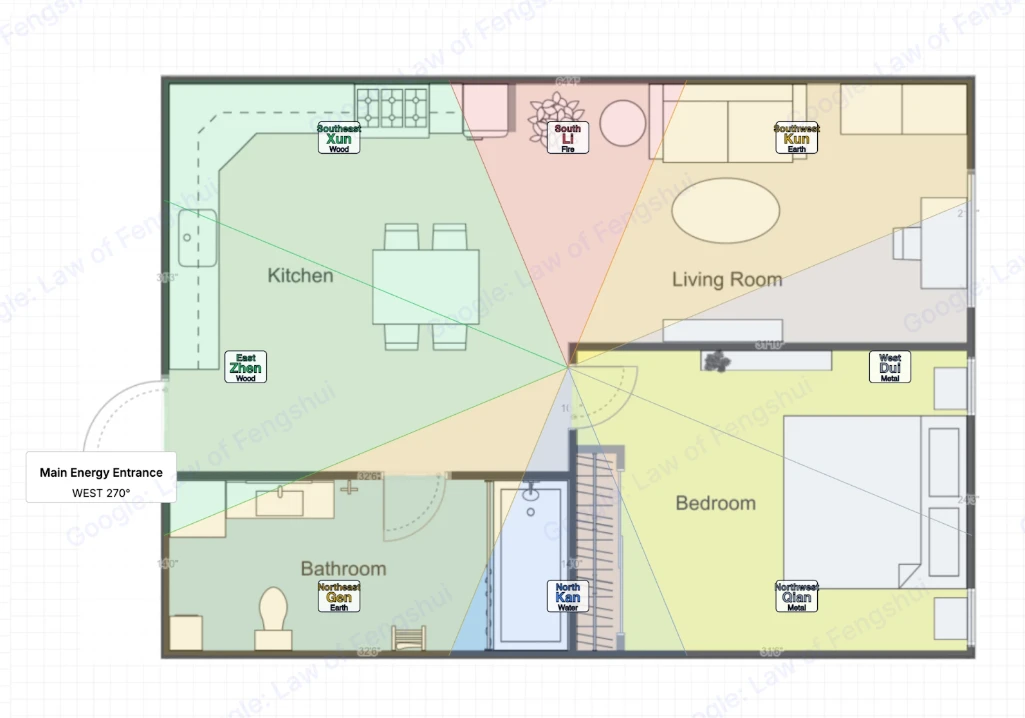
The Ba Gua overlay confirmed the bedroom sits in West (Dui) and Northwest (Qian) sectors both Metal-element zones aligning with Jenna’s Rooster Metal triad, confirming the bedroom resonates with her elemental profile.
One of the most common feng shui bed placement questions is whether the bed facing direction should be north, south, east, or west. Generic advice like “always sleep with the bed facing east” fails because it ignores personal data. For Jenna, the east sector (Rabbit) is her direct Six Clash the worst possible bed facing direction for her birth year. The correct bed facing direction is always specific to the person and the building. Two people in identical apartments will have different best walls because their Earthly Branches create different harmony and clash patterns.
Confirming the Placement
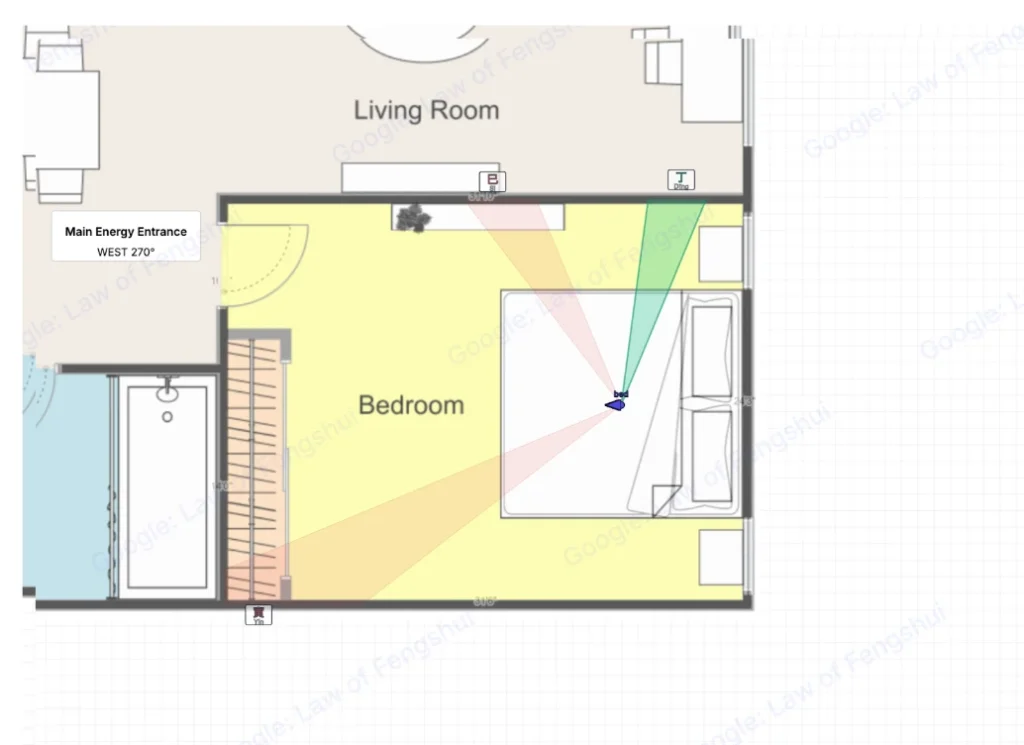
We ran a final furniture placement check using Na Jia Li, 24 Mountains Jie Sha, and Ba Sha Huang Quan. The green cones confirm the bed avoids harmful sectors from doors and windows validating the He Chong and Zi-Wu recommendation.
Feng Shui Bedroom Tips: Bed Placement and Beyond
Beyond compass analysis, applying feng shui principles from the form school tradition can elevate any feng shui bedroom layout. These are among the most powerful tools in feng shui for creating a space that supports restful, restorative sleep.
- Avoid placing the bed in front of the door (coffin position). The direct energy path from doorway to foot of bed disrupts restorative sleep. Place the bed at a diagonal sightline instead. If tight bedroom layouts force you to face the door, use a footboard to create a buffer that slows the flow of energy.
- Never place a bed under a window or bed under beams. A window beneath a window position weakens the solid wall behind the headboard, allowing chi to escape and disrupting the grounding energy the headboard provides. A bed in front of a window is one of the most common feng shui bedroom layout mistakes use heavy curtains and a tall headboard to compensate if unavoidable. Ceiling beams above the bed create downward pressure that can disrupt sleep. Avoid placing the bed directly under exposed beams.
- Mirrors should never reflect the bed. A mirror that reflects the bed creates a doubling of yang energy, which can disrupt the yin quality that restful sleep requires. This includes mirrored closet doors or TV screens that act as dark mirrors when off. Cover the mirror at night or reposition it so the bed is outside its reflection.
- Clear clutter from around the bed and under it. Clutter disrupts the flow of energy around your bed and prevents chi from circulating freely. Items under the bed block energy beneath you while you sleep. Keep the space around your bed clear clutter on nightstands and on the floor around the bed should be minimized. A clutter-free bedroom can promote balance and allows positive energy to move freely.
- Create symmetry on both sides of the bed. Place matching nightstands on each side with a few inches of space between the nightstands and the bed frame. Symmetry represents balance and harmony between yin and yang forces. Even if you sleep alone, having space on both sides of the bed signals openness and energetic equilibrium.
- Balance yin and yang in bedroom decor. The bedroom should lean toward yin soft lighting, calming hues, and grounding textures that create a calming atmosphere. Too much yang energy disrupts sleep. If you want a pop of color, keep it to accent pieces. Create a balanced mix: a grounding, restful yin foundation with enough yang to avoid stagnation.
- Avoid a shared bathroom wall and one-sided placement. Plumbing behind the headboard creates instability that a certified feng shui consultant would flag regardless of compass data. Both sides of the bed should be accessible arrange so neither side of the bed is against a wall, with the open side facing the door.
How to Feng Shui Your Bedroom: Where to Start
If you want to learn how to feng shui your bedroom but compass analysis sounds like a lot, here is a simplified approach that captures the core feng shui practices. Start with the command position. Identify every wall where you can place the bed with a clear diagonal sightline to the door and a solid wall behind the headboard. Eliminate any wall that puts the bed in the coffin position or beneath a window. The placement of your bed determines the foundation of the entire feng shui bedroom layout.
Check for form school conflicts. Remove any wall that backs onto a bathroom, shares a wall with a kitchen stove, or sits under a ceiling beam. These feng shui bedroom tips apply to every bedroom layouts regardless of compass direction. Use a compass app. Check which compass direction each remaining wall faces. A feng shui bedroom guide can help you interpret the data. Classical tools some of the most powerful tools in feng shui now run compass analysis on actual floor plans, including resources for feng shui tips that map personal energy and structural flow onto your layout. Commit for two weeks. Better sleep, ease of falling asleep, and how rested you feel are the practical metrics. The goal of these feng shui practices is restorative sleep the kind where your body can fully recharge. If you notice a difference after moving the bed, compass direction is likely the variable that changed.
Key Takeaways
- The command position is the non-negotiable baseline for any feng shui bed position. You must see the door diagonally from the bed, with a solid headboard wall behind you. But it only eliminates bad options it does not pick the best one.
- Classical compass analysis picks the winner. He Chong maps your birth year to compass sectors, showing which wall is a personal harmony zone and which is a direct clash. Zi-Wu Oblique Flow adds a second, independent layer based on the building’s structural energy.
- In this case study, the “obvious” wall sat in Jenna’s Six Clash zone. A less intuitive wall, backed by San He harmony and a Zi-Wu Four Repository position, was the clear best choice.
- Beyond bed placement, the best feng shui bedroom layout includes clutter-free surfaces, symmetry with nightstands on both sides, balanced yin and yang in decor, and no mirrors that reflect the bed.
- Generic direction rules miss the interaction between the building’s orientation and your personal energy. The answer is always specific.
- You do not need to be an expert to feng shui your bedroom. Classical tools can handle the compass analysis that determines your best feng shui bed position.
FAQs
It’s placing your bed where you can see the door diagonally while having a solid wall behind your headboard.
This creates the “coffin position,” which may disrupt sleep due to direct energy flow toward the body.
No, multiple walls may meet this rule, so deeper analysis like compass alignment is needed.
It refers to a direction that conflicts with your birth energy, potentially causing imbalance and poor sleep.
Yes, because feng shui considers personal energy based on birth year and direction.
It weakens support behind the headboard and allows energy to escape, affecting rest.
Yes, mirrors reflecting the bed can increase active energy, making it harder to relax.
Clutter blocks energy flow and can disrupt calmness and sleep quality.
Balanced sides of the bed promote harmony and emotional stability.
Start with the commanding position, remove conflicts, and test placements for better sleep.