Shipping containers weren’t designed to be comfortable, they were designed to cross oceans.
That’s why turning one into a functional office takes more thought than most Pinterest-style articles suggest. Steel conducts heat. It traps condensation. It amplifies sound. And once you start cutting into it, structural integrity becomes your responsibility.
Still, when done well a container office can outperform many temporary structures. It’s durable, secure, modular, and relatively quick to deploy. On construction sites, remote properties, or as overflow commercial space, it solves problems fast.
But it has to be built properly.
Let’s walk through what that actually involves.
Start With Size – And Think Beyond Today
Most people default to a 20ft container because it feels “standard.”
And for small teams, it often works. Two desks, storage, maybe a compact meeting table, tight but manageable. Delivery is easier. Foundation requirements are simpler. Budgets stay contained.
But here’s what frequently happens: the space feels efficient on paper and cramped in real life. Equipment accumulates. A third team member joins. You add a printer, filing storage, wall shelving. Suddenly the room feels smaller than expected.
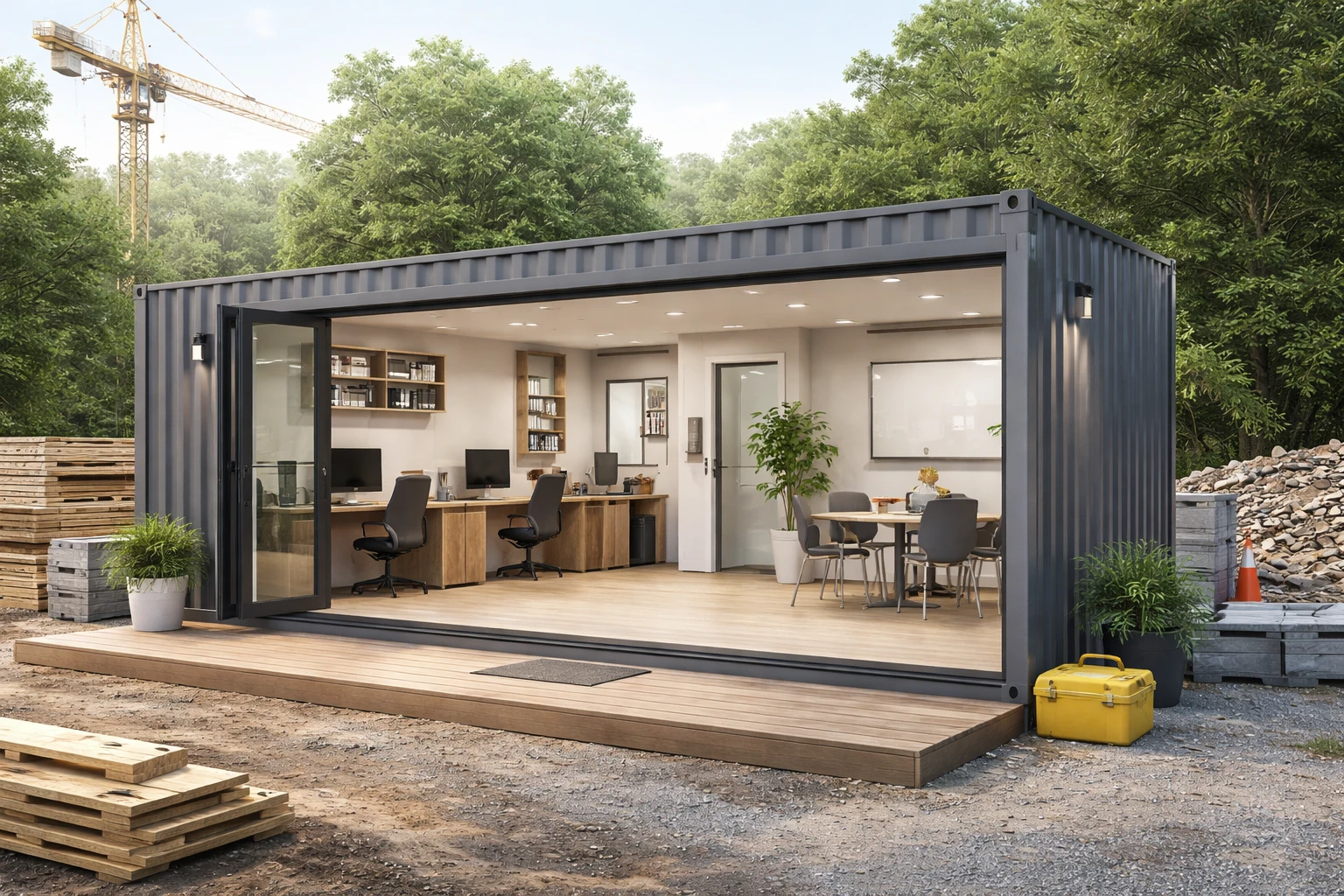
A 40ft container changes that dynamic. Not just because it’s longer, but because it allows zoning. Workstations on one end, meeting area on the other. Space to circulate. Space to breathe.
That’s one reason many permanent commercial setups start with 40ft units. There’s simply less compromise. Professionally executed container office solutions, like the shipping container offices by Universal Containers often favour longer layouts for this reason: fewer internal constraints, better long-term usability.
It’s rarely about “bigger is better.” It’s about avoiding a redesign six months later.
Before You Cut Anything – Check Regulations
- A container sitting on land can be considered temporary.
- Or modular.
- Or permanent.
And the classification changes everything.
If utilities are hard-connected, some councils treat the unit as a building. That can trigger electrical inspections, fire compliance checks, and in certain cases accessibility requirements.
Skipping this step is how people end up modifying twice.
The smart move is to speak with local building control early. Clarify:
- Is a permit required?
- How is the structure classified?
- What fire safety standards apply?
- Are accessibility provisions necessary?
Five conversations upfront can save thousands later.
Foundation:
Containers are strong at their corners. That’s how they carry weight.
They don’t need elaborate foundations, but they do need proper support. A poorly levelled base causes subtle problems, doors that don’t close properly, shifting over time, water pooling underneath.
Concrete slabs are best for permanent installations. Piers or compacted gravel pads work for temporary use.
Drainage is critical. Moisture trapped under steel accelerates corrosion. Even minor elevation above ground improves longevity.
It’s not a glamorous stage of the project, but it’s one of the most important.
Structural Modifications: Where Risk Enters
The moment you cut a window into a container wall, you change its strength profile.
Containers are rigid because their corrugated steel sides distribute load. Remove sections carelessly, and rigidity drops.
Adding a door or window means:
- Reinforcing openings with steel framing
- Distributing weight properly
- Avoiding warping
Roof modifications, such as adding drainage or slight overhangs, can also improve durability, particularly in heavy rainfall regions.
Cut carefully. Reinforce thoroughly. Treat it like structural work, because it is.
Insulation
Uninsulated metal is unforgiving.
In warm weather, it radiates heat. In cooler months, it collects condensation. Moisture forms inside the walls if insulation and vapour control aren’t handled correctly.
Spray foam insulation performs extremely well in container builds because it seals gaps and reduces condensation risk. It’s more expensive, but it controls air movement effectively.
Rigid board insulation is more affordable but requires careful installation and vapour barriers to prevent moisture build-up.
And here’s something people underestimate: insulation thickness reduces interior width. In a narrow 20ft container, that matters. Poor planning can make the finished office feel noticeably tighter.
Insulation decisions shouldn’t be rushed.
Electrical Planning
Lighting. Laptops. Monitors. Mini-split HVAC. Charging stations. Maybe a small fridge.
Add those together, and electrical demand rises quickly.
Container conversions commonly fail at this stage because wiring is treated as an afterthought. The breaker panel is sized only for lighting and outlets, until HVAC runs at full draw.
When designing the electrical layout:
- Calculate total load first
- Size your breaker panel appropriately
- Plan outlet positioning based on furniture layout
- Consider future equipment expansion
It’s far easier to run extra wiring before walls are sealed than to retrofit later.
LED lighting improves efficiency and reduces heat generation, which helps overall climate control.
Heating, Cooling & Airflow
Temperature management determines whether your container office feels professional or improvised.
Mini-split systems are generally the most effective long-term solution. They provide consistent heating and cooling without consuming excessive space.
Portable systems might work temporarily, but they rarely offer stable climate control in extreme conditions.
Ventilation is just as important as heating or cooling. Steel shells trap air. Without circulation, humidity builds, and comfort declines.
A well-balanced airflow plan protects both people and structure.
Interior Finishing
Sound behaviour inside a steel box is different. It echoes. It amplifies.
Adding layered finishes, drywall, plywood, composite panels, softens acoustics and improves comfort.
Flooring choices affect more than appearance. Vinyl plank and commercial-grade laminate are practical and durable. Carpet tiles reduce noise and make the environment feel more like a conventional workspace.
If retaining the original container floor, ensure it’s sealed properly.
Finishing choices don’t just improve appearance. They influence how the office feels to work in daily.
Layout Strategy
Furniture placement should be intentional, not improvised.
In smaller units, vertical space becomes valuable. Wall-mounted shelving prevents crowding. Compact desks preserve circulation.
In larger 40ft layouts, you gain flexibility. You can create subtle zones without physical partitions. A meeting corner. A storage wall. A workspace cluster.
Flow matters. Natural light positioning matters.
Think about how people enter, move, and exit.
Security & Exterior Durability
Steel is inherently secure, which is one reason container offices are popular for site use.
But thoughtful additions improve functionality:
- Reinforced doors
- Shutter protection for windows
- Exterior lighting
- Protective coatings
If branding is required, containers provide a clean, large surface for custom finishes.
Durability is one of the key advantages, take advantage of it.
DIY vs Professionally Built
DIY conversions can be satisfying and lower initial spend.
But they come with complexity. Structural reinforcement, electrical compliance, insulation layering, each decision carries technical consequences.
Professionally built container office units often arrive insulated, wired, reinforced, and compliant. Many businesses choose solutions such as those offered by Universal Containers because compliance, structural cuts, and system integration are already handled to commercial standards.
For companies where downtime costs money, speed and reliability outweigh experimentation.
It’s less about DIY skill and more about risk tolerance.
Cost Expectations (Realistically)
Budgets expand based on scope.
A basic insulated office build may start modestly. Adding HVAC, higher-end finishes, partition walls, upgraded electrical panels, each increases cost.
Delivery, permits, and professional labour also affect totals.
There’s no single universal price.
What matters more than initial cost is whether the office performs comfortably and safely long term.
Common Missteps
- What tends to go wrong?
- Choosing a container too small.
- Underestimating condensation.
- Installing insufficient electrical capacity.
- Skipping structural reinforcement.
- Assuming permits aren’t needed
- Most problems stem from rushing early decisions.
Where Container Offices Work Best
They’re ideal when you need durability and flexibility.
- Construction management offices.
- Remote site workspaces.
- Temporary commercial expansion.
- On-site coordination centres.
When built thoughtfully, they feel intentional, not improvised.
Final Thoughts
Turning a container into an office isn’t just about putting furniture inside a steel shell.
It’s about planning systems together:
- Structure.
- Insulation.
- Electrical load.
- Climate control.
- Layout.
When those elements are aligned, a container office can perform as reliably as many traditional builds, sometimes more so, given its strength and portability.
The difference between a good container office and an uncomfortable one usually comes down to planning depth.
Build it deliberately, and it won’t feel temporary at all.
FAQs
In many areas, yes—especially if utilities are permanently connected. Always check with local building control before starting modifications.
A 20ft works for small teams, but a 40ft offers better zoning and long-term flexibility with less crowding.
Yes, proper support is essential to prevent shifting and corrosion; concrete slabs or piers are commonly used.
Spray foam performs best for sealing and condensation control, while rigid board insulation is more budget-friendly but requires careful vapour management.
Calculate total power demand first, size the breaker panel correctly, and install wiring before interior walls are closed.
They can be, but only with proper insulation, ventilation, and a reliable HVAC system like a mini-split unit.
Yes, structural openings must be reinforced with steel framing to maintain integrity.
DIY builds can take weeks or months, while professionally built units may be delivered ready-to-use much faster.
Yes, steel construction offers strong baseline security, especially when paired with reinforced doors and window shutters.
It can be, but costs depend on insulation, HVAC, electrical upgrades, finishes, permits, and professional labour.