In the world of urban property development, “buying low” has a literal meaning. In markets where horizontal expansion is impossible due to lot lines and vertical expansion is capped by height acts, the only way to create new inventory is to go down. This is the essence of the basement condo conversion.
Executive Summary
For real-estate investors in high-density urban markets like Washington, D.C., the most lucrative square footage often lies beneath their feet. However, converting a standard cellar into a legal, sellable basement condo requires more than just aesthetic finishes; it demands structural intervention. This guide explores the technical and financial necessity of slab lowering and underpinning. While these processes represent a significant upfront investment-often ranging from $75,000 to $200,000-they are the “make-or-break” factors that determine whether a unit meets the mandatory 7-foot ceiling height for habitability. By mastering the engineering of the “deep dig,” investors can unlock six-figure equity gains and transform cramped storage spaces into premium residential assets.
Why the “Deep Dig” is Non-Negotiable
Most historic rowhouses were built with “cellars” designed for coal storage or utilities, typically featuring clearances of 6 feet or less. To convert these into a legal basement apartment or a separately deeded condominium, building codes (such as the IRC and DCMR) strictly require a minimum finished ceiling height of 7 feet for all habitable rooms.
If your existing space is 6’4″, you cannot simply “finish” the basement. You must lower the floor. This is achieved through two primary technical methods:
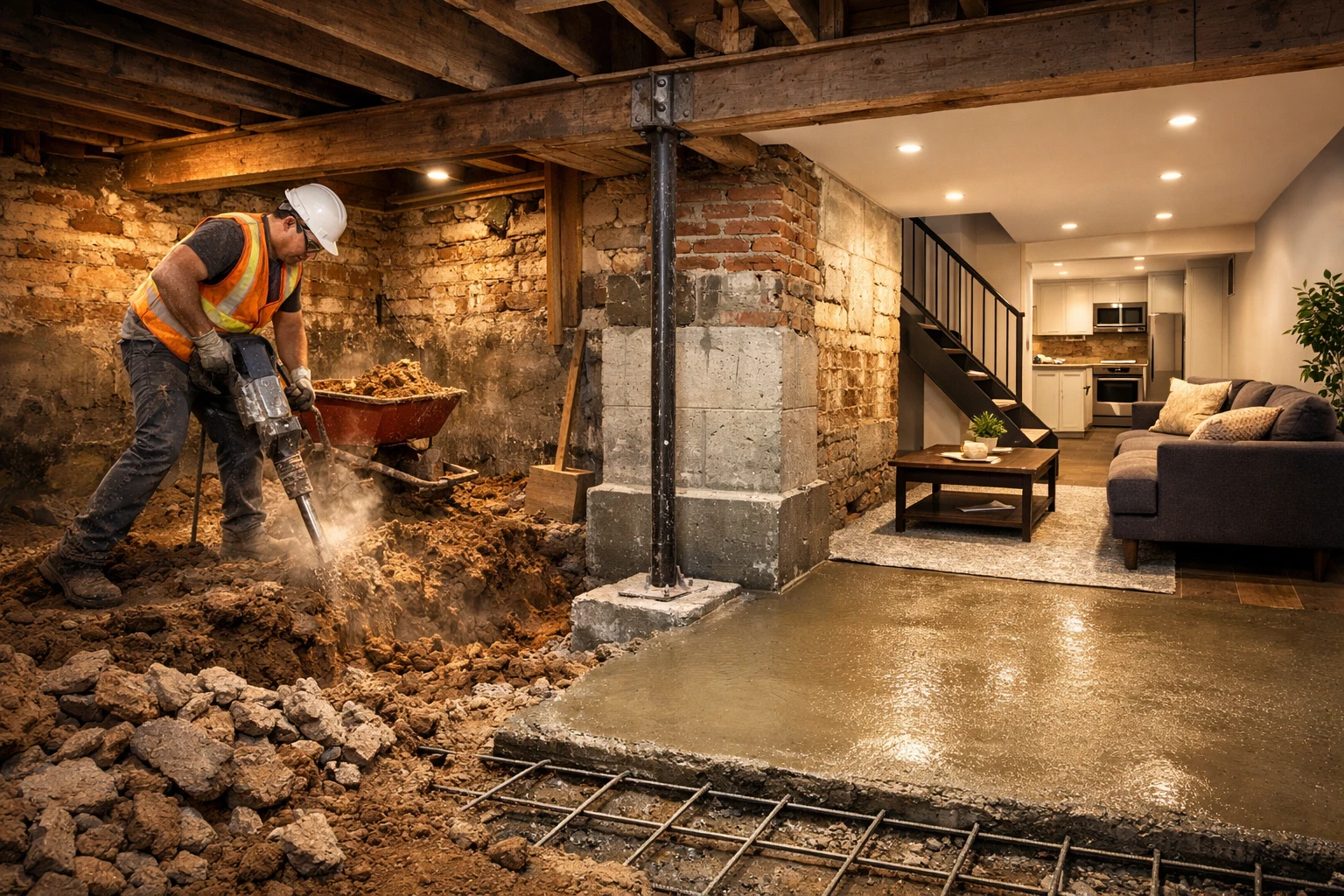
- Slab Lowering: Removing the existing concrete floor, excavating the dirt beneath to the required depth, and pouring a new, reinforced slab.
- Underpinning: The process of strengthening and extending the foundation of an existing building. When you dig below the current footings, you must install new concrete “legs” (pins) in a strategic sequence to ensure the structural integrity of the entire building remains intact.
The Financial Architecture of Underpinning
Investors often recoil at the initial cost of underpinning and slab lowering. In the DC market, these structural phases can consume 30% to 50% of the total project budget. However, the financial logic is underpinned (pun intended) by three factors:
- Legal Status vs. “Bonus Space”: A basement with 6’8″ ceilings is “bonus space” that adds marginal value. A basement with 7’2″ ceilings is a legal bedroom/unit that can be appraised at full market value and sold as a separate condominium.
- The Luxury Premium: High ceilings are a hallmark of luxury real estate. Increasing a basement’s height from 7 feet to 8 or 9 feet significantly increases the “absorption rate” (how fast it sells) and the final price point.
- Risk Mitigation: Professional underpinning includes modern waterproofing and drainage systems. For an investor, this eliminates the risk of future water damage claims and protects the long-term ROI.
Technical Milestones for a Successful Conversion
To ensure your investment “pencils out,” your project must navigate these critical technical hurdles:
- Engineering and Shoring: Never attempt a dig without a structural engineer’s sealed drawings. The sequence of the “pins” is vital to prevent the house (and the neighbor’s house) from settling.
- Egress Requirements: A legal condo requires at least two ways out. This usually means installing egress windows or a separate walk-out entrance, which must be coordinated with the new floor height.
- Utility Rerouting: Lowering the floor often means the main sewer line must be lowered or a sewage ejector pump must be installed to maintain proper drainage.
Conclusion
Lowering the floor is the ultimate value-add strategy for the sophisticated investor. While the “unseen” structural work is expensive, it is the foundation upon which all legal and financial value is built. By investing in the structural volume of the property, you aren’t just remodeling a room-you are creating new, high-value real estate where none existed before.
Expert Tip: Before you buy a “fixer-upper” with a basement, conduct a feasibility study to determine the depth of existing footings. Knowing if you need 12 inches vs. 24 inches of underpinning can save you $50,000 in unforeseen costs.
For a deep dive into the legalities and specific costs of these projects, check out this comprehensive guide on Basement Condo Conversions.
Frequently Asked Questions (FAQs)
While costs vary, a legal condo conversion in a prime urban neighborhood can increase a property’s total value by $300,000 to $500,000. Underpinning is the “key” that unlocks this value by making the square footage legally sellable.
Only if your existing foundation footings are already deep enough to accommodate the new floor height plus the necessary gravel and insulation layers. Most historic homes require underpinning to reach the 7-foot legal limit safely.
Typically, the structural phase (digging, underpinning, and pouring the new slab) takes 4 to 8 weeks, depending on the soil conditions and the size of the footprint.
Yes. In Washington, D.C., and most major cities, slab lowering and underpinning require a structural permit and third-party inspections to ensure the building remains safe for occupants and neighbors.